
TL;DR:
- Group therapy offers a cost-effective, evidence-based alternative to individual treatment, with comparable long-term outcomes for anxiety, depression, and trauma. Its structured social environment addresses shame, isolation, and social skills more effectively, providing unique therapeutic benefits. Accessible through sliding-scale clinics, online platforms, and peer-led groups, it broadens mental health care options for adults facing financial or scheduling barriers.
Group therapy is defined as a structured, therapist-led treatment format where multiple clients work toward shared mental health goals together, and it costs 25% to 50% of what individual therapy runs per session. For adults managing anxiety, depression, or trauma on a tight budget, this format delivers professional clinical care without the price tag of one-on-one sessions. Organizations like Open Path Collective and NAMI have made group counseling benefits more accessible than ever. A 2026 trial published in JAMA Psychiatry reported an 80% recovery rate from depression using group metacognitive therapy, a result that matches or exceeds many individual therapy benchmarks. Group therapy as an affordable alternative is not a compromise. It is a clinically validated, cost-effective path to real recovery.
How does group therapy compare with individual therapy in cost and effectiveness?
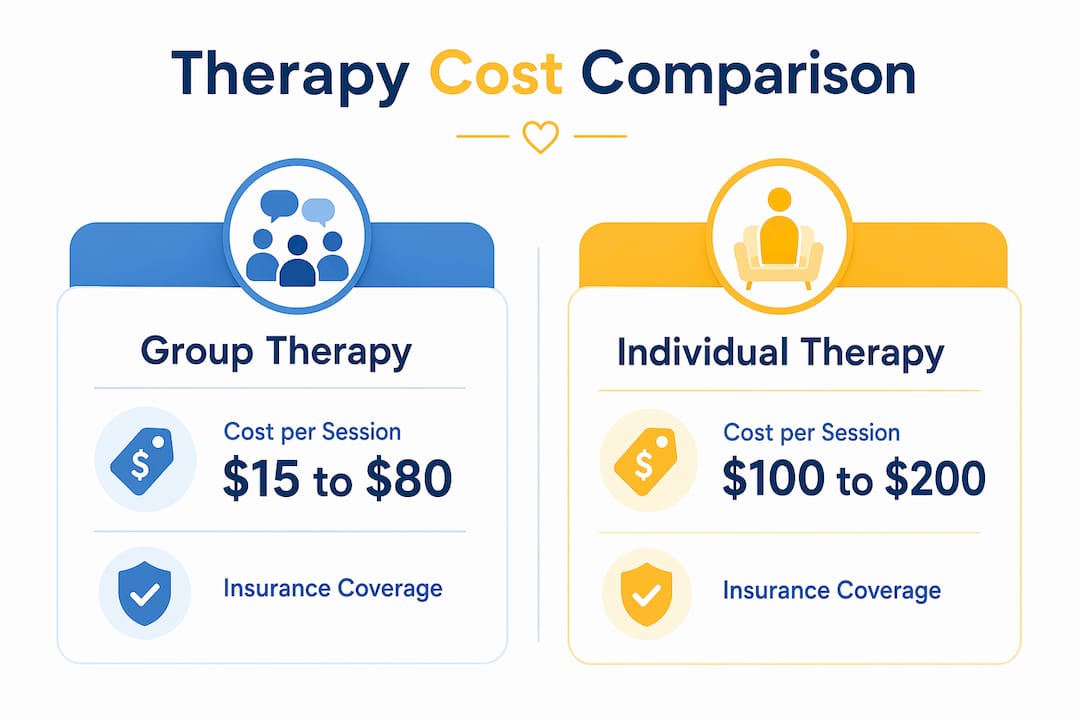
The cost difference between group and individual therapy is significant enough to change who can access care. Group therapy sessions typically cost $15 to $80 per session, while individual therapy averages $100 to $200 per session depending on location and provider. Over a full treatment course, the gap widens further. Per-participant costs average $304 for a complete group CBT program compared to $858 for individual CBT. That is a savings of over $550 per person for the same evidence-based treatment model.
Session structure also differs in ways that favor group formats for value. Group sessions last 60 to 120 minutes, while individual sessions typically run 45 to 60 minutes. More therapeutic contact time per dollar spent means clients in group settings often accumulate more total treatment hours across a course of care. This extended contact is not just a financial advantage. Research links higher therapeutic contact hours to stronger long-term outcomes for conditions like generalized anxiety disorder and major depression.
Clinical effectiveness is where many people expect group therapy to fall short. The evidence says otherwise. The 2026 JAMA Psychiatry trial confirmed that group therapy matches individual therapy for anxiety, depression, and grief with comparable long-term symptom reduction. A meta-analysis published in PLOS Mental Health found that transdiagnostic group formats addressing emotion regulation are broadly effective across multiple diagnoses. For the majority of adults seeking support for common mental health conditions, group therapy produces outcomes that are clinically equivalent to individual care.
Insurance coverage adds another layer of financial advantage. Many insurance plans cover group therapy under separate billing codes with lower copays than individual sessions. Some plans offer group therapy with zero copay. Patients who ask specifically about group therapy benefits, rather than assuming their standard mental health copay applies, often discover they have more coverage than they realized.
| Feature | Group therapy | Individual therapy |
|---|---|---|
| Cost per session | $15 to $80 | $100 to $200 |
| Full course cost (CBT) | ~$304 per participant | ~$858 per participant |
| Session length | 60 to 120 minutes | 45 to 60 minutes |
| Insurance copay | Often lower or zero | Standard mental health copay |
| Clinical effectiveness | Comparable for anxiety, depression, grief | Comparable for anxiety, depression, grief |
Pro Tip: Ask your insurance provider directly whether group therapy is billed under a separate benefit code. Many plans have lower copays for group sessions, and this single question can cut your out-of-pocket cost significantly.
What are the therapeutic benefits unique to group therapy?
Cost savings alone do not explain why group therapy works so well. The format creates therapeutic conditions that individual sessions simply cannot replicate. Psychoanalyst Bonnie Buchele describes the group as a microcosm of social interaction, a setting where clients practice real-world relationships in a safe, structured environment. For adults dealing with social anxiety, relational trauma, or chronic isolation, this dynamic is not just helpful. It is often the most direct path to change.

Group therapy addresses shame and loneliness in ways that one-on-one sessions struggle to reach. Hearing another person describe an experience you thought was uniquely yours reduces the weight of that shame immediately. Shared lived experience is therapeutic in itself, and no therapist can manufacture that effect alone. Research confirms that group therapy treats isolation and shame more efficiently than individual therapy for many clients, particularly those whose core struggles involve feeling fundamentally different or broken.
The practical benefits of group counseling extend beyond the session room:
- Peer accountability keeps members engaged between sessions in ways that self-directed homework rarely achieves.
- Interpersonal feedback from peers carries a different kind of credibility than feedback from a therapist. When five people in a group reflect the same pattern back to you, it lands differently.
- Modeling recovery by watching others progress through similar struggles builds genuine hope, not just therapist-prescribed optimism.
- Skill practice in real time means that techniques like cognitive restructuring or distress tolerance are tested in a live social context, not just discussed abstractly.
- Reduced wait times are a practical bonus. Group cohorts form dynamically and often start sooner than individual therapy slots open up, which can stretch to two months or more on some waitlists.
Pro Tip: Active participation in group therapy, not just attendance, drives outcomes. Commit to speaking at least once per session, even briefly. Members who engage verbally report faster progress than those who observe passively.
How to find and access affordable group therapy options?
Affordable group therapy exists across multiple access points, and knowing where to look determines how quickly you can get started. The options range from free peer-led programs to professionally supervised sliding-scale groups, and each serves a different need.
Sliding-scale groups at community mental health centers charge as little as $0 to $20 per session based on income. University training clinics, where licensed supervisors oversee graduate student therapists, typically charge $5 to $40 per session. These clinics often run structured CBT or DBT groups that match the quality of private practice programs. Open Path Collective charges a one-time $65 membership fee, then connects members to group sessions at $40 to $70 per session. For many adults, that membership pays for itself within the first two sessions compared to private practice rates.
Free peer-led support groups remove the financial barrier entirely. NAMI (National Alliance on Mental Illness) and DBSA (Depression and Bipolar Support Alliance) both run free, facilitated peer groups nationwide. AA and NA provide free community-based group support for substance use concerns. These groups are not clinical therapy, but they provide consistent peer connection and accountability that complements formal treatment effectively.
| Type of group | Typical cost | Best for |
|---|---|---|
| Community mental health center | $0 to $20 per session | Low-income adults needing clinical care |
| University training clinic | $5 to $40 per session | Adults open to supervised trainee therapists |
| Open Path Collective | $40 to $70 plus $65 membership | Adults wanting vetted private-practice quality |
| Online group therapy platforms | $20 to $60 per session | Adults needing flexible scheduling or telehealth |
| NAMI or DBSA peer groups | Free | Adults seeking peer connection and support |
Online group therapy platforms have expanded access dramatically for adults in rural areas or those with scheduling constraints. Platforms offering low-cost therapy alternatives via telehealth allow clients to join groups from home, removing transportation and childcare as barriers. Revivehealththerapy offers telehealth group sessions statewide across California, which means geography no longer limits who can participate.
Pro Tip: When contacting a provider, ask specifically whether they offer group therapy under your insurance plan. Many practices list individual therapy on their website but run active group programs that never appear in online directories.
What are common obstacles and misconceptions about group therapy?
The most persistent misconception about group therapy is that it delivers less personal attention and therefore less effective care. This belief keeps many adults from pursuing a format that could serve them better than individual therapy for their specific concerns. The clinical record on group therapy effectiveness does not support this view. For conditions like depression, anxiety, and grief, group formats produce outcomes that are statistically equivalent to individual treatment.
Privacy is a legitimate concern, and it deserves a direct answer. Group therapy operates under strict confidentiality agreements. Every member commits to keeping what is shared in the room private. Therapists are bound by the same HIPAA standards as in individual sessions. The group itself does not appear on your insurance records differently than individual therapy in most cases. That said, you are sharing personal material with peers rather than a single clinician, and that distinction matters. If your concerns involve highly sensitive disclosures you are not ready to share with others, individual therapy may be the better starting point.
Finding the right group fit takes some effort. Not every group will match your specific needs or communication style, and that is normal. Here are practical steps to evaluate fit before committing:
- Ask the therapist about the group’s focus, structure, and typical member demographics before your first session.
- Attend two to three sessions before deciding whether the group is right for you. First sessions often feel uncomfortable regardless of fit.
- Consider combining group and individual therapy if your needs are complex. Many clients use group sessions for skill-building and peer support while reserving individual sessions for deeper trauma processing.
- If you are managing a dual diagnosis, look for programs that address both concerns together. Specialty programs like those at Sylmar Treatment Center integrate group-based treatment for co-occurring conditions.
- Check whether the group is open (new members join anytime) or closed (fixed cohort). Closed groups often build deeper cohesion but require waiting for the next cycle to begin.
The stigma around group therapy, the sense that it is a lesser option for people who cannot afford “real” therapy, is both inaccurate and harmful. Group therapy is a distinct clinical modality with its own evidence base, not a discounted version of individual care.
Key takeaways
Group therapy delivers clinically equivalent outcomes to individual therapy for anxiety, depression, and trauma recovery at 25% to 50% of the cost, making it the most accessible evidence-based mental health treatment available to adults today.
| Point | Details |
|---|---|
| Cost advantage is substantial | Group CBT costs ~$304 per course versus ~$858 for individual CBT, saving over $550 per person. |
| Clinical outcomes are comparable | A 2026 JAMA Psychiatry trial showed an 80% depression recovery rate using group metacognitive therapy. |
| Unique therapeutic benefits exist | Group formats address shame, isolation, and social skill deficits in ways individual therapy cannot replicate. |
| Multiple free or low-cost options exist | NAMI, DBSA, university clinics, and sliding-scale centers provide access at $0 to $40 per session. |
| Insurance often covers group therapy | Many plans bill group therapy under separate codes with lower or zero copays than individual sessions. |
Why group therapy changed how I think about mental health access
I have spent years watching people delay getting help because they assumed therapy meant $150 sessions they could not afford. The conversation around mental health access has improved, but the assumption that professional support requires a significant financial commitment persists in ways that still surprise me.
What strikes me most about group therapy is not the cost savings, though those are real and significant. It is the specific kind of healing that happens when people recognize themselves in each other. I have seen clients who made limited progress in individual therapy shift meaningfully once they joined a group and heard someone else articulate exactly what they had been unable to say. That recognition does something that no therapist, however skilled, can manufacture alone.
The access argument for group therapy is also becoming more urgent. Individual therapist caseloads are at capacity across California and most of the country. Group therapy’s efficiency benefits the entire mental healthcare system by allowing one therapist to serve eight to twelve clients in the time that would otherwise serve one. That math matters when waitlists stretch for months.
My honest advice: do not treat group therapy as a fallback when individual therapy is unavailable or unaffordable. Consider it as a first-line option, especially if your concerns involve relationships, social anxiety, or the kind of shame that thrives in isolation. The group therapy methods available today are sophisticated, evidence-based, and often more targeted than people expect.
The future of accessible mental health care runs through group formats, telehealth delivery, and sliding-scale access. These are not compromises. They are the direction the field is moving.
— Amy
How Revivehealththerapy supports affordable group therapy in California
Revivehealththerapy offers group therapy for anxiety, depression, and trauma recovery across California, with both in-person sessions in Walnut Creek and Oakland and secure telehealth groups available statewide. Sliding-scale fees mean cost is not a barrier to getting started. The practice accepts insurance, including HSA and FSA plans, and the clinical team can help you identify whether your plan covers group sessions under a separate benefit code. If you are ready to explore psychotherapy in California and want to understand which format fits your needs and budget, Revivehealththerapy offers consultations to help you find the right path forward.
FAQ
How much does group therapy cost per session?
Group therapy typically costs $15 to $80 per session, compared to $100 to $200 for individual therapy. Sliding-scale options at community mental health centers can bring that cost down to $0 to $20 based on income.
Is group therapy as effective as individual therapy?
Yes. A 2026 trial in JAMA Psychiatry confirmed that group therapy produces comparable long-term outcomes to individual therapy for anxiety, depression, and grief, including an 80% recovery rate for depression using group metacognitive therapy.
Does insurance cover group therapy?
Most major insurance plans cover group therapy, often under a separate billing code with lower copays than individual sessions. Some plans offer group therapy with zero copay. Always ask your insurer specifically about group therapy benefits rather than assuming your standard mental health copay applies.
What conditions does group therapy treat effectively?
Group therapy is clinically validated for anxiety, depression, grief, trauma, social anxiety, and emotion dysregulation. Transdiagnostic group formats that address emotion regulation are particularly effective across multiple diagnoses simultaneously.
Can I do group therapy and individual therapy at the same time?
Yes, and many clinicians recommend combining both formats. Individual sessions address deeper or more sensitive material, while group therapy builds interpersonal skills, peer support, and accountability that individual sessions cannot provide on their own.