
TL;DR:
- Psychoeducation is a structured intervention that enhances understanding of mental health issues and promotes skill-building for better symptom management. It is delivered through individual, family, or group sessions and supported by practical tools like journals and action plans, tailored to client needs. Evidence shows it effectively reduces relapse and improves adherence, especially for serious conditions, when integrated thoughtfully into therapy.
Therapy is often imagined as two people talking in a quiet room, with one person listening while the other unpacks their thoughts. That picture is incomplete. A significant and often overlooked part of effective mental health treatment is psychoeducation, a structured approach that teaches you about your own mental health, symptoms, and coping strategies in ways that directly support healing. For Californians managing anxiety, depression, trauma, or relationship challenges, understanding what psychoeducation is and how it works can make a real difference in how much you get out of therapy.
Table of Contents
- What is psychoeducation and why does it matter?
- Psychoeducation in practice: Common formats and tools
- What does the evidence say? Effectiveness, limitations, and opportunities
- How psychoeducation fits into therapy in California
- Nuances, ethics, and client experience: What to ask and expect
- A deeper perspective: Why psychoeducation is rarely one-size-fits-all in therapy
- Ready to take the next step? Find therapy and psychoeducation support in California
- Frequently asked questions
Key Takeaways
| Point | Details |
|---|---|
| Structured learning empowers clients | Psychoeducation is more than sharing facts; it gives you tools to manage symptoms and boost well-being. |
| Formats fit your needs | Psychoeducation can be adapted for individuals, families, or groups to boost engagement and adherence. |
| Clinically proven, but not perfect | Evidence shows benefits, especially for severe illness, but quality of research and effects in common conditions vary. |
| Customization and pacing are crucial | Effective psychoeducation is tailored to your needs, respects your pace, and supports trauma-informed care. |
| Available in California therapy | Psychoeducation is part of both public and private therapy options, including telehealth across California. |
What is psychoeducation and why does it matter?
Psychoeducation is not simply a therapist handing you a pamphlet or explaining a diagnosis in passing. As research on therapy options in California confirms, the gap between information and real change is significant. Psychoeducation is a structured intervention aimed at increasing your knowledge and understanding of your illness and treatment, and helping you use that knowledge to manage symptoms and cope in your daily life. That distinction matters enormously.
Think of it this way: knowing that anxiety triggers the fight-or-flight response is information. Learning to recognize your personal triggers, understand what’s happening in your body during a panic attack, and practice a grounding technique during session is psychoeducation. It connects knowledge to lived experience and skill-building.
“Psychoeducation is intended as a structured intervention, not merely giving information, aimed at increasing clients’ knowledge and understanding of their illness and treatment and helping them use that knowledge to manage symptoms and cope.” — Cochrane Review on brief psychoeducation
For California clients dealing with a wide range of concerns, psychoeducation serves several core purposes:
- Awareness: Helping you recognize symptoms, patterns, and triggers before they escalate
- Skill building: Teaching practical coping techniques rooted in evidence-based approaches
- Engagement: Increasing your active participation in your own treatment plan
- Empowerment: Reducing shame and self-blame by normalizing your experience
- Adherence: Supporting consistency with therapy, medication, or self-care practices
When clients understand why they feel what they feel, they stop fighting themselves and start working with their therapists more effectively.
Psychoeducation in practice: Common formats and tools
Now that you know what psychoeducation is, let’s explore how it’s actually delivered in therapy sessions. The format depends on your needs, your therapist’s approach, and the mental health concern being addressed.
Psychoeducation is delivered in three main formats: individual sessions, family sessions, and group programs. Each has distinct strengths. Individual sessions allow the content to be tailored specifically to your symptoms, history, and goals. Family sessions bring in partners, parents, or caregivers to help your support network understand what you’re going through, which is particularly powerful in CBT for families approaches. Group programs create a sense of shared experience and accountability.
Integrating symptom and trigger education with illness-management action planning and guided practice, especially in family or group formats, leads to higher-impact adherence and relapse prevention. That means the way psychoeducation is structured and delivered is just as important as the content itself.
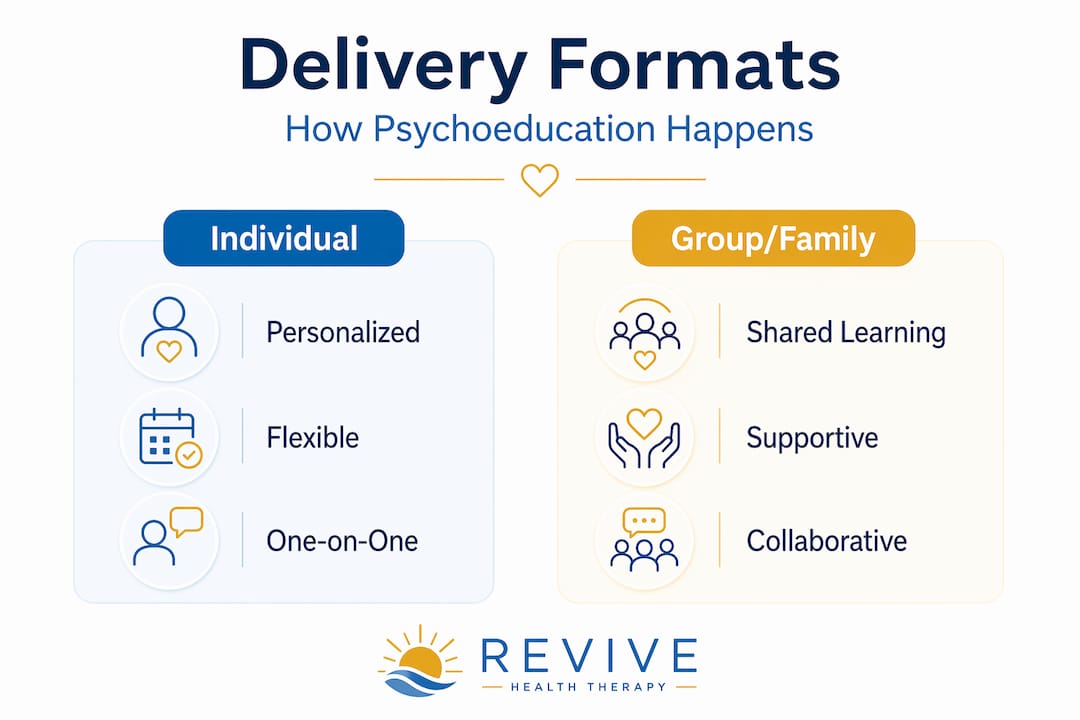
Here’s a comparison of common delivery formats:
| Format | Primary focus | Retention | Adherence support |
|---|---|---|---|
| Individual sessions | Personalized symptom mapping | High | Moderate |
| Family sessions | Shared understanding and support | Moderate to high | High |
| Group programs | Peer learning and normalization | Moderate | High |
| Workbook-based modules | Self-paced skill practice | Variable | Moderate |
Common tools used in psychoeducation include symptom tracking checklists, mood journals, trigger logs, psychoeducational workbooks, and written action plans for managing crisis moments. These aren’t busywork. They create a bridge between what you learn in session and what you apply in your everyday life.
A typical psychoeducation module might follow these steps:
- Identify the target: Your therapist pinpoints the area of focus, such as understanding panic attacks or recognizing signs of depression
- Provide structured content: Information is shared in plain language with examples relevant to your life
- Connect to your experience: You explore how the concepts apply to your personal symptoms and history
- Practice the skill: You try a related technique, like diaphragmatic breathing or cognitive restructuring
- Plan for real life: You and your therapist create a concrete plan for using the skill outside sessions
- Review and adjust: The next session begins by checking in on what worked, what didn’t, and why
Pro Tip: Ask your therapist at the start of treatment what psychoeducation looks like in their practice. Ask about pacing, preferred formats, and whether workbooks or handouts are part of the process. You have every right to shape how this education is delivered to you. More coping tips for Californians can help you supplement what you learn in session.
What does the evidence say? Effectiveness, limitations, and opportunities
Understanding how psychoeducation is structured leads to the big question: does it actually work?
The short answer is yes, especially for serious mental health conditions, but with important qualifications. Psychoeducation added to standard care for schizophrenia reduces relapse and readmission rates, and shows possible improvements in medication compliance. This is strong, consistent evidence across multiple studies.

For briefer interventions, brief psychoeducation (10 sessions or fewer) may reduce relapse in the medium term and promote medication compliance in the short term, though the quality of evidence is often rated as low or very low due to small sample sizes and study design limitations. That doesn’t mean it doesn’t work. It means we need more rigorous research.
Here’s a summary of what the evidence shows by condition and format:
| Condition | Format | Evidence strength | Key outcomes |
|---|---|---|---|
| Schizophrenia | Group or family | Strong | Reduced relapse, better medication adherence |
| Bipolar disorder | Individual or group | Moderate | Fewer episodes, improved functioning |
| Depression | Individual | Moderate | Improved engagement, reduced severity |
| Anxiety disorders | Individual | Moderate | Better symptom recognition, coping skills |
| Trauma/PTSD | Individual, trauma-informed | Emerging | Reduced avoidance, increased self-understanding |
| Relationship difficulties | Family or couples | Limited but promising | Communication improvement, shared language |
Key statistic: Studies show that psychoeducation combined with standard care can reduce relapse rates in schizophrenia by up to 20% compared to standard care alone, a meaningful difference in long-term functioning and quality of life.
The evidence is clearly strongest for severe and persistent mental illnesses. For common concerns like generalized anxiety or relationship stress, psychoeducation is widely used in clinical practice but fewer large-scale randomized trials exist. That’s a gap worth acknowledging. Consult your step-by-step therapy guide to understand how different evidence-based methods work together.
Pro Tip: Psychoeducation delivers its strongest results when combined with skills-based therapies like cognitive behavioral therapy (CBT). Think of psychoeducation as the map and CBT as the vehicle. You need both to actually get somewhere.
How psychoeducation fits into therapy in California
With national evidence outlined, it’s essential to know how psychoeducation is built into California’s therapy landscape.
California’s publicly funded behavioral health system formally recognizes psychoeducation as a distinct service. According to the DHCS Specialty Mental Health Services Billing Manual, psychoeducation in California is defined as assisting members to recognize symptoms and prevent, manage, and reduce them. This means it’s not just a nice add-on. It’s an officially coded, reimbursable service that your provider can deliver as part of your treatment plan.
In private therapy settings, psychoeducation is often woven throughout treatment rather than delivered as a separate block of sessions. You might not even hear the word “psychoeducation” during your appointment, but if your therapist explains what happens neurologically during a trauma response, walks you through a relapse prevention plan, or teaches you to use a thought record, that’s psychoeducation in action.
Here are the main ways Californians can access psychoeducation:
- Individual therapy sessions: Embedded within one-on-one treatment for anxiety, depression, trauma, or other concerns
- Family therapy formats: Structured sessions where loved ones learn about a family member’s diagnosis and how to help
- Group therapy programs: Facilitated group settings focused on shared education and peer support
- Telehealth sessions: Fully available through telehealth mental health services statewide, allowing you to access care from anywhere in California
- Psychosocial rehabilitation programs: Community-based programs often including formal psychoeducation modules
- Trauma-specific programming: Trauma recovery approaches that include trauma-informed psychoeducation as a foundational step before processing work begins
One important operational nuance: psychoeducation is sometimes a distinct and scheduled part of your treatment, and sometimes it’s embedded so naturally into conversation that you don’t notice the structure. Both approaches can be effective, but you deserve to know when and how it’s being used.
Nuances, ethics, and client experience: What to ask and expect
Now, let’s address important nuances and ensure psychoeducation is empowering, not overwhelming.
Not everyone absorbs educational content at the same pace, and that’s completely normal. Some clients feel overloaded by psychoeducation, especially if they’re already managing high levels of anxiety or are in an early stage of trauma recovery. When too much information is delivered too quickly, it can increase confusion rather than reduce it. This is why trauma-informed therapy specifically emphasizes pacing, accuracy, and respect for your autonomy throughout every step of the educational process.
“Trauma-informed psychoeducation should be accurate, evidence-based, paced, and delivered with respect for autonomy.” — Counselling Tutor
The ethical delivery of psychoeducation means your therapist checks in with you regularly, adjusts the amount of content based on your capacity, and never uses education as a substitute for genuine emotional support. It should feel like learning alongside a guide, not sitting through a lecture.
Here are key questions to ask your therapist about psychoeducation:
- How do you integrate psychoeducation into our sessions? This opens a conversation about their approach and philosophy.
- Will we use any workbooks or written materials? Understanding the tools involved helps you prepare.
- How will you know if I’m feeling overwhelmed by the content? This invites your therapist to build in check-ins.
- Can we slow down or revisit topics if I need more time? Confirms that pacing is flexible and client-driven.
- How does the psychoeducation connect to my specific goals? Ensures the content stays relevant to your actual experience, not a generic curriculum.
- What happens after we complete a module? Understanding what comes next keeps you oriented in your treatment journey.
These questions are not just useful, they signal to your therapist that you’re an engaged, informed participant in your own care. That dynamic itself tends to improve outcomes.
A deeper perspective: Why psychoeducation is rarely one-size-fits-all in therapy
After covering facts and guidance, it’s worth reflecting on what real-world therapy teaches us about psychoeducation’s limits and real opportunities for growth.
Here’s something that doesn’t get said often enough: most of the research on psychoeducation was built around severe and persistent mental illnesses like schizophrenia and bipolar disorder. That’s where the funding went, and that’s where the evidence base is strongest. But that doesn’t mean psychoeducation is irrelevant for someone managing relationship anxiety, burnout, or complicated grief. It means we need to apply it more thoughtfully and more individually for those situations.
The most effective therapists we’ve seen don’t treat psychoeducation as a module to check off. They treat it as an ongoing conversation that evolves as you do. What you need to learn in the first month of therapy is different from what’s useful six months in, when you’ve built more insight and capacity. Rigid, scripted psychoeducation, the kind that looks the same for every client, misses this entirely.
We also believe strongly that therapists who actively ask for feedback during educational components, who pause and say “Does this resonate with your experience?” rather than delivering a monologue, produce better outcomes. That responsiveness models the same autonomy and respect that effective psychoeducation is supposed to teach. Understanding the broader role of psychotherapy in mental wellness helps contextualize why this integration matters so much.
Beware of programs that offer “canned” psychoeducation, standardized scripts with no room for your reality. Integration is the key word. The education should connect to your history, your symptoms, your cultural context, and your goals. If it doesn’t, it’s just information, and information alone rarely changes anything.
Pro Tip: When you start with a new therapist, ask how they adjust their educational approach based on client feedback. The answer will tell you a lot about whether their practice is truly client-centered.
Ready to take the next step? Find therapy and psychoeducation support in California
If this guide has shifted how you think about therapy, that’s psychoeducation working in real time. You’re already better equipped to engage with your own mental health care.
At Revive Health Therapy, we integrate psychoeducation naturally into trauma-informed, evidence-based therapy for individuals, couples, families, and teens across California. Whether you’re focused on transforming your mental wellness or want to explore the specific benefits of trauma-informed therapy, our clinicians tailor each approach to your pace, your needs, and your life. We offer in-person sessions in Walnut Creek and Oakland, plus secure telehealth therapy statewide. Sliding-scale fees and insurance options make access realistic for more Californians. Reach out to our team to explore how we can support you.
Frequently asked questions
How many sessions does psychoeducation usually take?
Brief psychoeducation is defined as 10 sessions or fewer, though the total number of sessions depends on your specific needs, goals, and the complexity of your mental health concerns.
Is psychoeducation effective for anxiety and depression?
Evidence is strongest for severe mental illnesses, but psychoeducation is used clinically to support engagement and coping skills for anxiety and depression as well.
Can I get psychoeducation as part of online or telehealth therapy in California?
Yes. California includes psychoeducation in both in-person and telehealth behavioral health service definitions, so you can access it from anywhere in the state.
What if psychoeducation in therapy feels overwhelming?
Tell your therapist directly. Trauma-informed psychoeducation should be paced to match your capacity and always delivered with respect for your comfort and autonomy.
How do I know if my therapist uses psychoeducation?
Ask them directly how they incorporate education about your symptoms and coping strategies into your sessions. A skilled therapist will explain their approach clearly and adjust it based on your feedback.
Recommended
- Psychotherapy in California 2026: Evidence & Options – Revive Health Therapy
- Psychotherapy in trauma recovery: evidence-based options CA 2026 – Revive Health Therapy
- Why Seek Psychotherapy: Transforming Mental Wellness – ReviveHealthTherapy
- Role of psychotherapy in mental health: proven benefits 2026 – Revive Health Therapy