
TL;DR:
- Effective therapy, especially CBT-based approaches, significantly reduces clinical grief symptoms for those experiencing prolonged or traumatic loss. Support options like peer groups can help with normative grief, but targeted professional help is essential when grief becomes persistent and disruptive. Accessing online therapy, with proper screening, offers Californians a practical way to receive evidence-based care tailored to their needs.
Grief can crack your world open. Most people hear “give it time” when a loved one dies, but time alone doesn’t always close the wound. CBT-based approaches are the most effective intervention for prolonged grief disorder, with meta-analyses showing medium to large effect sizes. That’s not a small finding. It means structured, professional support can genuinely change your recovery. This guide walks you through the science, the different therapy types, who benefits most, and how you can access real help in California.
Table of Contents
- Why therapy matters in grieving: What science shows
- Therapy vs. support groups and other grief resources
- How therapy for grief works: Modalities and accessibility in California
- Who most benefits from therapy for grief, and when it’s not needed
- What most guides miss: The true limits and power of grief therapy
- Explore the best support for your grief journey
- Frequently asked questions
Key Takeaways
| Point | Details |
|---|---|
| Therapy is most effective for complicated grief | Clinical therapy, especially CBT, is proven to greatly reduce symptoms of prolonged or traumatic grief. |
| Support groups help, but aren’t enough alone | Peer and group resources may relieve depression, but they often do not resolve severe grief disorder symptoms. |
| Online therapy works as well as in-person | Internet-based therapy can be as impactful as face-to-face care, making support more accessible in California. |
| Therapy isn’t always needed for grief | Many people recover with informal support; therapy should be targeted when emotional pain is disabling or persistent. |
| Choose evidence-based approaches | Selecting structured therapies like CBT and working with experienced professionals leads to the best outcomes. |
Why therapy matters in grieving: What science shows
Grief feels intensely personal, yet the science around it is remarkably concrete. Researchers have spent decades measuring outcomes and comparing treatments, giving us real data on what actually moves the needle when someone is struggling after a loss.
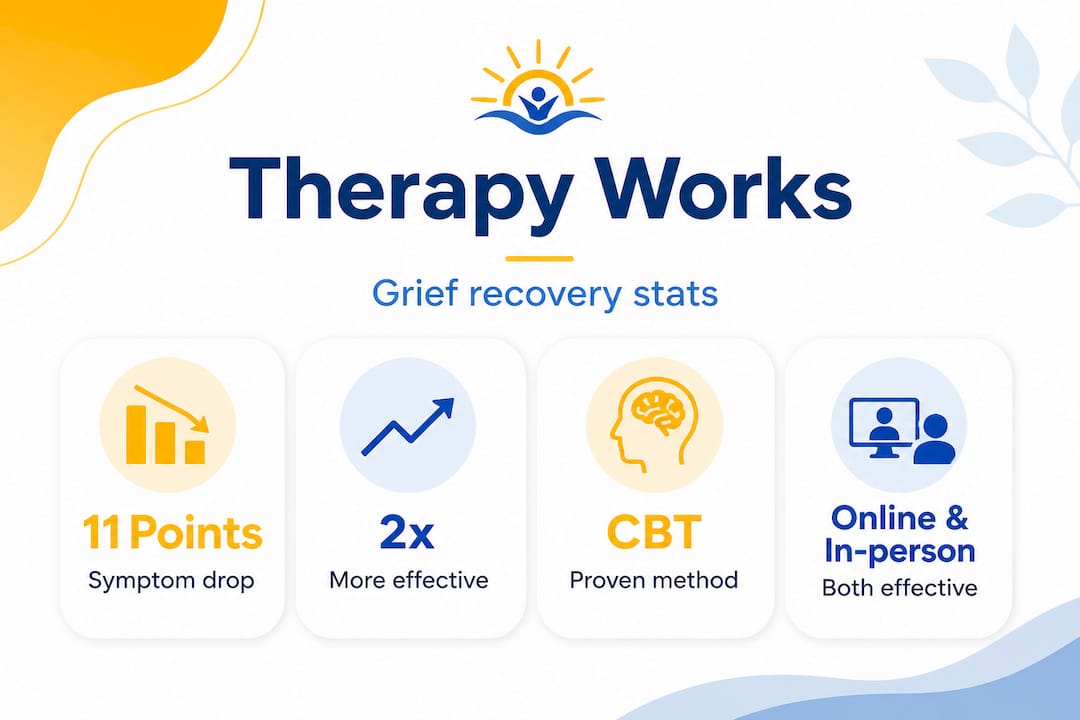
The numbers are striking. Psychotherapy reduces grief disorder symptoms by roughly 11 points on the Inventory of Complicated Grief (a 76-point scale), general grief symptoms by about 8 points on the Texas Revised Inventory, and depression by approximately 7 points on the Beck Depression Inventory. Those reductions translate directly into fewer sleepless nights, less intrusive thinking about the loss, and a greater ability to move through your daily life.
| Outcome measured | Symptom reduction | Scale |
|---|---|---|
| Grief disorder symptoms | ~11 points | Inventory of Complicated Grief (0-76) |
| General grief | ~8 points | Texas Revised Inventory |
| Depression | ~7 points | Beck Depression Inventory II |
The strongest effects appear for CBT-based approaches, with standardized mean differences ranging from -0.65 to -1.01. In research terms, that range sits firmly in the medium-to-large category. Prolonged Grief Disorder (PGD) is the clinical diagnosis given when grief is intense, persistent, and significantly disrupts functioning beyond six to twelve months after the loss. Traumatic losses, such as sudden deaths, accidents, or suicide, tend to push grief into PGD territory more often.
It’s also worth drawing a clear line between clinical grief and normative grief. Normative grief is the expected sadness, longing, and adjustment that follows any significant loss. Most people navigate normative grief without professional intervention. Clinical or complicated grief is different. It lingers, intensifies, and interferes with relationships, work, and health. Therapy shines brightest in that clinical space.
- Symptoms that suggest therapy may help: persistent inability to accept the death, intense longing that doesn’t ease, feeling that life has no purpose, withdrawal from relationships, difficulty carrying out daily tasks after several months
- Risk factors for PGD: sudden or traumatic loss, loss of a child, prior mental health history, limited social support, and suicide bereavement
Pro Tip: If you’re unsure whether what you’re feeling goes beyond typical grief, ask yourself whether the intensity has stayed the same or worsened after several months, and whether your ability to function at work or in relationships has taken a significant hit. Those two signals are strong indicators that professional support could offer real relief.
Therapy’s benefit for depression after loss is also well-documented, which matters because grief and depression often overlap and can be hard to separate without a trained eye. CBT therapy works by restructuring unhelpful thought patterns and building behavioral strategies that reduce avoidance, which is a common grief response that actually prolongs suffering.
Therapy vs. support groups and other grief resources
Not every person who is grieving needs to see a therapist. That’s an honest statement, and it’s backed by evidence. Understanding which type of support fits your situation can save you time, money, and emotional energy.

Support groups reduce depression but show unclear effects on grief disorder symptoms specifically. Peer support, self-help resources, and creative therapies like art or music therapy show limited or no measurable effects on complicated grief when studied rigorously. That doesn’t mean those options have zero value. It means they serve a different purpose.
| Support type | Best for | Limitations |
|---|---|---|
| Individual therapy (CBT) | PGD, traumatic loss, suicide bereavement, clinical symptoms | Requires access, time, and cost investment |
| Support groups | Social connection, mild depression, normative grief | Unclear benefit for complicated grief |
| Peer support | Normative grief, shared experience and validation | Limited evidence for clinical outcomes |
| Self-help / creative therapies | General coping, self-expression | Little measurable effect on grief disorder |
For normative grief, sharing your experience with a community of others who understand loss can be deeply comforting and is often enough. The social connection that support groups provide is genuinely valuable. Research consistently links social isolation to worse grief outcomes, and a group can disrupt that isolation effectively.
However, for people dealing with complicated or traumatic grief, that same group setting may not provide the targeted skill-building and trauma processing that individual therapy offers. Group therapy benefits are real, and some groups are clinician-led and more structured, which narrows the gap. Still, the evidence base for individual therapy in severe grief is considerably more robust.
“Psychotherapy should be targeted toward those most in need, particularly individuals with clinical grief disorders, rather than applied universally to all bereaved individuals.” This distinction matters because universal grief counseling, when given to everyone regardless of need, often shows weak or no effects in trials.
The practical takeaway here is simple. Start by being honest with yourself about where you are. If you’re sad but still functioning, connecting with others who understand your loss is a meaningful step. If daily life feels impossible and months have passed, professional therapy offers something more powerful.
How therapy for grief works: Modalities and accessibility in California
Once you recognize that therapy could help, the next step is understanding what it actually looks like and how to access it without hitting walls.
CBT is the most evidence-supported approach for grief. It works by helping you identify distorted or unhelpful thinking patterns around the loss, such as excessive guilt or catastrophic thinking about your future, and replacing them with more accurate and adaptive perspectives. Behavioral components encourage gradual re-engagement with meaningful activities, which is important because withdrawal and avoidance are two of the biggest barriers to recovery.
Beyond CBT, integrative approaches are common in grief therapy and often include:
- Trauma-focused CBT when the loss involved traumatic circumstances
- EMDR (Eye Movement Desensitization and Reprocessing), which processes distressing memories at a neurological level
- Acceptance-based strategies drawn from Acceptance and Commitment Therapy (ACT)
- Mindfulness practices to reduce rumination and improve emotional regulation
One of the most encouraging findings for Californians is that internet-based CBT is as effective as in-person therapy for grief symptoms. That’s significant because California is large, rural areas are underserved, and many people face transportation, scheduling, or mobility barriers. You don’t have to commute to a Walnut Creek or Oakland office to receive high-quality care.
Here’s how to get started:
- Identify your needs. Are you experiencing symptoms of PGD or traumatic grief, or is this normative grief that is still manageable? Being honest about this helps you choose the right level of care.
- Check insurance and cost options. Many therapists accept insurance, offer sliding-scale fees, or are covered by HSA/FSA plans, so cost doesn’t have to be a barrier.
- Search for grief-specialized therapists. Not every clinician has deep experience with complicated grief. Look for someone trained in CBT, EMDR, or trauma-focused care.
- Try telehealth. Starting online therapy is easier than most people expect, and the research supports it as a fully valid alternative to in-person sessions.
- Set a realistic timeline. Grief therapy isn’t a quick fix, but most evidence-based programs show meaningful improvement within 12 to 20 sessions.
Pro Tip: When searching for a therapist, use filters for “grief,” “bereavement,” “CBT,” and “trauma” simultaneously. A therapist who is comfortable with all of these is far better equipped to help with complicated grief than one with general experience only. Why online therapy works is also worth reading if you’re skeptical about the telehealth format. The evidence behind it is solid.
If you’re comparing platforms or providers, looking at the best online therapy services can help you navigate the options available to Californians with different budgets and needs.
Who most benefits from therapy for grief, and when it’s not needed
Knowing who therapy helps most is just as important as knowing what it does. This knowledge can actually reduce guilt for people who feel like they “should” be in therapy but may not need it, and it can motivate the people who truly do need it to reach out sooner.
PGD after traumatic or sudden losses has a prevalence ranging from 9.8% to 34.3% depending on the type of loss. Suicide bereavement sits at the higher end of that range. If you lost someone to suicide, a violent event, or a sudden accident, your risk of developing PGD is significantly higher, and the evidence for therapy in those situations is strong.
People who benefit most from professional grief therapy include:
- Those with symptoms of PGD: persistent yearning, difficulty accepting the death, bitterness, inability to engage with life after six or more months
- Individuals who experienced traumatic, sudden, or violent loss
- People bereaved by suicide, who often carry an additional layer of guilt, confusion, and stigma
- Those with a history of depression, anxiety, or trauma, which can complicate the grief process
- Anyone whose daily functioning, work, or relationships have been significantly disrupted
Not all grief needs therapy, and universal grief counseling offered to everyone regardless of need consistently underperforms in clinical trials. This is a critical insight. When therapy is applied broadly to all bereaved people without screening for clinical need, the results are modest at best. The power of therapy comes from its targeted application to those with the most intense, persistent symptoms.
“The evidence does not support universal grief counseling for all bereaved individuals. Screening for clinical symptoms and targeting therapy to those who need it most produces far better outcomes.”
Grief in children and adolescents is an important area with less robust evidence. Children experience and express grief differently, and while therapy can absolutely help, the specific approaches and indicators are still being studied. Cultural context also matters. Grief support resources tailored to communities in California are increasingly available, and cultural sensitivity in the therapeutic relationship significantly affects outcomes.
When it comes to medication, the evidence is limited. Pharmacotherapy may serve as an adjunct in some situations, particularly when depression is severe, but it does not replace psychotherapy as the primary evidence-based approach.
What most guides miss: The true limits and power of grief therapy
Most articles about grief therapy either sell it as a universal solution or dismiss it as unnecessary. Neither view is accurate, and both can actually harm people who are trying to make a real decision about their own care.
Here is what we’ve seen working with people in California who are navigating loss: therapy is genuinely transformative for the people who need it. When someone is stuck, unable to move forward, replaying the circumstances of a death over and over, or feeling like the future is simply blank, therapy creates movement. It doesn’t erase the loss. It builds the internal capacity to carry the loss differently.
But the risk of over-medicalizing normal grief is real. Grief is not a disorder. Sadness after losing someone you love is not a pathology. When well-meaning people push everyone who has experienced a death toward therapy, it can inadvertently send the message that grief itself is something to be fixed rather than felt. That does a disservice to the natural process of mourning.
The honest position is this: be honest with yourself about where you are. Are you sad and struggling, but moving through it? That may be normative grief, and it deserves space, not a clinical intervention. Are you frozen, months in, unable to function, and feeling like nothing will ever be okay again? That is where therapy can change the trajectory of your life.
The stigma around seeking help in California is real, particularly in communities where strength is defined by not asking for support. It takes courage to recognize that what you’re carrying has become too heavy to carry alone. The evidence is clear that for complicated grief, that courage pays off in concrete, measurable improvement.
Use the right tool for where you are. Therapy, group support, personal rituals, and time all have a role. The key is matching the intensity of the support to the intensity of the need.
Explore the best support for your grief journey
Grief that feels unmanageable deserves real, evidence-based support, not just time and hope.

At Revive Health Therapy, we offer trauma-informed, evidence-based care including CBT, EMDR, and mindfulness-based approaches designed specifically for people navigating complicated loss. Whether you’re in the Bay Area or anywhere across California, secure telehealth sessions make it possible to start without barriers. We also offer sliding-scale fees and accept insurance including HSA/FSA plans. Explore our mental health services for adults, review psychotherapy options in California, or learn more about evidence-based therapy benefits to find the support that fits your situation.
Frequently asked questions
How soon should I seek therapy after a loss?
Seek therapy promptly if grief symptoms feel overwhelming, persist beyond several months, or are significantly impairing your ability to function, since CBT-based interventions are most effective when applied to people with active clinical symptoms.
What makes therapy more effective than just talking to friends or family when grieving?
Therapy uses structured techniques like CBT that produce measurable results, with psychotherapy reducing grief disorder symptoms by around 11 points on clinical scales, which informal support simply cannot replicate through conversation alone.
Is online therapy as good as in-person therapy for grief?
Yes, research confirms that internet-based CBT is as effective as face-to-face sessions for grief symptoms, making telehealth a fully valid option for Californians who prefer or need remote access.
When are support groups or self-help more appropriate than therapy?
For typical grief without severe distress, support groups reduce depression and provide valuable social connection, making them a well-suited option when symptoms haven’t crossed into clinical complicated grief territory.
Does everyone who experiences grief need therapy?
No. Not all grief requires clinical intervention, and universal grief counseling for all bereaved individuals consistently underperforms in research; therapy is most effective when targeted to people with prolonged, intense symptoms or significant functional impairment.
Recommended
- Role of Therapy in Trauma Recovery: Evidence and Impact – ReviveHealthTherapy
- How therapists foster personal growth: Evidence and insights – Revive Health Therapy
- Why Online Therapy Works: Evidence and Real Benefits – Revive Health Therapy
- Psychotherapy in California 2026: Evidence & Options – Revive Health Therapy
- Grief and Bereavement: Finding Support After Loss | Graceland Hospice Care Blog