
TL;DR:
- Play therapy leverages natural non-verbal communication to help children process trauma and build coping skills.
- Different approaches, such as CCPT and sand tray, are tailored to children’s specific emotional and developmental needs.
- Parent involvement and qualified, specialized therapists are crucial for effective, lasting child mental health improvement.
Most parents think of play as something children do to pass the time. Few realize it’s the primary way children make sense of their world, process fear, and work through pain they can’t put into words. Play is a natural language children use to process trauma and build coping skills, and when guided by a trained professional, it becomes a powerful clinical tool. If your child is struggling with anxiety, behavioral changes, trauma, or emotional outbursts, understanding play therapy could be the most important step you take this year. This guide covers what play therapy is, how it works, and how to find qualified providers right here in California.
Table of Contents
- How play becomes therapy: Foundations and mechanisms
- Types of play therapy: Evidence-based approaches you might encounter
- What makes play therapy effective? Evidence, outcomes, and parent involvement
- Qualifications and finding a play therapist in California
- A fresh perspective: The uncomfortable truths and untapped power of play therapy
- Getting support: Connect with evidence-based child therapy today
- Frequently asked questions
Key Takeaways
| Point | Details |
|---|---|
| Play is healing work | Play therapy uses children’s natural language to process trauma and develop coping skills. |
| Method matters | Only evidence-based and guided methods of play are truly therapeutic and effective. |
| Parental involvement boosts results | Including parents in therapy improves outcomes and shortens healing time. |
| Qualifications are essential | Check for licensed, specially trained therapists for safe, effective care in California. |
How play becomes therapy: Foundations and mechanisms
Children are not small adults. They don’t sit across from a therapist and talk through their feelings the way grown-ups do. Their brains are still developing the language and abstract thinking needed for traditional talk therapy. Play is how they communicate naturally, and play therapy leverages this natural communication for trauma and emotional healing in a structured, intentional way.
But here’s what separates play therapy from a regular playdate: it is goal-oriented, clinically guided, and grounded in child development research. A trained therapist creates a safe, predictable environment where the child can use toys, art, sand, puppets, or movement to express what they cannot yet say aloud. The therapist observes, responds, and guides the process toward specific therapeutic goals.
The mechanisms behind play therapy include several key processes that drive healing:
- Safety: The play room is a consistent, non-threatening space where children feel in control.
- Non-verbal expression: Children act out emotions, fears, and memories through symbolic play.
- Emotional regulation: Repeated play scenarios help children practice managing intense feelings.
- Mastery: Children gain confidence by solving problems and overcoming challenges in play.
- Attachment: The therapist-child relationship models healthy, trusting connection.
These mechanisms work together to help children process difficult experiences without requiring them to verbalize trauma directly. To better understand how this fits into the broader landscape of mental health support for kids, what is child therapy offers a solid starting point for parents new to this space.
| Play therapy element | What it does for the child |
|---|---|
| Safe, structured environment | Reduces anxiety, builds trust |
| Symbolic and pretend play | Externalizes internal emotional states |
| Therapist guidance | Keeps sessions goal-directed |
| Repeated sessions | Builds emotional regulation over time |
| Parent involvement | Reinforces progress at home |
“The play room is the child’s world. What they do there is rarely random. Every toy chosen, every scene created, is a window into their emotional life.” — Child development perspective
Pro Tip: Don’t assume that because your child plays at home, they are processing their struggles on their own. Therapeutic play requires trained professional guidance and specific clinical goals. Supervised free play and structured play therapy are not the same thing.
Types of play therapy: Evidence-based approaches you might encounter
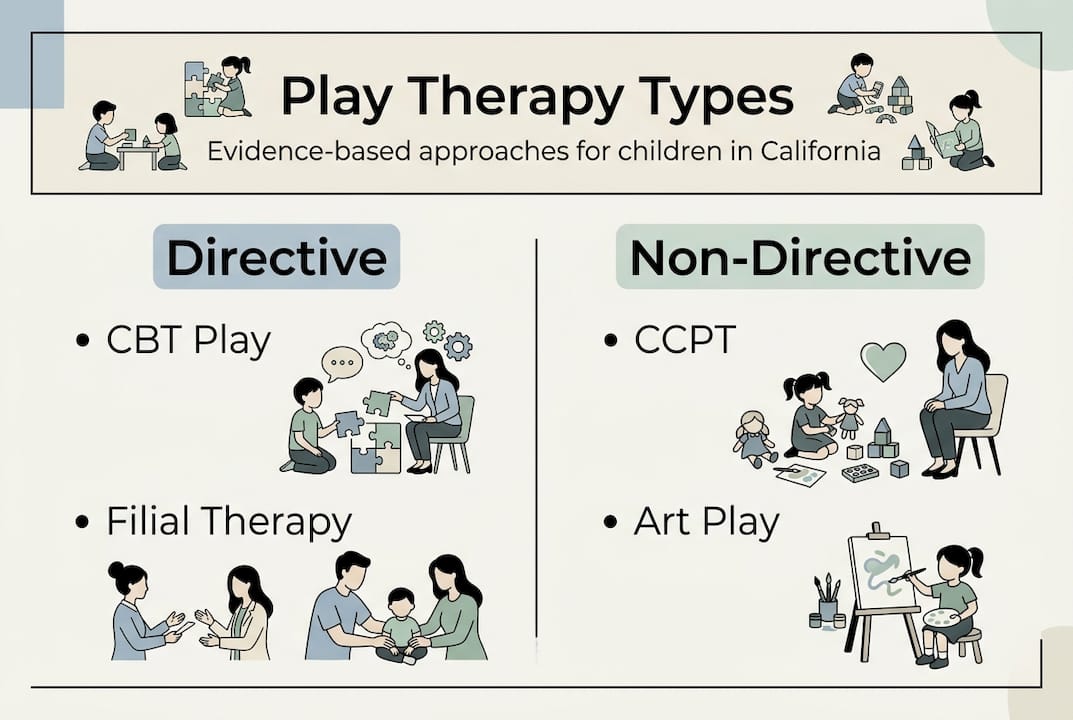
Not all play therapy looks the same. Different approaches are designed for different children, different ages, and different types of emotional or trauma-related challenges. Key methodologies include CCPT, TF-CBT, Theraplay, directive play, sand tray, and art-based interventions, each with its own theory and application.
Here’s a breakdown of the most common approaches:
- Child-Centered Play Therapy (CCPT): Non-directive. The child leads the play while the therapist reflects feelings and creates unconditional acceptance. Best for anxiety, self-esteem issues, and general emotional struggles.
- Trauma-Focused CBT with play elements: Combines cognitive behavioral therapy with play-based activities to address trauma narratives. Highly structured and evidence-supported for PTSD.
- Theraplay: Focuses on the parent-child attachment relationship through structured, playful activities. Excellent for children with attachment disruptions or early neglect.
- Directive play therapy: The therapist introduces specific activities or scenarios to address targeted issues. Useful for children who need more structure.
- Sand tray therapy: The child creates scenes in a tray of sand using miniature figures. Powerful for children who struggle with verbal or direct emotional expression.
- Art-based interventions: Drawing, painting, or collage as a medium for emotional processing. Works well alongside other modalities.
Different types suit different children and circumstances, which is why a good therapist will assess your child before committing to one approach. For a broader look at what’s available, types of child therapy can help you compare options side by side.
| Approach | Best for | Directive or non-directive |
|---|---|---|
| CCPT | Anxiety, self-esteem, general emotional struggles | Non-directive |
| TF-CBT with play | Trauma, PTSD | Directive |
| Theraplay | Attachment issues, early neglect | Directive |
| Sand tray | Non-verbal children, complex trauma | Mixed |
| Art-based therapy | Emotional expression, processing grief | Mixed |
Pro Tip: When interviewing a potential therapist, ask directly: “What specific play therapy approach do you use, and why is it right for my child’s situation?” A skilled therapist will give you a clear, confident answer tied to your child’s needs, not a vague response about “using play.”
What makes play therapy effective? Evidence, outcomes, and parent involvement
Skeptical parents often ask: does this actually work? The short answer is yes, and the research backs it up. Meta-analyses show play therapy reduces PTSD, anxiety, and depression in children, with effect sizes ranging from medium to large. Optimal outcomes are seen around 30 to 45 sessions, and results are significantly better when parents are actively involved in the process.
Here’s what the evidence shows children gain from play therapy:
- Reduced trauma symptoms: Lower levels of PTSD, nightmares, and hypervigilance.
- Improved behavior: Fewer tantrums, aggression, and defiance at home and school.
- Better social skills: Children become more empathetic and cooperative with peers.
- Stronger attachment: Improved relationships with caregivers and family members.
- Greater emotional regulation: Children learn to identify and manage their feelings more effectively.
That said, play therapy is not a quick fix. Slower progress in severe trauma is common, and therapy is less effective when used in isolation without family involvement. The family system matters enormously. A child who makes breakthroughs in the therapy room but returns to a chaotic or unsupportive home environment will struggle to maintain those gains.
“Parent engagement is not optional. It’s one of the strongest predictors of lasting improvement in child therapy outcomes.”
The role of parents in therapy is often underestimated. Parents who attend regular check-ins, follow therapist recommendations at home, and model emotional regulation themselves dramatically accelerate their child’s healing. If you’re wondering whether therapy is the right call at all, psychotherapy for children explains the clinical case in plain language.
| Outcome area | What research shows |
|---|---|
| PTSD and trauma symptoms | Significant reduction with 30 to 45 sessions |
| Anxiety and depression | Medium to large effect sizes in meta-analyses |
| Behavioral issues | Measurable improvement with parent involvement |
| Attachment and relationships | Strengthened with family-inclusive approaches |
Pro Tip: Ask your child’s therapist for a brief monthly summary of progress. This keeps you informed, helps you reinforce skills at home, and signals to the therapist that you are an engaged partner in your child’s healing.
Qualifications and finding a play therapist in California
California has specific requirements for mental health professionals, and knowing what to look for protects your child from underqualified providers. Play therapists in California must be licensed mental health professionals, complete 3,000 supervised hours, pass specific exams, and for specialization, hold the APT Registered Play Therapist (RPT) credential.
Here’s what to verify before booking a first session:
- Valid California license: Look for LMFT (Licensed Marriage and Family Therapist), LPCC (Licensed Professional Clinical Counselor), LCSW (Licensed Clinical Social Worker), or a licensed psychologist.
- RPT credential: The Registered Play Therapist designation from the Association for Play Therapy signals advanced, specialized training.
- Child-specific experience: General therapy training is not enough. Ask how many child clients they currently work with.
- Trauma training: For children with trauma histories, ask specifically about trauma-informed approaches like TF-CBT or EMDR adapted for children.
Steps to find the right fit:
- Search the California Board of Behavioral Sciences website to verify any therapist’s license status.
- Check the Association for Play Therapy’s online directory for RPT-credentialed providers near you.
- Schedule a 15-minute consultation call to assess communication style and fit.
- Ask about family involvement practices and how they track progress over time.
- Trust your instincts. Cultural fit and communication style directly impact how comfortable your child will feel.
For practical guidance on vetting providers, tips for choosing a therapist walks through what to ask and what to avoid. If you want California-specific guidance, choose a therapist in California covers the licensing landscape in detail. And if you’re just starting out, the step by step therapy guide is a helpful roadmap for first-time therapy seekers in the state.
Red flags to watch for: providers who can’t clearly explain their methods, therapists without child-specific training, anyone who discourages parent involvement, or practices that offer no outcome tracking whatsoever.
A fresh perspective: The uncomfortable truths and untapped power of play therapy
Here’s something most articles won’t say directly: parent skepticism about play therapy is sometimes justified. Not because play therapy doesn’t work, but because play therapy requires specialized training and a nuanced understanding of family systems that not every provider actually has.
The field has a visibility problem. When parents see a child playing with toys in a therapist’s office, it can look like expensive supervised free time. That perception sticks when therapists fail to communicate their clinical reasoning or involve families meaningfully in the process.
What leading research is now pointing toward is this: individual play therapy alone is rarely enough for lasting change. The role of parents in reinforcing skills, modeling regulation, and maintaining therapeutic gains at home is not a bonus feature. It is the backbone of durable healing.
The future of play therapy in California depends on three things: cultural tailoring to serve the state’s diverse communities, rigorous outcome tracking to hold providers accountable, and a whole-family model that treats the child not as an isolated patient but as part of a living, breathing system.
Getting support: Connect with evidence-based child therapy today
If this article has helped you see play therapy in a new light, the next step is finding qualified support for your child. At Revive Health Therapy, we offer child and teen therapy grounded in evidence-based methods, trauma-informed care, and genuine family involvement.

Our team serves families across California through both in-person sessions in Walnut Creek and Oakland, and secure telehealth statewide. We accept insurance and offer sliding-scale fees to make care accessible regardless of income. Explore our mental health services for children or reach out directly to get started. When you’re ready to take that step, contact Revive Health Therapy and let’s find the right fit for your family.
Frequently asked questions
How does play therapy help children who can’t talk about their trauma?
Play therapy allows children to express emotions non-verbally, using toys, art, and symbolic play to process trauma safely without needing to describe it in words.
How long does play therapy usually take to show results?
Optimal outcomes occur around 30 to 45 sessions, though progress varies depending on the severity of the child’s struggles and how actively parents participate.
What qualifications should a play therapist have in California?
Look for a valid California license such as LMFT or LPCC, and ideally the RPT certification from the Association for Play Therapy, which confirms specialized play therapy training.
Is all play during therapy considered therapeutic?
No. Only structured, therapist-guided play with defined clinical goals qualifies as therapy. Unguided play, even in a clinical setting, does not produce the same outcomes.
Recommended
- Child Therapy Steps in California: 70% Symptom Reduction – ReviveHealthTherapy
- Why Psychotherapy for Children Matters Most – ReviveHealthTherapy
- Therapy session structure: Evidence-based approaches explained – Revive Health Therapy
- How to Choose Child Therapist for Anxiety or Trauma – ReviveHealthTherapy
- Why Naming Your Feelings Helps — The Caia Journal