
TL;DR:
- CBT targets distorted thoughts and avoidance behaviors to reduce anxiety effectively.
- Tracking tools like GAD-7 and SUDS help monitor progress and guide treatment adjustments.
- Professional guidance enhances CBT’s effectiveness, especially for trauma, complex cases, or severe anxiety.
Step-by-step CBT for anxiety: A guide for Californians
Anxiety has a way of making you feel trapped inside your own mind. One moment you’re fine, and the next, a racing heart or a flood of worst-case-scenario thoughts hijacks your day. If you’ve tried to “just relax” or avoid whatever scares you, you already know those strategies don’t stick. Cognitive Behavioral Therapy, or CBT, is different. It works by targeting the specific patterns of thought and behavior that keep anxiety alive. This guide walks you through the exact steps therapists use, tailored for anyone in California ready to take real action toward emotional relief and lasting personal growth.
Table of Contents
- How CBT tackles anxiety: The fundamentals you need to know
- Before you begin CBT: Preparation, safety, and what to expect
- Step-by-step CBT for anxiety: A practical walkthrough
- Tracking your CBT progress: Monitoring, troubleshooting, and adapting
- Alternatives and advanced tips: What if traditional CBT isn’t enough?
- What most CBT guides miss about real-life progress
- Find skilled CBT and evidence-based therapy in California
- Frequently asked questions
Key Takeaways
| Point | Details |
|---|---|
| CBT is evidence-based | CBT is a proven approach and first-line treatment for many anxiety disorders. |
| Preparation matters | Assess your needs and consider professional guidance for best results, especially for exposure tasks. |
| Stepwise progress | Structured CBT steps—identifying thoughts, challenging beliefs, and facing fears—create sustainable change. |
| Monitor and adapt | Tracking symptoms helps you measure gains and know when to adjust or seek extra support. |
| Alternatives exist | If CBT isn’t enough, options like ACT, psychodynamic, or trauma-focused therapy may help. |
How CBT tackles anxiety: The fundamentals you need to know
CBT stands for Cognitive Behavioral Therapy, a structured, evidence-based approach that targets the relationship between thoughts, feelings, and behaviors. At its core, CBT operates on a simple but powerful idea: your thoughts about a situation shape how you feel, and how you feel drives what you do. When anxiety is running the show, that cycle almost always includes distorted thinking and avoidance behaviors that reinforce fear rather than reduce it.
Common cognitive distortions tied to anxiety include:
- All-or-nothing thinking: Seeing situations in black and white with no middle ground
- Mind reading: Assuming you know what others think, usually negatively
- Catastrophizing: Expecting the worst possible outcome as if it’s certain
- Overgeneralization: Drawing sweeping conclusions from a single event
- Emotional reasoning: Believing something is true because it feels true
Recognizing these distortions is step one. But CBT doesn’t stop at awareness. It teaches you to actively question anxious beliefs using tools like Socratic questioning, behavioral experiments, and exposure tasks. Exposure, in particular, is widely misunderstood. The goal isn’t to simply relax in a feared situation. It’s to create a new memory, a process researchers call inhibitory learning, where your brain learns that the feared outcome either doesn’t happen or is manageable. That new learning gradually overrides the old fear response.
This is why CBT is first-line care for generalized anxiety disorder, panic disorder, and social anxiety under NICE stepped care guidelines. It’s not just popular. It’s the most rigorously tested psychological treatment available for anxiety.
| Technique | CBT | Alternative approaches |
|---|---|---|
| Core method | Thought challenging and exposure | Relaxation, talk therapy, insight work |
| Mechanism | Inhibitory learning, behavioral change | Emotional processing, relational repair |
| Evidence base | Very strong (RCTs, meta-analyses) | Moderate to strong depending on modality |
| Best for | GAD, panic, social anxiety, phobias | Trauma, relational patterns, existential concerns |
If you’re still exploring what approach fits best, learning about types of therapy for anxiety can help you make a more informed decision before committing to a path.
Pro Tip: Don’t wait until you fully understand CBT to start. Understanding builds through doing. Begin with curiosity, not perfection.
Before you begin CBT: Preparation, safety, and what to expect
Jumping into CBT without any baseline assessment is a bit like starting a road trip without checking your fuel. Before you take your first step, it helps to know where you’re starting from and what potential speed bumps to watch for.
Two widely used screening tools can help you measure anxiety severity:
- GAD-7 (Generalized Anxiety Disorder 7-item scale): A seven-question self-report that scores anxiety from minimal to severe, giving you a concrete starting point
- OASIS (Overall Anxiety Severity and Impairment Scale): Measures both the frequency and impact of anxiety on daily functioning, useful for tracking change over time
Taking these assessments every two to four weeks gives you real data about your progress, not just a gut feeling.
Next, decide whether self-guided CBT or therapist-led CBT is right for you. For mild to moderate anxiety without trauma history or complex comorbidities, structured self-help workbooks can be genuinely effective. However, self-help workbooks can support but do not replace professional guidance, especially when exposure tasks are involved. A trained therapist can calibrate the pace and intensity in ways that a book simply cannot.
Important safety note: If you have a trauma history, significant depression alongside anxiety, or have experienced panic attacks that feel medically alarming, please connect with a licensed clinician before beginning exposure-based work on your own. Starting too aggressively can temporarily overwhelm your nervous system.
Here’s a preparation checklist before you start:
- Complete the GAD-7 and note your score
- Identify your top three anxiety triggers
- Gather a CBT workbook or structured worksheet packet
- Set aside at least 20 to 30 minutes, three times per week for practice
- Identify one trusted support person who can check in with you
- Review mindfulness strategies for anxiety as a complementary skill to use between sessions
| Tool or resource | Purpose | Where to find it |
|---|---|---|
| GAD-7 | Baseline and ongoing measurement | Free online or from your provider |
| OASIS | Functional impairment tracking | Clinical settings or research sites |
| CBT workbook | Structured exercises and thought records | ABCT, Amazon, therapist recommendation |
| Mindfulness audio | Between-session regulation | Apps, YouTube, or therapist resources |
| Anxiety self-care checklist | Daily support habits | Revive Health Therapy website |
Pro Tip: Take your GAD-7 before reading any further so you have an honest baseline. This one small step turns vague feelings into trackable data.
Step-by-step CBT for anxiety: A practical walkthrough
Now for the part you’ve been waiting for. CBT for anxiety follows a logical sequence. Each step builds on the last, and skipping steps tends to make the whole process feel scattered and ineffective. Here’s how to work through it.
-
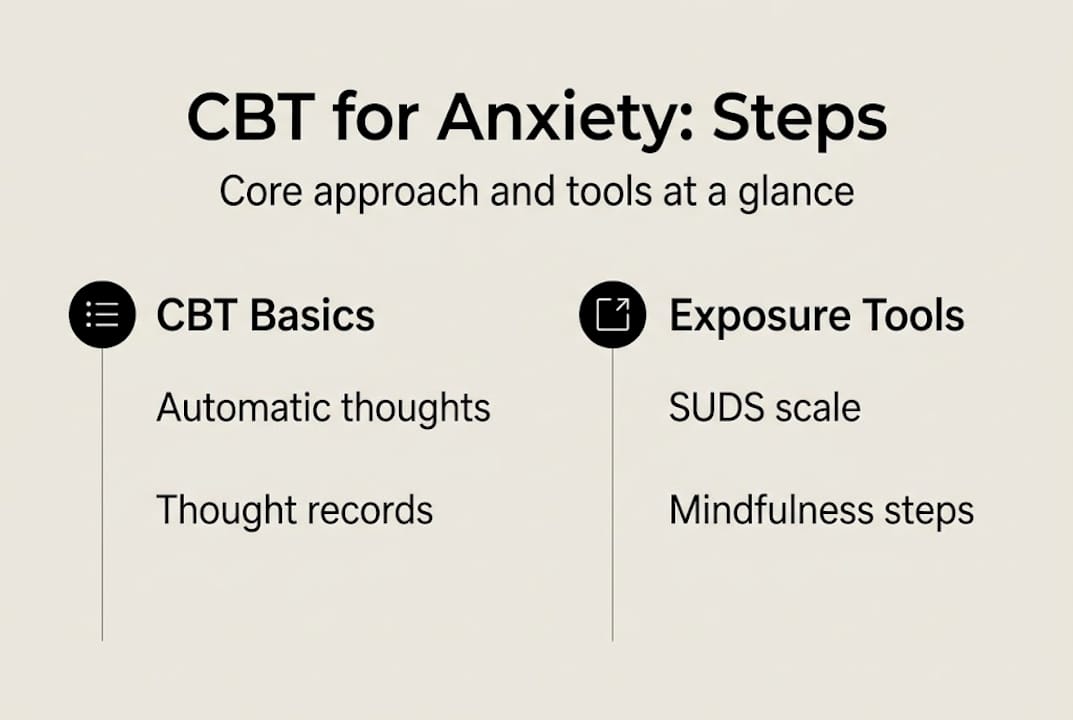
Identify your triggers and automatic thoughts. Start by keeping a simple log. When anxiety spikes, write down the situation, your immediate thought, and your emotion. For example: “I was about to present in a meeting. I thought, ‘Everyone will think I’m incompetent.’ I felt terrified.” This is your raw material.
-
Challenge distortions using a thought record. Take your automatic thought and run it through a structured series of questions. What’s the evidence for this thought? Against it? What would you tell a friend thinking the same thing? What’s a more balanced, realistic alternative? The CBT cognitive model works by targeting automatic thoughts and deeper schemas through exactly this kind of Socratic questioning, a dialogue between your anxious mind and your rational mind.
-
Design a behavioral experiment or exposure task. This is where real change happens. Choose a situation you’ve been avoiding and create a graded approach. For example, if social anxiety makes you avoid eye contact, start with brief eye contact in a low-stakes setting like a coffee shop. Then gradually work up to sustained eye contact in conversations. The key is to stay in the situation long enough for your nervous system to experience the outcome as manageable, not to escape at the peak of fear.
-
Review your results and track your numbers. After each exposure or experiment, rate your anxiety using the SUDS (Subjective Units of Distress Scale), a 0 to 100 scale where 0 is completely calm and 100 is the worst distress imaginable. Also re-check your GAD-7 every two weeks. Research using validated scales shows that roughly 50% of people achieve reliable recovery through CBT in routine practice. Tracking keeps you honest and motivated.
Pro Tip: When you notice your SUDS dropping during an exposure, resist the urge to leave immediately. Staying in the situation until your anxiety drops by at least 50% builds far stronger inhibitory learning than cutting the session short.
Building in a mindfulness workflow between exposure tasks helps regulate your nervous system and keeps you from becoming flooded between practice sessions.
Tracking your CBT progress: Monitoring, troubleshooting, and adapting
Completing CBT steps without tracking your progress is like exercising without ever checking if you’re getting stronger. Measurement isn’t optional. It’s what separates genuine improvement from going through the motions.
Use your GAD-7 every two weeks, and your SUDS rating after every exposure task. Using validated scales like the GAD-7 and SUDS directly supports inhibitory learning by helping you notice real change rather than relying on anxious self-perception, which is notoriously inaccurate. Write down your scores and look for trends across three to four weeks, not day to day.
Remember: Anxiety often spikes early in treatment, particularly during exposure tasks. This is not a sign that CBT is making things worse. It’s often a sign that you’re engaging with the very fears that need new learning. Short-term discomfort is the price of long-term freedom.
Here’s how to distinguish normal progress from red flags:
| Status | What you’ll notice | What to do |
|---|---|---|
| Normal progress | SUDS drops during exposure; GAD-7 trending down over weeks | Continue as planned; celebrate small wins |
| Temporary spike | Anxiety increases but stabilizes; still functioning | Reduce exposure intensity slightly; add grounding skills |
| Plateau | No change in GAD-7 after 4 weeks of consistent practice | Review thought records for missed distortions; consult a therapist |
| Red flag | Significant functional impairment, panic attacks worsening | Seek professional assessment immediately |
Signs you may need professional support rather than continuing self-guided CBT:
- GAD-7 stays above 15 despite four or more weeks of practice
- Panic attacks are increasing in frequency or intensity
- You feel unable to complete daily tasks or work responsibilities
- Depressive symptoms are growing alongside anxiety
- Trauma memories or flashbacks are surfacing during exposures
The anxiety management checklists available through Revive Health Therapy can help you track these markers systematically and know when to escalate your support.
Alternatives and advanced tips: What if traditional CBT isn’t enough?
CBT is powerful, but it’s not a one-size-fits-all solution. Some people hit genuine walls with standard CBT, and that’s not a failure. It’s information worth acting on.
Signs that standard CBT may not be the right fit on its own:
- You’ve completed 12 or more sessions with minimal change
- Anxiety is rooted primarily in unresolved trauma rather than distorted thinking alone
- Relational patterns with family, partners, or coworkers are driving most of your anxiety
- You struggle to engage intellectually with thought records, finding them disconnected from how you actually feel
- You experience dissociation or emotional numbness during exposures
When those signs appear, broader options deserve serious consideration. Acceptance and Commitment Therapy (ACT) shifts the focus from changing thoughts to changing your relationship with them, which many people find more natural and less effortful. Psychodynamic and relational models explore the deeper patterns underneath surface-level anxiety. EMDR (Eye Movement Desensitization and Reprocessing) is highly effective when anxiety is trauma-rooted.
It’s worth noting that NICE anxiety guidelines have been criticized as outdated, with growing calls from the broader clinical community for more inclusive therapy options beyond CBT alone. This reflects a genuine evolution in how anxiety treatment is understood.
Modern CBT has also evolved. The newer inhibitory learning model is more flexible and less rigid than classic exposure hierarchies. Digital CBT platforms now offer guided practice between sessions. And trauma-informed CBT integrates safety-building and stabilization before any exposure work begins.
Pro Tip: If you feel stuck, advocate clearly with your therapist by saying something like, “I’ve been working hard on this, but something isn’t clicking. Can we explore a different angle or approach?” A good therapist will welcome that conversation. To understand your full range of options, comparing CBT vs. other therapies can clarify which modality fits your specific situation. For younger Californians, CBT for teens follows adapted protocols designed for adolescent development.
What most CBT guides miss about real-life progress
Here’s something we’ve learned working with anxiety clients across California: the people who get the most out of CBT are almost never the ones who follow it most rigidly. They’re the ones who stay curious about their own patterns, bring their therapist into the messy middle parts, and resist the urge to “graduate” before they’ve truly consolidated their gains.
Most guides treat CBT like a checklist. Complete the thought record. Do the exposure. Done. But real recovery is rarely that linear. A client might sail through cognitive restructuring only to discover that an unresolved relationship dynamic is fueling the anxiety at a deeper level. Or someone may find that their evidence-based therapy works far better when woven together with mindfulness and trauma-informed stabilization techniques, rather than practiced in isolation.
The uncomfortable truth is that self-help CBT has a ceiling. That ceiling is often hit not because the person isn’t trying hard enough, but because anxiety, especially anxiety rooted in past experiences or ongoing relational stress, requires a skilled human being in the room with you. Flexibility, compassion, and professional partnership are what make CBT not just effective but sustainable.
Find skilled CBT and evidence-based therapy in California
Reading about CBT is a meaningful first step. But knowing the steps and having someone skilled to guide you through them are genuinely different experiences.
At Revive Health Therapy, we offer personalized CBT and a full range of evidence-based approaches, including EMDR, ACT, and trauma-informed care, across California. Whether you’re in the East Bay, the Bay Area, or anywhere statewide, our telehealth sessions make it easy to access consistent, professional support. We accept insurance and offer sliding-scale fees so that cost isn’t a barrier. If you’re ready to move from managing anxiety to genuinely overcoming it, understanding why seek psychotherapy is a great place to start. Explore your therapy options in California and take the next step today.
Frequently asked questions
What is the first step in CBT for anxiety?
The first step is identifying your anxiety triggers and automatic negative thoughts, typically using a thought record or structured worksheet. This process comes directly from the CBT cognitive model targeting automatic thoughts and deeper schemas.
How many CBT sessions does it typically take to see results?
Meta-analyses show large effect sizes for CBT in 8 to 12 sessions, though many people notice meaningful improvements after just 5 sessions depending on anxiety severity.
Can I do CBT for anxiety by myself?
Self-help workbooks can be effective for mild anxiety but do not replace therapist guidance, especially for exposure tasks or when symptoms are moderate to severe.
What should I do if my anxiety worsens during CBT?
Short-term anxiety spikes are common during exposure work and often signal active learning rather than harm. If distress becomes severe or persistent, consult a professional who can adjust the pace and intensity of your treatment.
Is CBT always the best therapy for anxiety?
CBT is highly effective for most anxiety presentations, but broader therapy options including ACT, psychodynamic therapy, and trauma-focused approaches may be better suited for certain individuals or complex cases.
Recommended
- Overcoming Depression: A Step-By-Step Guide for Californians – Revive Health Therapy
- Manage anxiety with proven therapies in California 2026 – Revive Health Therapy
- Step by step therapy guide for Californians 2026 – ReviveHealthTherapy
- CBT for adolescents: How therapy empowers California teens – Revive Health Therapy
One Response