
Many people assume all therapy works the same way, but that’s not true. If you’ve struggled with anxiety, depression, or trauma recovery, you may have noticed that traditional talk therapy sometimes feels incomplete or even uncomfortable. That’s because not all therapy approaches account for how past trauma shapes your present mental health. Trauma-informed therapy is different. It prioritizes safety, trust, and avoiding re-traumatization, making it especially valuable for Californians seeking accessible, evidence-based care. This article explains what trauma-informed therapy is, how it differs from traditional methods, when it’s most beneficial, what the evidence shows, and how you can access it affordably in California.
Table of Contents
- What is trauma-informed therapy?
- How trauma-informed therapy differs from traditional approaches
- When is trauma-informed therapy especially beneficial?
- What does the evidence actually say?
- How accessible and affordable is trauma-informed therapy in California?
- Next steps: Find trauma-informed care that works for you
- Frequently asked questions
Key Takeaways
| Point | Details |
|---|---|
| Focus on safety and trust | Trauma-informed therapy was designed to foster a sense of safety, trust, and empowerment for those healing from trauma. |
| Addresses trauma’s root cause | Unlike traditional models, this approach considers trauma’s ongoing impact on mental health conditions like anxiety and depression. |
| Proven tools for PTSD and anxiety | Techniques such as TF-CBT and EMDR show strong outcomes, especially within trauma-informed frameworks. |
| Accessible and affordable care | California residents benefit from telehealth and insurance options that make trauma-informed therapy easier to access. |
| Know the evidence limits | While engagement improves, robust research for overall superiority is still growing, so consider both promise and limitations. |
What is trauma-informed therapy?
Trauma-informed therapy (TIT) is an approach that recognizes trauma’s widespread impact on mental health and integrates that understanding into every aspect of treatment. According to SAMHSA, trauma-informed therapy realizes trauma’s prevalence, recognizes its signs, integrates trauma knowledge into practice, and actively resists re-traumatization. This isn’t just a buzzword. It’s a framework built on six core principles that guide how therapists interact with clients.
Those principles are:
- Safety: Creating a physically and emotionally secure environment
- Trust and transparency: Building honest, clear communication
- Peer support: Encouraging connection and shared experiences
- Collaboration: Sharing power and decision-making with clients
- Empowerment: Recognizing client strengths and resilience
- Cultural awareness: Respecting diverse backgrounds and experiences
These principles matter because trauma doesn’t just cause immediate distress. It can reshape how your brain processes stress, relationships, and safety. When trauma goes unaddressed, it often manifests as chronic anxiety, depression, or difficulty trusting others. Trauma-informed therapy acknowledges this reality and creates a therapeutic space where you feel genuinely safe to explore difficult emotions without fear of judgment or re-traumatization.
“Trauma-informed care is not a specific intervention but a framework that shapes how care is delivered, emphasizing safety and empowerment at every step.”
If you’re exploring California therapy options, understanding these principles helps you identify providers who truly prioritize your psychological safety.
How trauma-informed therapy differs from traditional approaches
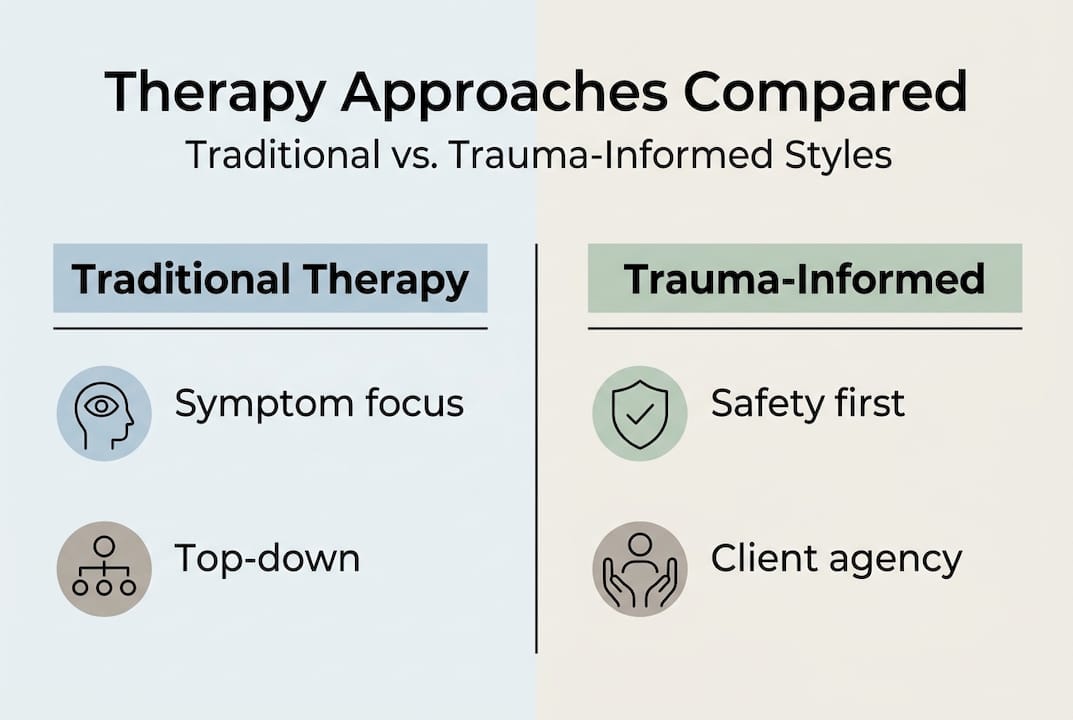
Traditional therapy often focuses on symptoms. You come in with anxiety, and the therapist teaches coping skills. You mention depression, and they explore thought patterns. That’s helpful, but it can miss the root cause. Trauma-informed therapy flips the question from “What’s wrong with you?” to “What happened to you?” This shift changes everything.
Consider a client who flinches when a therapist raises their voice slightly. In traditional therapy, this might be noted as anxiety. In trauma-informed therapy, the therapist recognizes it as a potential trauma response and adjusts their tone, pace, and approach to avoid triggering distress. Trauma-informed care avoids re-traumatizing practices like confrontational language or rigid power dynamics.

Here’s a side-by-side comparison:
| Traditional Therapy | Trauma-Informed Therapy |
|---|---|
| Symptom-focused | Root-cause focused |
| Therapist as expert | Collaboration and shared power |
| Standard protocols | Flexible, individualized approach |
| May inadvertently trigger | Actively prevents re-traumatization |
| Less emphasis on safety | Safety is foundational |
Another key difference is language. Trauma-informed therapists avoid phrases that imply blame or judgment. Instead of “Why didn’t you leave that situation?” they might ask, “What made it difficult to leave?” This subtle shift validates your experience and reduces barriers by fostering trust.
Pro Tip: When interviewing therapists, ask how they handle moments when you feel triggered or unsafe. Their answer will reveal whether they practice trauma-informed care or just claim to.
For more on how different methods address trauma, explore evidence-based trauma therapies and therapy accessibility in California.
When is trauma-informed therapy especially beneficial?
Trauma-informed therapy isn’t just for people with diagnosed PTSD. It’s valuable for anyone whose mental health struggles are rooted in past experiences. Here are situations where it’s particularly helpful:
- Complex trauma: If you experienced repeated trauma (abuse, neglect, violence) over time, trauma-informed therapy provides the safety and structure needed to process those experiences without feeling overwhelmed.
- Anxiety or depression linked to trauma: Trauma-informed care’s focus on safety is crucial when anxiety or depression stems from unresolved trauma, rather than approaches that may overlook trauma’s role.
- Marginalized communities: People from minority or marginalized backgrounds often face systemic trauma (discrimination, violence, poverty). Trauma-informed therapy’s cultural awareness principle ensures your unique experiences are recognized and respected.
- Difficulty trusting therapists: If past therapy felt invalidating or unsafe, trauma-informed care rebuilds trust through transparency and collaboration.
That said, trauma-informed therapy isn’t always the sole solution. Some people benefit from phase-based care, where trauma-informed principles guide the overall approach, but specific trauma-focused techniques (like EMDR or TF-CBT) are used to directly address symptoms. Others may need integrated care that combines trauma-informed therapy with medication or other supports.
Pro Tip: If you’re unsure whether trauma plays a role in your mental health, consider this: Do you avoid certain places, people, or situations because they trigger intense emotions? Do you feel on edge or disconnected from others? These can be signs that trauma-informed therapy could help.
For additional support, check out family mental health support and mental health coping tips.
What does the evidence actually say?
Trauma-informed therapy has strong anecdotal support, but the research picture is more nuanced. Let’s break it down.
Systematic reviews show that trauma-informed care principles improve engagement, but there’s insufficient high-quality evidence proving it outperforms traditional therapy in symptom reduction. Many studies have high risk of bias or lack randomized controlled trials. However, trauma-focused methods like TF-CBT and EMDR, which operate within a trauma-informed framework, have strong evidence for treating PTSD, anxiety, and depression.
Here’s what the data shows:
| Outcome | Evidence Level | Notes |
|---|---|---|
| Patient engagement | Moderate to strong | Staff report better trust and communication |
| Symptom reduction (PTSD) | Strong (for TF-CBT, EMDR) | Trauma-focused methods have robust RCT support |
| Overall TIT effectiveness | Insufficient | High-quality trials are limited |
| Re-traumatization prevention | Moderate | Anecdotal and qualitative evidence is positive |
One editorial notes that staff report improved compassion, but quantitative superiority remains unproven. This doesn’t mean trauma-informed therapy doesn’t work. It means we need more rigorous research to confirm what clinicians and clients already observe: that feeling safe and understood matters.
“The absence of high-quality evidence doesn’t negate the value of trauma-informed principles. It simply means we must balance optimism with realistic expectations.”
For Californians, this means seeking therapists who combine trauma-informed principles with evidence-based techniques. Learn more about evidence-based outcomes and choosing the right therapist.
How accessible and affordable is trauma-informed therapy in California?
California offers multiple pathways to access trauma-informed therapy, regardless of income or location. Here’s how to get started:
- Check Medi-Cal coverage: Trauma-informed therapy is accessible via Medi-Cal, which covers many mental health services, including trauma-focused treatments.
- Explore sliding scale providers: Many therapists offer reduced fees based on income, making care affordable even without insurance.
- Use telehealth: Telehealth has dramatically expanded access, allowing you to connect with trauma-informed therapists anywhere in California.
- Visit community clinics: Nonprofit and community mental health centers often provide trauma-informed care at low or no cost.
- Ask about HSA/FSA: If you have a health savings account, you can use it to pay for therapy.
Cost and location are the biggest barriers, but telehealth has changed the game. You no longer need to live near a major city to access quality care. Language and cultural barriers are also being addressed, with more bilingual and culturally competent therapists available statewide.
Statistic Callout: Over 60% of Californians now have access to telehealth mental health services, up from less than 20% before 2020.
For more guidance, explore mental health telehealth access and finding trauma-informed therapists.
Next steps: Find trauma-informed care that works for you
You now understand what trauma-informed therapy is, how it differs from traditional approaches, and why it matters for anxiety, depression, and trauma recovery. The next step is finding a provider who aligns with your needs. Whether you’re looking for in-person sessions in Walnut Creek or Oakland, or prefer the flexibility of telehealth, California offers accessible, affordable options.

Start by exploring why choose telehealth therapy to see if remote sessions fit your lifestyle. If you’re ready to dive deeper into specific methods, check out trauma therapy options to compare approaches like EMDR, TF-CBT, and mindfulness-based care. For a comprehensive overview of services, visit top mental health services to find the right fit for your recovery journey.
Frequently asked questions
How can trauma-informed therapy help with anxiety or depression?
Trauma-informed therapy prioritizes safety and trust, reducing risks of re-traumatization and helping address the trauma driving anxiety or depression. Its emphasis on trust is crucial for those with trauma-linked symptoms.
Is trauma-informed therapy covered by insurance or Medi-Cal in California?
Yes, trauma-informed therapy is accessible via Medi-Cal and many private insurance plans, with telehealth and sliding scale options increasing affordability.
What is the difference between trauma-informed and trauma-focused therapy?
Trauma-informed therapy uses trauma principles in any session, while trauma-focused therapy uses specific techniques like TF-CBT or EMDR to treat trauma symptoms directly.
Can trauma-informed therapy be accessed remotely?
Absolutely. Trauma-informed therapy in California is accessible via telehealth, allowing you to connect with therapists statewide from home.
Is trauma-informed therapy evidence-based?
Trauma-informed principles improve engagement and safety, but only trauma-focused methods like TF-CBT and EMDR are strongly supported for symptom reduction.
Recommended
- Psychotherapy in trauma recovery: evidence-based options CA 2026 – Revive Health Therapy
- Psychotherapy in California 2026: Evidence & Options – Revive Health Therapy
- Why Seek Individual Therapy for Trauma Recovery – ReviveHealthTherapy
- How to Find a Therapist for Accessible Trauma Care – ReviveHealthTherapy
5 Responses