
TL;DR:
- Child-inclusive therapy actively involves both the child and caregiver to promote emotional regulation and resilience. Research shows it’s more effective than traditional child-only therapy, with sustained symptom reduction when caregivers participate. Selecting a flexible, developmentally appropriate therapist enhances long-term outcomes and family healing.
Child-inclusive therapy is defined as a treatment model that actively involves both the child and their caregiver in the therapeutic process to build emotional regulation, communication, and resilience. This approach differs from traditional child-only therapy by treating the parent-child relationship as the primary vehicle for healing. The CDC endorses methods like Trauma-Focused Cognitive Behavioral Therapy (TF-CBT) and Teaching Recovery Techniques as evidence-based options that depend on caregiver participation for lasting results. Understanding why seek child-inclusive therapy matters gives you the foundation to make informed decisions about your child’s mental health care.
Why seek child-inclusive therapy: the evidence behind it
Child-inclusive therapy that actively involves caregivers is the most effective model for treating common childhood mental health disorders. This is not a philosophical preference. It is a clinical finding backed by multiple research reviews.
TF-CBT and Teaching Recovery Techniques both show symptom reductions of 3–14 points on CRIES scales, which measure trauma-related distress in children. Those gains hold at 3–6 month follow-ups, meaning the improvements are not just temporary. That durability is directly tied to caregiver involvement, because parents reinforce coping skills at home between sessions.
| Therapy Type | Core Method | Effectiveness Metric | Best For |
|---|---|---|---|
| Trauma-Focused CBT (TF-CBT) | Caregiver + child joint sessions | 3–14 point CRIES reduction | Trauma, anxiety, PTSD |
| Teaching Recovery Techniques | Structured group + caregiver coaching | Sustained gains at 3–6 months | Post-trauma stress in school-age children |
| Play Therapy | Child-led symbolic play | Improved emotional expression | Ages 3–10, limited verbal ability |
| Cognitive Analytic Therapy (CAT) | Collaborative self-reflection | Emerging evidence in adolescents | Teens with relational difficulties |
| High-Intensity Behavioral Intervention | Intensive structured sessions | Effect size 0.72 vs. 0.34 for low-intensity | Children with autism spectrum disorder |
For children with autism, high-intensity behavioral interventions produce an effect size of 0.72 compared to 0.34 for low-intensity programs. That gap is significant. It tells you that dosage and structure matter, and that choosing the right intensity level is as important as choosing the right method.
Pro Tip: Ask any prospective therapist directly: “How do you involve parents in sessions?” A therapist who cannot give a specific answer likely follows a child-only model, which research shows produces weaker long-term outcomes.
How does child-inclusive therapy differ from traditional therapy?
Traditional child therapy places the child alone in the room with a therapist. The assumption is that the therapist fixes the problem and the child returns home changed. That model creates what clinicians call a progress silo.

Without caregiver involvement, therapy progress stays isolated to the clinical setting. The child may feel safe and regulated during sessions but struggles to access those same skills at home, where the emotional triggers actually live. The therapy room becomes a bubble rather than a training ground.
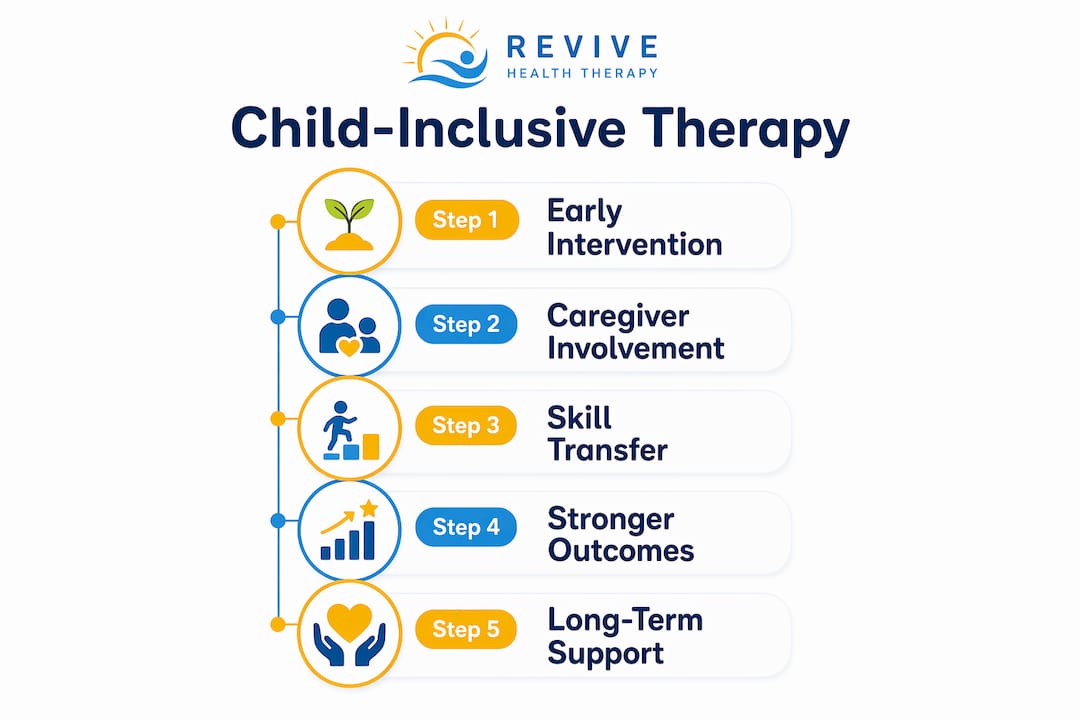
Child-inclusive therapy breaks that silo by design. Caregivers learn the same tools the child is practicing. They understand the language the therapist uses, which means they can prompt and support their child during a meltdown on a Tuesday afternoon, not just during a Thursday session.
The methods used in child-inclusive models also differ. Play, art, and storytelling are central tools because children often cannot articulate complex emotions verbally. A seven-year-old cannot explain attachment disruption, but they can show it through how they play. These creative methods give children a voice without requiring adult-level language.
Key differences between the two models include:
- Caregiver role: Passive observer in traditional therapy vs. active co-participant in child-inclusive therapy
- Skill transfer: Limited to the therapy room vs. practiced and reinforced at home
- Relationship focus: Child-therapist bond only vs. child-caregiver bond strengthened alongside therapy
- Session structure: Child alone vs. mixed individual and joint sessions
- Long-term outcomes: Gains often fade without home reinforcement vs. sustained improvement through caregiver coaching
Pro Tip: When choosing a therapist, look for someone who follows the child’s lead using play-based and tactile methods rather than rigid session scripts. Flexibility in approach signals a therapist who can meet your child where they are developmentally.
When should parents seek child-inclusive therapy?
The decision to seek therapy does not require a crisis. Mental health experts use a three-criteria model to assess when professional support is warranted: frequency, duration, and intensity of the child’s emotional or behavioral concerns.
Frequency asks how often the behavior occurs. Duration asks how long it has been happening. Intensity asks how much it disrupts the child’s daily life, including school, friendships, and family routines. When all three criteria are elevated, therapy is the appropriate next step.
Signs that warrant a professional evaluation include:
- Separation anxiety that prevents the child from attending school or sleeping alone for more than two weeks
- Repetitive behaviors or rituals that the child cannot stop even when distressed
- Persistent sadness, withdrawal, or loss of interest in activities the child previously enjoyed
- Aggressive outbursts that are disproportionate to the trigger and occur multiple times per week
- Physical complaints like stomachaches or headaches with no medical cause, tied to specific stressors
- Regression to earlier behaviors, such as bedwetting or baby talk, after a period of normal development
Early intervention reduces difficulties at home, school, and in peer relationships. Waiting for problems to resolve on their own often allows patterns to become more entrenched. A child who receives support at age seven has a fundamentally different developmental trajectory than one who waits until adolescence.
If you are unsure where to start, a guide on how to choose a child therapist for anxiety or trauma can help you identify the right fit for your family’s specific needs.
What types of child-inclusive therapy exist?
Therapy is not one-size-fits-all. Matching therapy to developmental stage is a clinical requirement, not a preference. A technique that works for a ten-year-old may be completely inappropriate for a four-year-old or a sixteen-year-old.
Play therapy is the primary modality for children under ten. It uses symbolic play to help children process experiences they cannot verbalize. A child who witnessed domestic violence may not be able to say what happened, but they will often show it through play scenarios, giving the therapist a window into their inner world.
Cognitive Behavioral Therapy (CBT) becomes more effective as children develop abstract thinking, typically around age eight or nine. TF-CBT is the trauma-specific version and includes a dedicated caregiver component where parents learn the same coping skills their child is practicing. This parallel structure is what makes it so effective for trauma recovery. You can explore the evidence-based trauma therapy options available in California for a deeper look at how these methods are applied clinically.
Cognitive Analytic Therapy (CAT) is an emerging approach for adolescents. It focuses on self-compassion, relational patterns, and collaborative goal-setting between the teen and therapist. CAT is particularly useful for teens who resist traditional therapy because it positions them as equal partners in the process rather than subjects of treatment.
| Therapy Type | Age Range | Core Method | Caregiver Role | Ideal For |
|---|---|---|---|---|
| Play Therapy | Ages 3–10 | Symbolic play, art, storytelling | Observes and learns at home | Trauma, anxiety, developmental delays |
| TF-CBT | Ages 6–18 | Structured sessions with joint components | Active co-participant | Trauma, PTSD, abuse recovery |
| Standard CBT | Ages 8–18 | Thought-behavior restructuring | Coached on reinforcement | Anxiety, depression, OCD |
| Cognitive Analytic Therapy | Ages 12–18 | Collaborative reflection, self-compassion | Informed and supportive | Relational difficulties, identity issues |
| High-Intensity Behavioral | Ages 2–12 | Intensive structured skill-building | Central to generalization | Autism spectrum disorder |
The right choice depends on your child’s age, the nature of their difficulties, and how much structure they can tolerate. A skilled therapist will assess all three before recommending a modality. The role of parents in therapy also shifts depending on the approach, so understanding your expected involvement upfront helps you prepare.
Key takeaways
Child-inclusive therapy produces stronger, more lasting outcomes than child-only models because caregivers transfer therapeutic skills directly into the home environment.
| Point | Details |
|---|---|
| Caregiver involvement is non-negotiable | TF-CBT and Teaching Recovery Techniques show sustained gains only when parents actively participate. |
| Progress silos are a real risk | Without caregiver coaching, therapy gains often stay limited to the clinical setting and fade at home. |
| Use the three-criteria model | Assess frequency, duration, and intensity of concerns to determine when professional therapy is needed. |
| Match therapy to developmental stage | Play therapy suits younger children; CBT and CAT are more effective for school-age kids and teens. |
| Early intervention changes outcomes | Starting therapy before patterns become entrenched reduces long-term difficulties across all life areas. |
What i’ve learned after years of watching families heal
The most common mistake I see parents make is treating therapy as something that happens to their child rather than with their child. They drop their son or daughter off, sit in the waiting room, and expect to pick up a more regulated child forty-five minutes later. That model misunderstands how emotional healing actually works.
Children do not generalize skills automatically. A child who learns to breathe through anxiety in a therapist’s office will not automatically use that skill during a school test or a sibling conflict. They need a trusted adult to prompt them, model the behavior, and create the conditions where the skill feels safe to try. That adult is you, not the therapist.
The parents who see the most dramatic progress in their children are the ones who show up to sessions, ask questions, and practice the techniques at home. They treat therapy as a family project, not a referral. And the children in those families do not just reduce symptoms. They build genuine resilience.
The uncomfortable truth is that caregiver engagement is also the hardest part. Parents are often exhausted, overwhelmed, and carrying their own unresolved stress. Asking them to be active therapy partners on top of everything else is a real demand. I think it is worth being honest about that rather than pretending participation is easy. If you find yourself struggling to stay engaged, that is worth exploring too, possibly with your own therapist. Resources on life outside the caretaking role can help you reconnect with your own needs so you have more to give.
Therapy is not a quick fix. It is a relational process that unfolds over time. The families who understand that from the start are the ones who stay the course long enough to see real change.
— Amy
How Revivehealththerapy supports your family’s healing
Revivehealththerapy offers specialized child and teen therapy services in California that center caregiver involvement at every stage of treatment. Clinicians at Revivehealththerapy use evidence-based methods including TF-CBT, CBT, and trauma-informed care, matched to your child’s developmental needs and your family’s specific situation.

Sessions are available in person at Walnut Creek and Oakland, as well as via secure telehealth statewide, so geography is not a barrier to getting started. Sliding-scale fees and insurance acceptance, including HSA and FSA plans, make care accessible regardless of income. If you are ready to take the next step, explore why psychotherapy works for children and families, or contact Revivehealththerapy directly to schedule an initial consultation.
FAQ
What is child-inclusive therapy?
Child-inclusive therapy is a treatment model that involves both the child and their caregiver actively in the therapeutic process. The goal is to build emotional regulation and communication skills that transfer from the therapy room to everyday life.
How effective is therapy for children with trauma?
TF-CBT and Teaching Recovery Techniques reduce trauma symptoms by 3–14 points on CRIES scales, with gains sustained at 3–6 month follow-ups. Caregiver participation is the primary factor in maintaining those improvements.
At what age should a child start therapy?
Play therapy is appropriate for children as young as three years old. The right starting age depends on the frequency, duration, and intensity of the child’s emotional or behavioral difficulties rather than age alone.
How do i know if my child needs therapy or just parental support?
Use the three-criteria model: if the behavior is frequent, has lasted more than two weeks, and significantly disrupts school, friendships, or home life, a professional evaluation is the appropriate next step.
What should i look for in a child therapist?
Look for a therapist who uses play-based and flexible methods, involves caregivers directly in sessions, and can explain clearly how they will tailor their approach to your child’s developmental stage and specific needs.
Recommended
- Role of Parents in Therapy: Supporting Child Recovery – ReviveHealthTherapy
- How to Prepare for Child’s First Therapy Session Effectively – ReviveHealthTherapy
- 7 Types of Child Therapy Every Parent Should Know About – ReviveHealthTherapy
- Child therapy guide: what parents need to know – Revive Health Therapy