
TL;DR:
- The therapeutic alliance predicts about 30% of therapy outcomes, as important as technique.
- A strong alliance involves trust, empathy, shared goals, and mutual understanding, regardless of therapy format.
- Involving parents and children enhances alliance effects, and telehealth can build relationships as effectively as in-person therapy.
Most people walk into therapy believing that the right technique will fix everything. Choose CBT, choose EMDR, pick the right diagnosis and the right protocol, and healing follows. But a meta-analysis of 295 studies tells a more surprising story: the relationship between you and your therapist predicts outcomes just as powerfully as any method. Whether you are an adult managing anxiety, a parent searching for a child therapist, or a couple trying to rebuild connection, the therapy alliance is the invisible engine behind real change. This guide explains what that alliance actually is, why it matters across ages and formats, and how to use that knowledge to get the most from therapy in California.
Table of Contents
- What is the therapy alliance and why does it matter?
- How alliances drive success in anxiety, depression, and CBT
- Therapy alliances in child, teen, and family treatment
- Online vs. in-person: Are therapy alliances different in telehealth?
- Why the therapy alliance deserves more attention than technique
- Finding a therapy alliance that works for you in California
- Frequently asked questions
Key Takeaways
| Point | Details |
|---|---|
| Alliance predicts outcomes | A strong therapy alliance accounts for up to 30% of client improvement, more than the therapy technique alone. |
| Works for all ages | Alliance benefits are seen in adults, children, teens, and families, with specific effects depending on who is involved. |
| Telehealth holds up | Alliance quality and its positive impact are just as robust in online therapy as in traditional, in-person settings. |
| Parents matter | For children and teens, parent involvement and ratings play a key role in effective therapy. |
| Building alliance is active | Early focus on mutual trust and goals with your therapist increases the likelihood of positive outcomes. |
What is the therapy alliance and why does it matter?
The word “alliance” gets thrown around a lot in mental health circles, but it is not just a fancy way of saying your therapist is friendly. The therapeutic alliance has three distinct parts: a mutual emotional bond, agreement on the goals of therapy, and shared understanding of the tasks used to reach those goals. All three have to be present. A warm, likable therapist who is steering toward goals you do not care about is not building a true alliance.
This distinction matters because people often confuse rapport with alliance. Rapport is surface-level comfort. Alliance is collaborative. You can enjoy talking to someone without ever feeling that your sessions are moving you forward. The alliance requires both trust and direction.
So how much does it actually matter? The alliance accounts for roughly 30% of change in therapy outcomes according to the common factors model, outperforming the specific technique a therapist uses. That number is striking. Technique matters, but the relationship doing the work around the technique matters just as much, if not more.
The alliance accounts for approximately 30% of therapeutic change, outperforming technique as a predictor of outcome. This is not a minor footnote. It is one of the most replicated findings in psychotherapy research.
Here is how the alliance stacks up against other common predictors:
| Factor | Contribution to outcome |
|---|---|
| Therapeutic alliance | ~30% |
| Specific technique used | ~15% |
| Client factors (motivation, severity) | ~40% |
| Expectancy and placebo effects | ~15% |
The key dimensions of a strong alliance include:
- Trust: Feeling safe enough to be honest about what is and is not working
- Empathy: Knowing your therapist genuinely understands your experience
- Shared goals: Both of you are working toward the same things
- Task agreement: You understand why you are doing the exercises or conversations your therapist suggests
- Repair capacity: When the relationship feels strained, you and your therapist can talk through it
For California residents exploring evidence for online therapy, the alliance holds up in virtual settings too, which we will cover shortly.
How alliances drive success in anxiety, depression, and CBT
Once you understand what the alliance is, the next question is practical: how does it actually function inside real therapy for anxiety, depression, or cognitive behavioral therapy (CBT)?

Research shows that alliance-outcome correlation for anxiety and depression sits at r=0.24 for anxiety and r=0.26 for depression. Those numbers mean that across thousands of clients, a stronger alliance reliably predicted better symptom reduction, regardless of which therapy model was used.
Here is a snapshot of how alliance strength relates to outcomes across common conditions:
| Condition/Context | Alliance-outcome correlation ® |
|---|---|
| Anxiety disorders | 0.24 |
| Depression | 0.26 |
| CBT (all conditions) | ~0.25 |
| Face-to-face therapy overall | 0.278 |
CBT is a structured, skill-building approach that teaches people to identify and challenge unhelpful thought patterns. It is highly effective, but the structure only works when the client actually trusts the process enough to practice it. A weak alliance means a client is less likely to complete homework, less likely to challenge core beliefs honestly, and less likely to return after a difficult session.
Here is how the alliance supports CBT step by step:
- Assessment: The client shares openly because they feel safe, giving the therapist accurate data.
- Goal setting: Agreed-upon targets feel meaningful, not imposed.
- Skill introduction: The client engages with new techniques because they trust the therapist’s judgment.
- Practice and homework: Motivation to try skills outside sessions increases with a stronger bond.
- Review and adjustment: Honest feedback flows both ways, allowing real-time course correction.
This sequence works equally well in online therapy outcomes as it does in person, which removes a common barrier for Californians who cannot easily reach a physical office.
Pro Tip: The alliance tends to be most influential in the earliest sessions. If something feels off in the first two or three meetings, say so directly. Therapists trained in alliance-focused work expect this conversation and will welcome it.
Therapy alliances in child, teen, and family treatment
The alliance’s effects extend across ages, but things work differently when therapy involves children, parents, or whole families. Parents naturally want to know: does the alliance still matter when my child is the one in the room?
The answer is yes, and alliance-outcome effects in children and teens show a meta-analytic effect size of d=0.39, meaning the alliance is a meaningful predictor of improvement for younger clients too. Specifically, when children report feeling connected to their therapist, parents observe reduced irritability and better emotional regulation at home.
There is an important wrinkle, though: in child and family therapy, you are not measuring one alliance but several. The parent-therapist alliance, the child-therapist alliance, and even the co-parent alliance all operate at the same time. Each matters.
Unique benefits of a strong youth therapy alliance include:
- Reduced irritability and emotional outbursts reported by parents
- Higher session attendance and lower dropout rates
- Greater willingness to practice coping skills between sessions
- Improved communication with parents and caregivers
- Better outcomes maintained at follow-up checkpoints
Parent involvement also shapes how the alliance grows. Research shows the parent-therapist alliance increases over time, especially when parents are actively included in sessions or briefings. Understanding why psychotherapy for children matters is a useful first step for families who are new to the process.
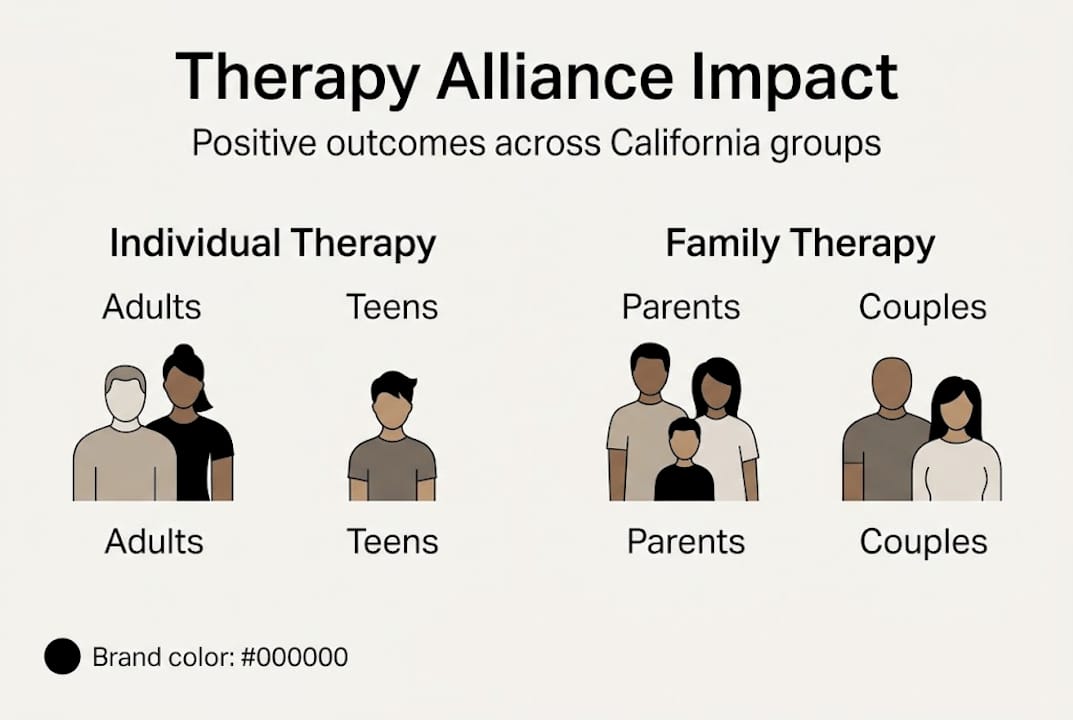
For families navigating this, choosing a child therapist who explicitly discusses alliance-building is worth prioritizing. Similarly, parents supporting teens should know that teen therapy approaches that center the youth-therapist relationship tend to produce stronger voluntary engagement.
In family-involved therapy, the alliance-outcome link in family-involved therapy shows an overall correlation of r=0.183 with outcomes, which is somewhat weaker than individual therapy. This happens partly because split alliances (where the therapist feels closer to one family member than another) can undermine progress.
Pro Tip: As a parent, check in with your child after sessions. A child who is reluctant to return or says “I don’t know” when asked what they talked about is signaling that the alliance may need attention. Both the parent-therapist and child-therapist connections deserve regular check-ins.
For parents wondering how to best support children in therapy, staying curious and non-pressuring about session content signals safety to your child. It also strengthens the whole relational system around the therapy.
Online vs. in-person: Are therapy alliances different in telehealth?
Given today’s popularity of telehealth, does the alliance hold up outside the traditional therapy room? Many California clients and parents wonder whether a screen creates distance that hurts the relationship.
The data is reassuring. Alliance strength: online vs. in-person shows nearly identical correlations: online therapy produces an alliance-outcome correlation of r=0.275 compared to r=0.278 for face-to-face. That difference is statistically negligible.
| Setting | Alliance-outcome correlation ® |
|---|---|
| Face-to-face therapy | 0.278 |
| Online/telehealth therapy | 0.275 |
| Difference | 0.003 (negligible) |
Alliance quality in telehealth is effectively equivalent to in-person therapy. For California clients who choose to work remotely, the relationship with your therapist can be just as strong and just as predictive of good outcomes.
The CAMFT ethics promote evidence-based practice and competence in telehealth, meaning California therapists are held to professional standards that support high-quality care in virtual formats as well as traditional ones.
Practical tips for building a strong alliance in telehealth sessions:
- Choose a private, quiet space for every session
- Use a stable video platform with good lighting so nonverbal cues are visible
- Tell your therapist early if you feel disconnected or the format is not working
- Keep your camera on as much as possible to maintain presence
For couples especially, telehealth for couples therapy has shown strong alliance outcomes when both partners treat the session with the same intentionality they would bring to an in-person appointment. And for anyone still weighing formats, understanding the benefits of telehealth can help you make a confident, informed choice.
Why the therapy alliance deserves more attention than technique
Here is something most people never hear in a therapist’s waiting room: the causality of the alliance-outcome link is bidirectional. That means a strong alliance reduces symptoms, and fewer symptoms strengthen the alliance. The relationship and the healing feed each other. You cannot separate them the way you can separate a prescription from a diagnosis.
Yet most conversations about therapy focus almost entirely on method. Should I try CBT or EMDR? Should I look for a trauma specialist? These are real questions. But they sometimes distract from a more immediate question: do I actually feel safe with and understood by this person?
The tendency to chase the perfect modality also reflects something true of clinical training. Therapists learn techniques in detail and may underestimate how much of their effectiveness comes from who they are in the room, not what they do. Clients and parents routinely rate the alliance higher than therapists themselves do, suggesting therapists sometimes miss how much the relationship means.
In couples’ alliance work, this matters even more. The within-couple bond, who feels heard, who feels blamed, who trusts the process, shapes outcomes in ways that no checklist captures. Alliance is not a technique. It is a living dynamic that requires attention from the first session onward.
Finding a therapy alliance that works for you in California
Understanding the alliance is only useful if it changes what you do next. At ReviveHealthTherapy, we build sessions around evidence-based care that places the therapist-client relationship at the center, not as an afterthought.
Whether you are exploring why seek psychotherapy for the first time, looking for teen therapy for your adolescent, or trying to figure out which therapy options in California fit your situation, our therapists in Walnut Creek, Oakland, and across California via telehealth are ready to help you build that foundation. Sliding-scale fees and insurance acceptance mean you do not have to choose between affordability and quality care. Reach out today to take the first step.
Frequently asked questions
How soon does the therapy alliance impact outcomes?
The early alliance is vital and often predicts later improvement within the first few sessions, making early honesty with your therapist especially valuable.
Does alliance matter if I choose online therapy?
Alliance strength online is nearly identical to in-person therapy, so choosing telehealth does not weaken the relationship’s impact on your outcomes.
How can parents tell if their child’s alliance with a therapist is strong?
Watch for your child’s willingness to attend sessions, openness at home, and reduced irritability, since child-reported alliance is a reliable sign of a working therapeutic relationship.
Are there special rules about alliances for therapists in California?
CAMFT ethics on professional relationships stress professionalism and evidence-based competence, which supports alliance-centered practice without explicitly mandating specific relationship benchmarks.
What if alliance ratings between client and therapist don’t match?
Client and parent ratings of alliance are often higher than therapist ratings, with only moderate convergence, so rater discrepancies in alliance are common and best addressed through direct, open conversation with your therapist.
Recommended
- Psychotherapy in California 2026: Evidence & Options – Revive Health Therapy
- Defining therapy outcomes: clear measures for real progress – Revive Health Therapy
- How therapists guide self-discovery for growth in California – Revive Health Therapy
- Why Is Therapy Accessible for Californians Today – ReviveHealthTherapy
- Why Naming Your Feelings Helps — The Caia Journal
2 Responses