
TL;DR:
- Trauma manifests through sleepless nights, tense shoulders, and feelings of internal brokenness, impacting every aspect of life. Healing is possible by starting with safety, trauma screening, support, and evidence-based therapies like EMDR or CBT. A trauma-informed environment at home, school, and community is essential for lasting recovery and meaningful change.
Trauma doesn’t announce itself with a warning label. It shows up in sleepless nights, tense shoulders, arguments that come from nowhere, and a creeping sense that something is permanently broken inside you. Trauma can affect mental health, relationships, and daily functioning in ways that ripple far beyond the original event. Whether you’re an adult in California managing anxiety or depression, a parent worried about your child, or a couple trying to find solid ground again, healing is absolutely possible. This guide gives you practical, evidence-backed steps to start recovery with clarity, not confusion.
Table of Contents
- Understanding trauma and its effects
- Getting started: Safety, support, and trauma screening
- Step-by-step: Key phases of trauma recovery
- Special considerations: Children, families, and couples in trauma recovery
- Why lasting trauma recovery requires a trauma-informed culture
- Take the next step: Find support for trauma recovery in California
- Frequently asked questions
Key Takeaways
| Point | Details |
|---|---|
| Start with safety | Creating a safe and supportive environment is the first step in trauma recovery. |
| Screening is vital | Trauma screening and connecting to evidence-based interventions drive the best results, especially for children. |
| Follow evidence-based steps | Recovery improves significantly when using proven methods and structured support. |
| Involve family and peers | Family engagement and peer support accelerate and sustain healing for individuals of all ages. |
| Sustain trauma-informed culture | Trauma recovery works best when trauma-informed values are present at home, at school, and in the community. |
Understanding trauma and its effects
Trauma is not just one thing. It can come from a single devastating event, like a car accident or natural disaster, or it can build slowly over years of emotional neglect, domestic abuse, or chronic stress. What all traumatic experiences share is this: they overwhelm your nervous system’s ability to cope. And when that happens, the effects spread into every part of your life.
Adults often experience symptoms like hypervigilance (being constantly “on alert”), emotional numbness, intrusive memories, or sudden bursts of anger. Children show trauma differently. You might notice regression to earlier behaviors, sleep disturbances, school avoidance, or aggressive outbursts that seem disconnected from anything obvious. Couples sometimes find that trauma creates walls between partners, making intimacy and trust feel impossible even when both people genuinely love each other.
Here’s a quick look at how trauma symptoms tend to differ across groups:
| Group | Common symptoms |
|---|---|
| Adults | Anxiety, depression, flashbacks, emotional numbness, irritability |
| Children | Nightmares, regression, school problems, clingy or withdrawn behavior |
| Couples | Communication breakdown, emotional distance, conflict escalation |
| Families | Role confusion, difficulty setting boundaries, generational stress patterns |
Understanding these distinctions matters because healing looks different for each group. A one-size-fits-all approach often misses the mark entirely.
One of the most important frameworks for healing is trauma-informed care. This model recognizes that a person’s history of trauma shapes how they experience the world, and it builds support around five core principles. Trauma-informed care is based on safety, trustworthiness, empowerment, collaboration, and peer support. These aren’t just abstract values. They translate into practical actions, like never forcing a child to talk about something before they’re ready, or always explaining what a therapist will do before doing it.
“Healing begins when people feel safe enough to tell their story on their own terms.”
When you’re looking for a therapist or program, ask directly whether they use trauma-informed principles. It makes a measurable difference in whether you or your child will feel safe enough to make real progress. You can also explore the healing trauma steps outlined by experienced clinicians as a starting framework for what to expect.
Now that you know trauma’s profound effects, let’s look at what you need to start your healing journey.
Getting started: Safety, support, and trauma screening
Before you can process trauma, you need to feel safe. That sounds simple, but it’s one of the most underestimated parts of recovery. For adults, safety means having a stable living situation, trusted people in your life, and a therapist you genuinely feel comfortable with. For children, it means predictable routines, a calm caregiver, and a school environment that doesn’t add more stress.
Here’s a side-by-side look at what “getting started” typically involves for different groups:
| Starting point | Adults and couples | Children and families |
|---|---|---|
| Primary need | Emotional safety and open communication | Caregiver stability and routine |
| First professional step | Intake assessment with a therapist | Trauma screening by a qualified professional |
| Support network | Friends, peer groups, couples counselor | School counselors, pediatricians, family therapists |
| Best first action | Identify triggers, begin self-monitoring | Parent education on trauma symptoms |
For children specifically, starting with a formal trauma screening is not optional. It’s essential. Trauma screening is a crucial first step for children, and connecting families to evidence-based services leads to measurably better outcomes. Skipping this step often means kids get generic support that doesn’t address the root cause, and their symptoms continue or worsen.
Here are five concrete steps to get started:
- Identify whether you or your child feel emotionally safe in your current living and relational environment.
- Talk to a primary care physician or therapist about a formal trauma screening, especially for children under 18.
- Build a small, trusted support network of two to three people you can be honest with.
- Learn the language of trauma by reading reliable resources or attending a family psychoeducation group.
- Schedule an initial therapy consultation to understand what treatment options are available to you.
Pro Tip: If you’re a parent trying to figure out where to start, learning how to evaluate a therapist first saves enormous time and emotional energy. Resources like choosing a child therapist and supporting kids in therapy can make this process far less overwhelming.
For adults and couples, the starting point is often simply agreeing to get help together. Research consistently shows that having even one person actively support your recovery dramatically improves outcomes. If your partner is willing to attend a few sessions with you, that shared commitment can change the entire trajectory of healing.
Step-by-step: Key phases of trauma recovery
Now that you’re ready with the right supports, let’s break down the recovery process into clear, practical steps.
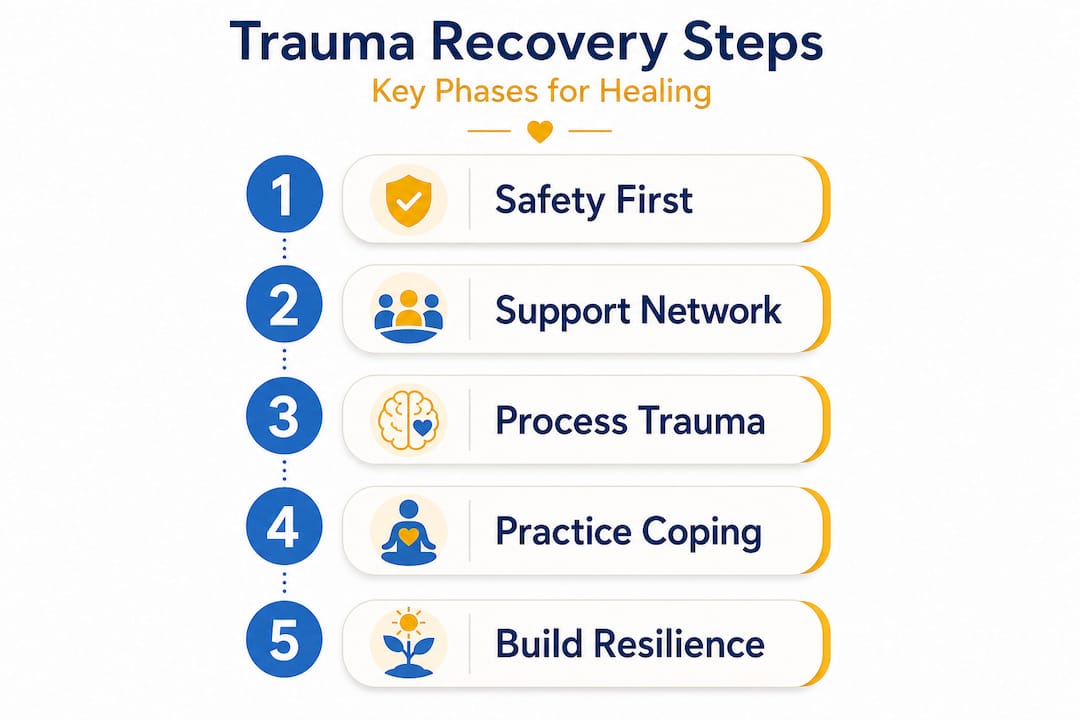
Trauma recovery isn’t a straight line. But research and clinical experience have identified a general sequence that works for most people. Think of it in three broad phases: establishing safety, processing the trauma, and rebuilding daily life. These phases can overlap, and you may move back and forth between them. That’s normal. It’s not a sign that you’re failing.
Here’s a practical sequence to follow:
- Establish physical and emotional safety. This means removing or reducing ongoing sources of harm and stress. For couples, this might mean agreeing to pause conflict escalation using specific cool-down strategies.
- Begin working with a trained therapist who uses approaches like EMDR (Eye Movement Desensitization and Reprocessing), CBT (Cognitive Behavioral Therapy), or somatic therapy. Learn more about evidence-based trauma therapy and which method might fit your situation best.
- Build daily coping skills. These are tools like grounding exercises, breathing techniques, and mindfulness tools that reduce emotional flooding during the day.
- Process traumatic memories gradually, with professional guidance. This is where therapies like EMDR do their heaviest work, reducing the emotional charge attached to memories.
- Reconnect with meaningful activities and relationships. This phase is about reintegration, rebuilding a sense of purpose, identity, and connection after trauma has disrupted them.
- Maintain and monitor. Recovery isn’t static. Regular check-ins with your therapist, honest self-assessment, and a plan for managing setbacks keep you on track.
The data on recovery outcomes is genuinely encouraging. Adults who received blended care for anxiety or depression showed recovery or reliable improvement in over 81% of cases, even among those not receiving additional therapy simultaneously. That’s a meaningful benchmark. If you engage consistently with evidence-based treatment, most people see real, measurable change.
Recovery benchmark: Over 81% of adults in blended care for anxiety or depression showed reliable improvement. This includes people with moderate to severe symptoms at the start of treatment.
Pro Tip: Don’t wait until you feel “ready” to start therapy. Most people never feel fully ready. The act of showing up is itself part of the healing. Explore available trauma therapy options in California and pick one that fits your schedule and budget.
Mindfulness deserves special mention here. It’s not a replacement for therapy, but it is one of the most well-researched tools for reducing reactivity and building emotional tolerance. Practices as simple as five minutes of focused breathing daily can make it easier to stay present during difficult conversations or therapy sessions.
Special considerations: Children, families, and couples in trauma recovery
Having outlined the recovery steps for individuals, let’s look at how families and couples can make these steps most effective for children or partners.
Children don’t recover from trauma in isolation. They recover inside relationships. The quality of a caregiver’s response to a traumatized child has an enormous influence on how quickly and completely that child heals. When parents are calm, consistent, and emotionally available, kids feel safe enough to process difficult experiences.
Here are some key things to keep in mind for families:
- Parental involvement is not optional. Parents who attend therapy sessions alongside their children, or who participate in parent coaching, produce significantly better outcomes than parents who drop their child off and wait in the lobby.
- Normalize emotional conversations at home. Children who hear adults name emotions out loud (“I felt frustrated today, and here’s what I did about it”) learn to do the same.
- Watch for secondary trauma in parents. Caregivers often absorb their child’s distress. This is called secondary traumatic stress, and it’s real. Parental support in therapy is part of comprehensive family care, not an add-on.
- Use school counselors as allies. California schools increasingly have trauma-informed staff who can support children’s recovery during the school day.
- Be patient with timelines. Children’s healing is rarely linear, and pushing for fast resolution often creates more resistance.
For parents wondering where to start, children’s therapy options in California range from play therapy for younger children to trauma-focused CBT for older kids and teens. Understanding why psychotherapy matters for children’s development can also help parents make the case to skeptical family members.
Connecting children to evidence-based supports rather than general advice is specifically emphasized by California trauma specialists, because generic strategies often miss what kids actually need.
One sobering statistic is worth noting: only 12.9% of veterans initiate evidence-based PTSD treatment within 21 months of a diagnosis, and retention in therapy stays under 50%. While this data focuses on veterans, it reflects a broader challenge. Starting treatment is hard. Staying in treatment is harder. This is why building a support system around your recovery from the beginning, not after you’ve already hit a wall, matters so much.
Pro Tip: For couples navigating trauma together, try scheduling a weekly 20-minute “connection check-in” where each partner shares one feeling and one need without interruption. This simple structure builds the communication safety that trauma often strips away.
Why lasting trauma recovery requires a trauma-informed culture
Here’s something that often gets left out of step-by-step recovery guides: the steps only stick when the environment around you supports them.
We’ve seen this pattern repeatedly. Someone does excellent work in therapy, builds real insight, and develops strong coping skills. Then they go home to a household where emotional vulnerability is treated as weakness, or they return to a school where teachers still use shame-based discipline. And slowly, the gains erode.
That’s because trauma recovery isn’t just an individual project. It’s a relational and community one. Trauma-informed approaches rely on safety, trust, collaboration, empowerment, and peer support at every level of a person’s environment. That means therapy, yes, but also parenting, classrooms, workplaces, and community spaces.
When families use trauma-informed values daily, such as validating emotions without judgment, setting predictable expectations, and sharing power in decision-making, they create conditions where professional therapy gains actually hold. When schools and workplaces adopt these same values, recovery becomes something a person is supported in everywhere, not just for 50 minutes a week in a therapist’s office.
This is why we believe that finding trauma-informed therapists is only the first layer of building a sustainable recovery. The second layer is bringing those values into your daily relationships and asking the people in your life to understand and honor them too. That’s not a soft idea. It’s the hard, practical work that separates short-term relief from lasting change.
Take the next step: Find support for trauma recovery in California
Taking the first step toward professional support is one of the most meaningful decisions you can make for your mental health and relationships.
At Revive Health Therapy, we work with adults, children, teens, couples, and families across California, offering both in-person therapy in Walnut Creek and Oakland, as well as secure telehealth sessions statewide. Our clinicians use evidence-based methods including EMDR, CBT, and mindfulness, grounded in trauma-informed principles. Learn more about the trauma-informed therapy benefits that make our approach effective for so many Californians. Whether you’re seeking mental health services for adults or specialized mental health services for children, we offer sliding-scale fees and accept most insurance plans, including HSA and FSA. You don’t have to navigate this alone.
Frequently asked questions
What is trauma-informed care and why is it important?
Trauma-informed care is an approach grounded in safety, trust, empowerment, peer support, and collaboration designed to provide healing support without causing further harm or retraumatization.
How should parents in California start trauma recovery for their child?
Begin with a formal trauma screening through a qualified professional, then connect with evidence-based services recommended by California childhood trauma specialists for the best outcomes.
Does therapy really help adults recover from trauma, anxiety, or depression?
Yes. Adults in structured, blended care programs show recovery or improvement in over 81% of cases, which is a strong benchmark for what’s achievable with consistent, evidence-based support.
What can couples do if both partners have experienced trauma?
Couples benefit most from joint counseling that uses trauma-informed communication strategies and specialized therapies focused on rebuilding emotional safety, trust, and genuine mutual support between partners.
How long does it take to see results from trauma-focused therapy?
Timelines vary widely depending on the person, trauma type, and consistency of treatment. Notably, retention in PTSD therapy stays below 50%, which is why early commitment and consistent attendance make a critical difference in how quickly you see meaningful results.
Recommended
- Healing Trauma Process 2026: Step-by-Step Recovery Guide – ReviveHealthTherapy
- Role of Therapy in Trauma Recovery: Evidence and Impact – ReviveHealthTherapy
- Step-by-step EMDR guide for teens: trauma recovery made simple – Revive Health Therapy
- 7 Effective Types of Trauma Therapy for Recovery – ReviveHealthTherapy