
Mental health parity means your health plan cannot treat mental health or substance use disorder (MH/SUD) benefits more harshly than it treats comparable medical or surgical benefits. If your plan covers both, the rules for accessing mental health care must be no more restrictive than the rules for accessing a broken arm or a cardiac procedure. Three things to check right now: (1) Does your plan cover MH/SUD services at all? (2) Have you requested your plan’s medical necessity criteria in writing? (3) If you’ve been denied, call the DOL/EBSA Benefits Advisor at 1-866-444-3272. NAMI also offers free consumer guidance on navigating parity claims.
Key Takeaways
Federal parity law requires that when a plan covers mental health or substance use disorder benefits, those benefits must be subject to no more restrictive financial requirements or treatment limits than comparable medical/surgical benefits.
| Point | Details |
|---|---|
| Parity means equal treatment | MH/SUD benefits cannot face stricter limits than comparable medical/surgical benefits in the same plan. |
| Coverage is not guaranteed | Parity applies only if your plan already covers MH/SUD benefits; it does not force plans to add them. |
| Request the NQTL analysis | Ask your plan administrator in writing for the comparative NQTL analysis — plans must provide it. |
| Save every denial document | Keep EOBs, denial letters, and provider notes; you need them for an internal appeal or agency complaint. |
| Know who to call | DOL/EBSA (1-866-444-3272) for ERISA plans; your state insurance commissioner for fully insured plans. |
Table of Contents
- What explaining mental health parity actually means under U.S. law
- Which health plans must follow parity rules
- What parity actually requires your plan to do
- How to spot a parity violation in your own plan
- Step-by-step: how to appeal a denial or file a parity complaint
- How state parity laws can give you stronger protections
- How your clinician can strengthen your appeal
- Why parity law matters more than most people realize
- Authoritative resources to consult
- Sources
What explaining mental health parity actually means under U.S. law
Three federal laws form the backbone of mental health parity law in the United States.
Three federal agencies share enforcement. The Department of Labor (DOL) / Employee Benefits Security Administration (EBSA) oversees ERISA-covered private employer plans. HHS and CMS cover marketplace plans, non-Federal governmental plans, and Medicaid managed care. The Treasury/IRS handles tax-code compliance for employer plans. The CRS report on mental health parity notes that federal parity rules do not force any plan to offer MH/SUD benefits — but once a plan does offer them, parity prohibits more restrictive limits. The statutory language lives at 26 USC 9812.
Which health plans must follow parity rules
Most Americans with employer-sponsored or marketplace coverage are protected. Here is a quick checklist:
- Large group employer plans generally follow MHPAEA parity rules.
- Self-insured employer plans fall under MHPAEA via ERISA, with federal, not state, enforcement.
- Individual and small-group marketplace plans are required to offer MH/SUD coverage with parity.
- Some non-Federal governmental plans are subject to parity, with limited opt-outs.
- Medicaid managed care and CHIP have parity rules.
- Medicare Advantage plans must follow parity rules.
- Retiree-only, dental, vision plans, and very small plans are usually exempt.
One distinction worth understanding: fully insured plans (where an insurance company carries the risk) are regulated by both federal law and state insurance departments. Self-insured plans (where the employer carries the risk) are governed almost entirely by federal ERISA law, which means your state insurance commissioner has no jurisdiction over them. If you’re not sure which type you have, check your Summary Plan Description (SPD) or ask HR.
Parity applies only when the plan actually covers MH/SUD benefits. As NAMI explains, a plan can comply with parity requirements even if the coverage amounts are limited — parity ensures equal treatment for MH/SUD benefits relative to medical/surgical benefits within the plan, not a guarantee of benefit generosity.
What parity actually requires your plan to do
Parity rules cover four categories of limits, tested across six benefit classifications.
The four limit types:
- Aggregate lifetime and annual dollar limits: Plans cannot impose dollar caps on MH/SUD benefits if they don’t impose the same caps on medical/surgical benefits.
- Financial requirements: Copays, coinsurance, and deductibles for MH/SUD cannot exceed those applied to medical/surgical benefits in the same classification.
- Quantitative Treatment Limits (QTLs): Day and visit limits (e.g., “20 therapy visits per year”) must be no more restrictive than limits on comparable medical/surgical benefits.
- Non-Quantitative Treatment Limitations (NQTLs): Prior authorization requirements, step therapy protocols, medical necessity criteria, network admission standards, and geographic limits all count as NQTLs. These are where most parity violations actually occur.
The six benefit classifications (plans test parity within each one separately):
- In-network inpatient
- Out-of-network inpatient
- In-network outpatient
- Out-of-network outpatient
- Emergency care
- Prescription drugs
The “predominant” test for financial requirements and QTLs works like this: look at what the plan charges for the majority of medical/surgical benefits in a classification. MH/SUD benefits in that same classification cannot cost more or have tighter limits. CMS explains that when a plan covers MH/SUD benefits it generally cannot impose financial requirements or treatment limitations that are more restrictive than those applied to medical/surgical benefits.
NQTLs deserve special attention. Under the CAA 2021, plans must perform a written comparative analysis showing that the processes, strategies, and factors used to apply an NQTL to MH/SUD benefits are comparable to those used for medical/surgical benefits. CMS FAQs detail the required content for these analyses and explain that parity compliance depends on both the plan’s written terms and how the plan operates in practice. You can request this analysis from your plan administrator.
Pro Tip: Ask your plan for its NQTL comparative analysis in writing. Plans are required to provide it to participants upon request. If the plan refuses or cannot produce one, that itself is a red flag worth reporting to DOL/EBSA.
How to spot a parity violation in your own plan
Most parity problems show up in one of four patterns. Run through this checklist against your own plan documents:
- You pay a higher copay or coinsurance for a therapy visit than for a primary care visit in the same network tier.
- Your plan requires prior authorization for outpatient mental health sessions but not for comparable outpatient medical visits.
- Your plan limits therapy to a set number of visits per year but imposes no comparable visit cap on physical therapy or other outpatient medical services.
- Your insurer denied a claim as “not medically necessary” but never gave you the criteria it used to make that determination.
- Your plan’s in-network mental health provider directory is noticeably smaller or more outdated than its medical provider directory. Even when an insurer is compliant on paper, a network lacking available providers can create a de facto parity problem. NAMI notes that consumers should document such issues if filing complaints.
Documents to collect and save:
- Explanation of Benefits (EOB) statements for every denied or partially paid claim
- The denial letter, including the specific reason and any clinical criteria cited
- Your plan’s Summary Plan Description (SPD) and Summary of Benefits and Coverage (SBC)
- Provider notes and treatment plans from your clinician
- Any written communication with the insurer’s customer service
Questions to ask your insurer’s customer service:
- “What are the specific medical necessity criteria you used to deny this claim?”
- “Does this plan require prior authorization for outpatient mental health visits? Does it require the same for outpatient medical visits?”
- “Can you send me the plan’s NQTL comparative analysis?”
Step-by-step: how to appeal a denial or file a parity complaint
Step 1: File an internal appeal with your insurer. Submit a written appeal within the deadline stated in your denial letter (typically 180 days for ERISA plans). Include your EOBs, the denial letter, your provider’s treatment plan and letter of medical necessity, and a written comparison showing that the plan applies the disputed restriction to MH/SUD but not to comparable medical/surgical services.
Step 2: Request external review. If your internal appeal fails, most plans must offer independent external review. For ERISA plans, federal external review standards apply. For fully insured plans, your state’s external review process governs. External reviewers are independent of the insurer and their decisions are generally binding.
Step 3: File a complaint with the right agency. The right door depends on your plan type:
- ERISA-covered private employer plan: Contact DOL/EBSA at 1-866-444-3272 or file online at dol.gov/ebsa. Tri-agency reviews and increased auditing described in CRS reporting mean federal agencies are actively reviewing NQTL documentation.
- Fully insured state-regulated plan: File with your state insurance commissioner.
- Marketplace plan: Contact CMS at cms.gov or call the Health Insurance Marketplace at 1-800-318-2596.
- Medicaid: Contact your state Medicaid agency.
Keep copies of everything you submit and note the date and name of every person you speak with.
How state parity laws can give you stronger protections
Federal parity law is a floor, not a ceiling. States can require broader mental health coverage, narrower exemptions, or additional consumer protections — and many do.
- California, for example, has state-level parity rules and consumer protections that often exceed federal minimums, including requirements around insurance and telehealth access that affect how plans must cover remote therapy.
- Some states mandate coverage of specific conditions or treatment modalities that federal law does not require.
- State laws can narrow the exemptions that federal law allows (for example, some states apply parity to smaller employer groups than federal law covers).
- For fully insured plans, state rules and federal rules both apply; the more protective rule governs.
- Self-insured ERISA plans are generally preempted from state insurance regulation, so federal law is the primary protection for those employees.
To find your state’s specific rules, visit your state insurance department’s website. NAMI maintains state-level parity summaries that are a practical starting point. The impact of insurance design on California families illustrates how state-level rules translate into real coverage differences.
How your clinician can strengthen your appeal
A treating clinician’s documentation is often the difference between a successful appeal and a dead end. Here is what a clinician can provide:
- Letter of medical necessity: States the diagnosis, the recommended level of care, the evidence-based rationale (citing clinical guidelines such as those from the American Psychiatric Association), and why a lower level of care would be clinically insufficient.
- Treatment plan: Documents measurable goals, frequency of sessions, and expected duration — the kind of specificity that matches insurer clinical-criteria language.
- Progress notes: Show clinical changes over time and justify continued treatment.
- Prior authorization support letter: Addresses the plan’s specific denial reason directly, using the plan’s own medical necessity language where possible.
- Superbill: For out-of-network reimbursement, a superbill with the correct CPT and ICD-10 codes lets you submit claims directly to your insurer. This is worth doing even when you pay out of pocket, because a denied out-of-network claim can still be appealed as a parity violation.
Clinicians who mirror insurer clinical-criteria language — citing evidence-based guidelines, clearly stating level-of-care justification, and documenting measurable clinical changes — materially improve appeal outcomes, per DOL/EBSA consumer guidance.
Pro Tip: Ask your clinician to request the plan’s medical necessity criteria on your behalf before writing the appeal letter. Framing the clinical narrative to match the plan’s own language is far more persuasive than a generic letter.
Why parity law matters more than most people realize
Parity law is genuinely important. But it is also genuinely limited, and conflating the two leads people to give up when they shouldn’t or to expect protections that don’t exist.
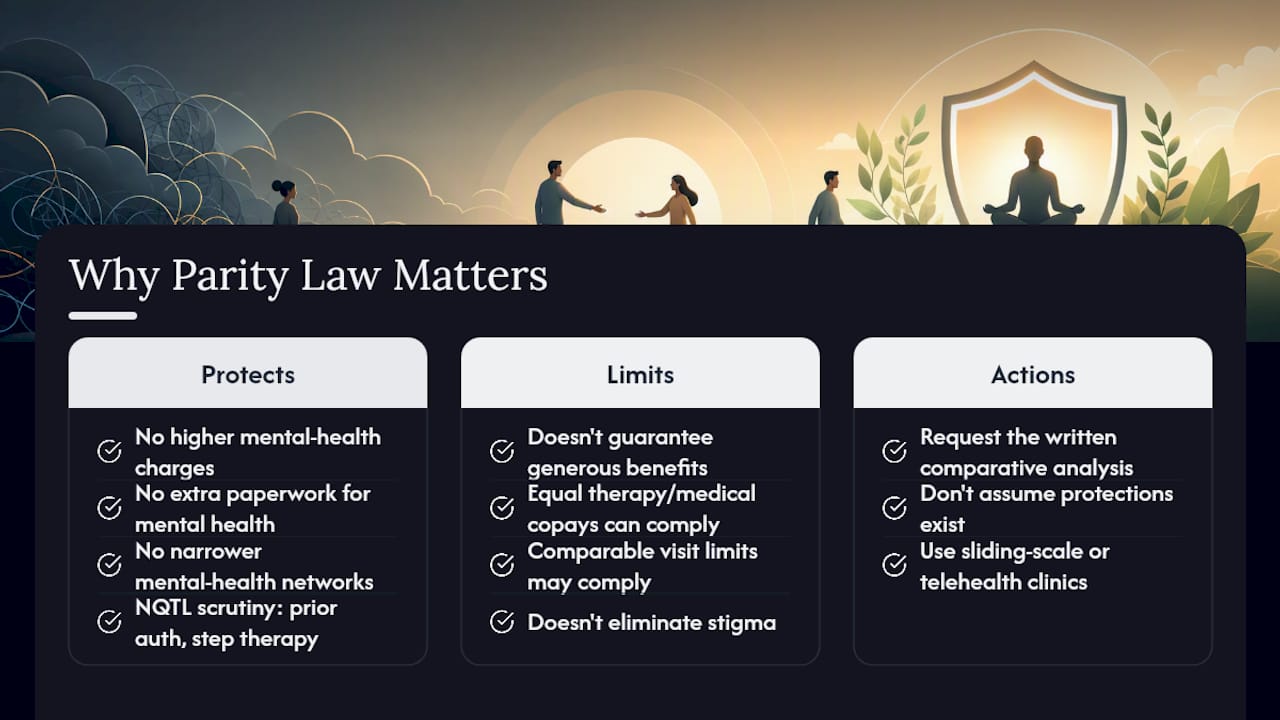
The law does not guarantee generous benefits. A plan with a therapy copay equal to the medical copay generally complies with parity requirements. Similarly, visit limits for therapy are parity-compliant if medical visit limits are comparable. Parity prohibits unequal treatment such as higher charges, more paperwork, or narrower networks specifically for mental health care.
The place where parity law has the most real-world bite is NQTLs. Prior authorization requirements, step therapy protocols, and medical necessity criteria have historically been applied far more aggressively to mental health care than to comparable medical care. The CAA 2021’s requirement for written comparative analyses was designed precisely to surface those disparities and force plans to justify them. Requesting that analysis is the single most powerful consumer action most people never take.
Parity also doesn’t solve stigma or provider shortages. Research from the OECD shows that barriers to mental health access include social determinants and stigma, extending beyond insurance design alone. Legal coverage is necessary but not sufficient, which explains the existence of clinics like Revivehealththerapy, offering sliding-scale fees and telehealth statewide, alongside the legal framework.
Authoritative resources to consult
| Resource | What it provides |
|---|---|
| DOL/EBSA Consumer Guide | Plain-English parity overview, six benefit classifications explained, EBSA Benefits Advisor phone (1-866-444-3272) |
| CMS MHPAEA Page | Agency explanation of core parity rules for marketplace and non-Federal governmental plans |
| CMS MHPAEA FAQs Part 45 | Detailed guidance on NQTL comparative analysis content requirements and agency review standards |
| NAMI Parity Consumer Page | Practical consumer guidance, state parity summaries, and how to check your coverage |
| CRS Report R47402 | Congressional Research Service overview of federal parity law, statutory tests, and agency oversight |
This article provides general information about U.S. federal mental health parity law and is not a substitute for legal or professional advice. Confirm current rules with the relevant federal agency or a qualified benefits attorney.
Sources
- Understanding Your Mental Health and Substance Use Disorder Benefits | U.S. Department of Labor
- The Mental Health Parity and Addiction Equity Act (MHPAEA) | CMS
- Mental Health Parity and Coverage in Private Health Insurance (CRS report)
- What is Mental Health Parity? | NAMI
- MHPAEA FAQs (CMS/CCIIO) — Part 45
Recommended
- Insurance & Mental Health Access: 85% CA Telehealth Coverage – ReviveHealthTherapy
- Affordable Mental Health Care – Why It Changes Lives – ReviveHealthTherapy
- Why mental health accessibility in California boosts recovery 50% – ReviveHealthTherapy
- Sliding Scale Therapy: Making Mental Health Affordable – ReviveHealthTherapy