
TL;DR:
- Family psychotherapy treats the family as a system, improving communication and resolving conflicts by changing interaction patterns. It offers measurable benefits like reduced stress, enhanced family functioning, and stronger emotional bonds, supported by extensive research. Access to evidence-based family therapy in California involves in-person or telehealth options tailored to specific relational and emotional challenges.
Many families assume that mental health support means one person sitting alone with a therapist. That assumption leaves entire households stuck in the same cycles of conflict, disconnection, and unspoken hurt. Family psychotherapy treats the family as a system, improving communication, resolving conflicts, and addressing issues like anxiety and trauma by changing how family members interact rather than focusing only on one person’s internal struggles. This article walks you through how the approach works, what the research says about outcomes, how it compares to other treatments, and how California families can access these services today.
Table of Contents
- How family psychotherapy works: Beyond individual treatment
- Evidence-based methodologies in family psychotherapy
- How psychotherapy improves family outcomes: Proven results
- Comparing family therapy to other treatments: What the evidence shows
- Our perspective: What most families miss about psychotherapy’s true impact
- Exploring next steps: Accessing family psychotherapy in California
- Frequently asked questions
Key Takeaways
| Point | Details |
|---|---|
| Families work best as systems | Psychotherapy treats the family unit to resolve conflict and emotional issues more effectively than focusing only on individuals. |
| Evidence supports family therapy | Statistical research shows clear improvements in caregiver burden, distress, and relationships following family psychotherapy. |
| Variety of approaches | Different methodologies like CBT, EFT, and Family Systems Theory address unique needs for California families. |
| Know the limitations | Family therapy is not universally superior; effectiveness depends on context, and telehealth may present challenges. |
| Accessible support available | California families can find therapy services tailored to their needs—many options exist for in-person and online care. |
How family psychotherapy works: Beyond individual treatment
When one person in a family is struggling, the whole household feels it. A teenager with anxiety withdraws, a parent with unresolved trauma overreacts, a couple caught in constant arguments pulls the emotional energy away from the children. Individual therapy can help each person separately, but it often misses the invisible web of interactions that keeps problems alive.
Family psychotherapy works differently. Rather than isolating the “problem person,” it examines the patterns, roles, and communication habits that the entire family has built over time. Family therapy for teens, for example, doesn’t just treat the teen. It brings parents and siblings into the room because their responses and relationships are part of what’s maintaining the teen’s distress.
The systemic approach to therapy recognizes that anxiety, trauma, and emotional challenges don’t live inside one person in isolation. They live in the space between people. A parent who grew up in a chaotic household may unconsciously recreate that chaos at home, not because they want to, but because the pattern feels familiar. Family therapy surfaces those patterns, names them, and gives everyone tools to respond differently.
Key benefits families notice from this approach include:
- Improved communication, where family members learn to express needs without blame or withdrawal
- Reduced frequency and intensity of conflicts, as new patterns replace old reactive ones
- Stronger emotional support within the family unit, so members feel less isolated in their struggles
- Clearer boundaries and roles, which reduce confusion and resentment over time
- Faster progress for children and teens when parents are actively engaged in the therapeutic process
“Therapy isn’t about fixing the broken person in the room. It’s about changing the room itself so everyone inside it has space to heal.”
These outcomes are not anecdotal. They are grounded in decades of clinical research and practice, which we’ll explore in the sections that follow.
Evidence-based methodologies in family psychotherapy
Not all family therapy looks the same. Therapists trained in different approaches bring different tools to the session, and the right fit depends on what your family is dealing with. Understanding these methods helps you ask better questions and feel more confident walking into the process.
Common methodologies include Family Systems Theory, Emotionally Focused Therapy (EFT), Cognitive Behavioral Therapy (CBT), Strategic Family Therapy, and communication-based techniques like active listening and boundary setting.
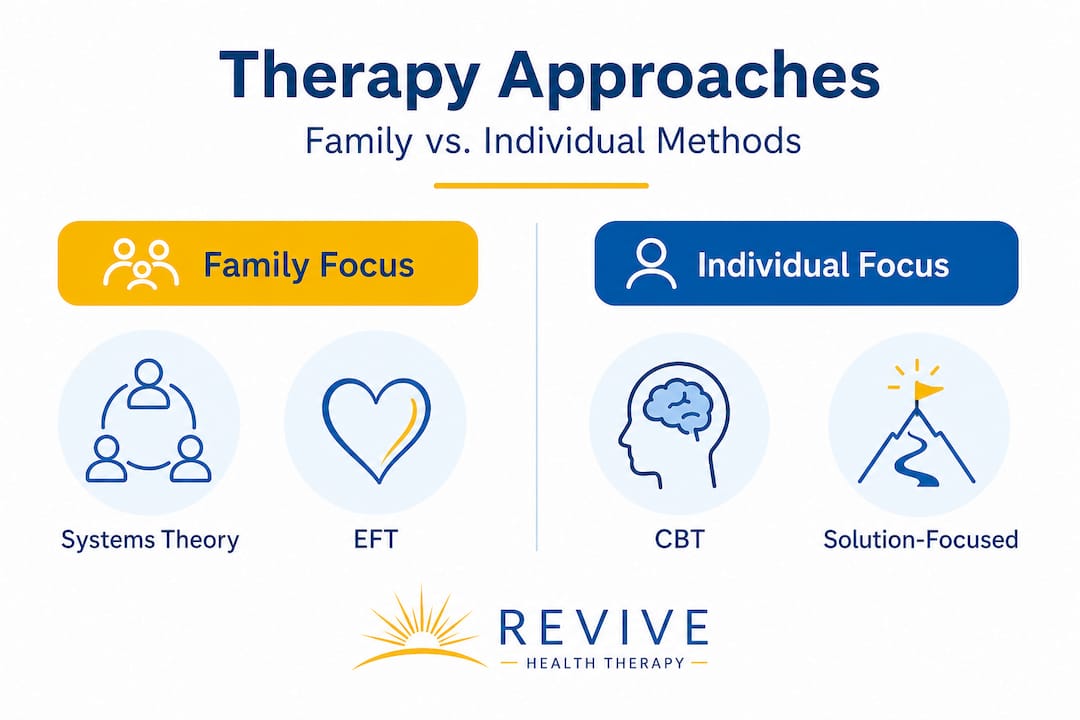
Here’s a comparison of the most commonly used approaches:
| Approach | Best suited for | Key techniques |
|---|---|---|
| Family Systems Theory | Generational patterns, roles, triangles | Genograms, circular questioning, reframing |
| Emotionally Focused Therapy (EFT) | Attachment issues, couples, emotional distance | Identifying attachment cycles, restructuring bonds |
| Cognitive Behavioral Therapy (CBT) | Anxiety, depression, behavioral issues | Thought records, behavioral experiments, exposure |
| Strategic Family Therapy | Communication breakdowns, rigid roles | Reframing, directives, structural shifts |
| Narrative Therapy | Identity, trauma, shame | Externalizing problems, reauthoring stories |
Understanding which method fits your situation matters. A family dealing with a child’s anxiety will likely benefit most from CBT-based family therapy, which helps parents understand how their responses can either calm or escalate a child’s fear response. A couple navigating emotional disconnection after years of conflict will often see the most sustained results with EFT.
Here’s a practical sequence for how a family might move through evidence-based therapy:
- Assessment phase (1-3 sessions): The therapist gathers history, identifies patterns, and helps the family understand the relational system at play.
- Skill-building phase (4-10 sessions): The family learns specific communication tools, conflict de-escalation strategies, and emotional regulation techniques.
- Restructuring phase (ongoing): Old patterns are actively challenged and replaced with new ways of interacting.
- Consolidation phase (final sessions): Progress is reviewed, relapse prevention is discussed, and the family develops a plan for maintaining gains independently.
You can also explore the full range of family therapy types used in California to understand what each approach targets specifically.
Pro Tip: Before your first session, write down two or three specific situations where your family gets stuck. Bringing concrete examples, not vague descriptions like “we don’t communicate well,” helps your therapist identify patterns faster and saves valuable session time.
For couples within the family context, marriage counseling modalities often overlap with family therapy methods, especially when parental conflict is affecting children’s emotional wellbeing.
How psychotherapy improves family outcomes: Proven results
Here’s where the conversation gets concrete. Families often wonder whether therapy will actually make a measurable difference. The answer, backed by strong empirical data, is yes, particularly for specific issues like psychosis-related caregiver stress, youth behavioral challenges, and couples work.

Empirical research on family therapy shows significant effect sizes across several domains:
| Outcome measured | Effect size | What this means |
|---|---|---|
| Carer burden reduction | g = 0.68 | Substantial reduction in stress for family caregivers |
| Psychological distress | g = 0.35 | Moderate improvement in overall emotional wellbeing |
| Patient hospitalization | g = 0.52 | Notable reduction in crisis-level events |
| Family functioning (youth) | ES = 0.46 | Moderate gains in how families operate together |
| EFT recovery for couples | 70-75% | Most couples show sustained emotional reconnection |
These numbers matter because they move family therapy from “maybe this could help” into the category of clinically supported treatment. A reduction in caregiver burden means a parent who has been running on empty starts showing up differently at the dinner table. A moderate improvement in family functioning for youth means a child who was escalating in school has a more stable emotional foundation at home.
Families dealing with these specific challenges tend to see the clearest benefits:
- Anxiety in children and teens, especially when parents learn how to respond in ways that don’t inadvertently reinforce avoidance
- Post-trauma relational strain, where one family member’s trauma has rippled into everyone’s daily interactions
- Adolescent behavioral issues, where family dynamics play a direct role in maintaining problematic patterns
- Caregiver burnout, particularly in families supporting a member with a serious mental health condition
For families navigating anxiety-driven avoidance, family therapy adds a layer of support that individual treatment simply cannot replicate. And when a child has experienced trauma, choosing the right child therapist for trauma who incorporates family members into the healing process significantly strengthens long-term outcomes.
Research on edge cases in family therapy also highlights situations where family therapy shows particular strength, including complex relational trauma and cases where individual therapy has stalled.
Comparing family therapy to other treatments: What the evidence shows
Family therapy doesn’t exist in a vacuum. Families often ask whether it’s better than individual therapy, whether it works for depression, or whether the benefits last. These are fair questions, and the honest answer is layered.
| Comparison | Family therapy | Individual therapy |
|---|---|---|
| Relational issues | Strong evidence | Limited (focuses on one person’s perspective) |
| Depression | Mixed evidence | Stronger, more consistent evidence |
| Trauma recovery | Strong for relational trauma | Strong for personal trauma processing |
| Youth behavioral issues | Strong when family engaged | Moderate without family involvement |
| Long-term gains | Sustained with EFT, moderate others | Variable by modality |
Current Cochrane-level evidence suggests family therapy performs better than no treatment, but compares roughly equally to other active treatments in the short term. In areas like depression, study heterogeneity makes it harder to draw clean conclusions. This does not mean family therapy fails at depression. It means the research picture is still developing and that individual CBT or medication may sometimes need to run alongside family work.
“The goal is rarely to choose one approach over another. The most effective treatment is usually the one that matches the specific problem and the specific family.”
Pro Tip: If your family has tried individual therapy for one member without lasting results, that’s often a signal to bring the relational context into treatment. A therapist who can assess whether systemic factors are maintaining the problem may unlock progress that wasn’t possible before.
Evidence suggests online therapy can be highly effective and accessible, though research on edge cases notes that videoconferencing can reduce immersion for multi-person sessions, which is worth considering when deciding between telehealth and in-person family sessions.
CBT for adolescents also benefits significantly when parents are included in the treatment process, reinforcing the idea that family involvement is an asset across many modalities, not just those explicitly labeled “family therapy.”
Our perspective: What most families miss about psychotherapy’s true impact
Most families come to therapy looking for relief from symptoms. The teenager stops acting out. The couple stops fighting. The anxiety calms down. Those are real and valuable goals, and family therapy consistently helps achieve them. But focusing only on symptom relief misses what therapy is actually building.
In our experience, the families who get the most lasting value from psychotherapy are the ones who treat it as an investment in relational capacity, not just a fix for a current crisis. When a family learns to sit with discomfort without escalating, that skill doesn’t expire when the sessions end. When a parent learns to stay regulated during a child’s emotional storm, every future storm is navigated better. These are not small things.
There’s also a common tendency for families to drop out of therapy once the immediate pain decreases. The conflict cools, the teen seems calmer, and the sessions start to feel less urgent. This is exactly the point where the deepest work becomes possible. The child therapy steps that move from symptom reduction toward genuine resilience require consistency through that less dramatic middle phase.
We also want to name something uncomfortable: therapy works better when every person in the room is honest about their own role in the problem. Families sometimes unconsciously assign the “sick” label to one member and show up expecting that person to be fixed. But if the patterns in the home helped create or maintain the distress, all members need to be willing to look at their own contributions. That kind of accountability isn’t a sign of blame. It’s the entry point to real change.
Finally, outcomes in family psychotherapy are not solely dependent on the methodology. The therapeutic relationship, consistency of attendance, and the willingness to practice new behaviors between sessions all predict results as strongly as which specific technique is being used. Therapy is not a passive process. The families who commit to it, even when it’s uncomfortable, are the ones who transform.
Exploring next steps: Accessing family psychotherapy in California
For families ready to take the next step, here’s how to access effective and evidence-based therapy options.
At Revive Health Therapy, we work with families across California who are navigating anxiety, trauma, communication breakdowns, and relational conflict. Our therapists use evidence-based approaches including EMDR, CBT, and EFT, with trauma-informed care woven into every session.

We offer in-person sessions in Walnut Creek and Oakland, as well as secure telehealth for families throughout California. Sliding-scale fees and insurance acceptance, including HSA and FSA plans, make our services accessible regardless of income level. Whether you’re seeking mental health services for adults or mental health services for children, our team can match your family with the right fit. Reach out to Revive Health Therapy today to schedule a consultation and take the first step toward lasting change.
Frequently asked questions
What issues can family psychotherapy address?
Family psychotherapy is effective for communication issues, conflict, anxiety, trauma, and other emotional challenges within family units, treating the entire relational system rather than a single individual.
Does family therapy work for trauma?
Research shows family therapy improves relational outcomes after trauma, often more effectively than individual therapy alone when the trauma has disrupted family bonds and communication.
How long does it take to see results from family psychotherapy?
Families often notice moderate improvements within a few sessions, and EFT recovery rates for couples show 70 to 75 percent of cases achieving sustained emotional gains over the course of treatment.
What are the limitations of family psychotherapy?
Effectiveness varies by issue, and heterogeneity in depression studies means the evidence base for family therapy as a standalone depression treatment is less consistent than for relational or behavioral challenges.
Is online (telehealth) family therapy as effective as in-person?
Telehealth significantly improves access, but videoconferencing challenges such as reduced immersion can affect the depth of multi-person family sessions, making in-person attendance worth considering when possible.
Recommended
- Psychotherapy in California 2026: Evidence & Options – Revive Health Therapy
- Mental health tips for families in California 2026 – ReviveHealthTherapy
- How to Choose a Therapist in California for Lasting Change – ReviveHealthTherapy
- CBT for families: how therapy helps California families – Revive Health Therapy