
TL;DR:
- Therapy outcomes are measurable changes in symptoms and well-being, not just feelings.
- Regular assessments using standardized tools guide treatment decisions and track progress.
- Evidence-based, outcome-informed care improves results and makes therapy more accessible and effective.
Most people start therapy hoping to “feel better,” but few know how to tell if that’s actually happening. Feeling better is real, but it’s also vague. Science has a more precise answer. Therapists use standardized, evidence-based tools to track your progress at every stage of treatment, turning what feels like a subjective journey into something measurable and transparent. This guide breaks down exactly what therapy outcomes mean, how they’re defined, and how you can use that knowledge to stay informed and empowered throughout your own recovery.
Table of Contents
- What are therapy outcomes and why do they matter?
- How are therapy outcomes measured? Understanding metrics and benchmarks
- Key outcome types: Improvement, recovery, remission, and deterioration
- California context: Evidence-based care, access, and affordability
- Myths versus reality: What truly predicts therapy outcomes?
- Our perspective: Moving beyond checklists—personalizing therapy outcomes in California
- Connect with real progress: Find your fit with California therapy
- Frequently asked questions
Key Takeaways
| Point | Details |
|---|---|
| Clear measurement is key | Reliable improvement, recovery, and remission use standardized, trackable tools for real progress. |
| Evidence-based care works | Therapy using MBC and matched methods leads to 75-85% improvement for most in California. |
| Telehealth is effective | Online and in-person evidence-based therapy yield similar outcomes when best practices are followed. |
| Monitor for early warning signs | 5-10% may worsen, but ongoing measurement allows for prompt adjustment and safer care. |
What are therapy outcomes and why do they matter?
Therapy outcomes are not just a feeling. They are measurable changes in your mental health, functioning, and overall well-being that occur over the course of treatment. When your therapist tracks outcomes, they’re looking for concrete shifts in symptoms, behaviors, and quality of life, not just your general mood on a given day.
Understanding outcomes matters for several reasons. First, it keeps therapy honest. Without defined goals and metrics, sessions can drift without clear direction. Second, it sets realistic expectations. You and your therapist agree on what “getting better” actually looks like before you start. Third, it creates accountability on both sides. If something isn’t working, the data shows it early enough to change course.
According to standardized outcome metrics, therapy outcomes fall into four main categories:
- Reliable improvement: A statistically meaningful positive change in symptoms
- Recovery: Scores move into the non-clinical range, meaning symptoms are no longer at a level that indicates a disorder
- Remission: Symptoms drop below clinical cutoff thresholds
- Deterioration: A measurable worsening of symptoms that needs immediate attention
These categories aren’t just clinical jargon. They give both you and your therapist a shared language for progress. When you know what “recovery” means in measurable terms, you stop guessing and start tracking.
“Measurement-based care transforms therapy from a conversation about feelings into a structured, data-informed process where both client and therapist can see exactly what’s changing and why.”
For many Californians, access to this kind of structured care has historically been limited by cost or geography. That’s why accessible therapy in California and affordable mental health care are not just nice ideas. They’re essential for making outcome-based treatment available to everyone who needs it.
How are therapy outcomes measured? Understanding metrics and benchmarks
Knowing that outcomes exist is one thing. Understanding how they’re actually tracked is where things get practical. The gold standard today is Measurement-Based Care (MBC), a system where patient-reported outcome measures (PROMs) are collected regularly throughout treatment and used to guide clinical decisions in real time.

The repeated use of PROMs like the PHQ-9 for depression and the GAD-7 for anxiety gives therapists a running record of your symptom levels across sessions. These aren’t one-time assessments. They’re ongoing check-ins that create a data trail.
Here’s a quick look at the most common tools:
| Tool | What it measures | Format |
|---|---|---|
| PHQ-9 | Depression severity | 9-item questionnaire |
| GAD-7 | Anxiety severity | 7-item questionnaire |
| PCL-5 | PTSD symptoms | 20-item checklist |
| OQ-45 | Overall functioning | 45-item self-report |
Once scores are collected, therapists use specific benchmarks to interpret them:
- Reliable Change Index (RCI): Determines whether a score change is statistically meaningful or just normal variation
- Clinical cutoff scores: Thresholds that separate clinical from non-clinical symptom levels
- Effect sizes: Measure the magnitude of change across a group or population
Pro Tip: Ask your therapist to share your PROM scores with you after each assessment. Seeing your own data can be motivating and helps you stay engaged in your treatment goals.
Research shows that blended care improvement rates reach 75 to 85% for anxiety and depression when MBC is used consistently. That’s a powerful number. It means that structured, tracked therapy is not just theory. It delivers results for the vast majority of people who engage with it.
For a deeper look at how the process works from start to finish, the step-by-step therapy process is a helpful resource. And if you’re wondering how online therapy tools in California fit into this picture, the short answer is: they work just as well.
Key outcome types: Improvement, recovery, remission, and deterioration
Now that we’ve covered the tools, let’s look closer at the different types of outcomes you and your therapist will monitor, both the success stories and the challenges.
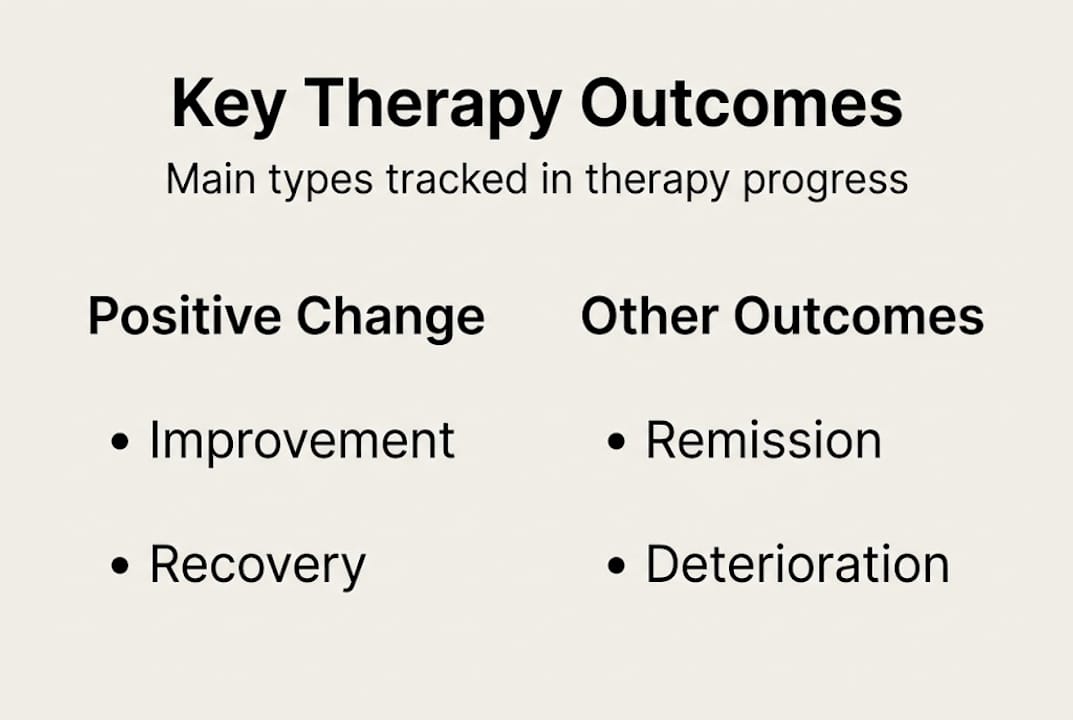
Reliable improvement means your scores have changed enough to be statistically significant. It’s not just a good week. It’s a real shift that goes beyond normal fluctuation. This is usually the first milestone clients hit.
Recovery goes further. Your scores have moved into the non-clinical range, meaning your symptoms are no longer at a level that would typically indicate a disorder. This is the goal for most people entering therapy.
Remission is closely related but slightly different. Your symptoms have dropped below clinical cutoffs, but you may still be in treatment to maintain those gains and prevent relapse.
Here’s a side-by-side comparison:
| Outcome type | What it means | Typical sign |
|---|---|---|
| Reliable improvement | Statistically significant positive change | Score drops meaningfully on PHQ-9 or GAD-7 |
| Recovery | Scores reach non-clinical range | Below disorder threshold |
| Remission | Symptoms below clinical cutoff | Sustained low scores |
| Deterioration | Reliable worsening of symptoms | Scores increase significantly |
Deterioration is the outcome nobody wants to talk about, but it’s critical to understand. Research shows that 5 to 10% of clients experience reliable worsening during therapy. This doesn’t mean therapy failed. It means the current approach needs adjustment, and MBC catches it early enough to act.
Key signs that deterioration may be occurring include:
- Consistent score increases on your PROM assessments
- New or worsening symptoms between sessions
- Feeling more distressed after sessions rather than gradually more settled
Pro Tip: Deterioration is not a reason to quit therapy. It’s a signal to have an honest conversation with your therapist about adjusting your treatment plan. Choosing the right therapist from the start can reduce this risk significantly.
For those exploring affordable therapy options, understanding these outcome types helps you ask better questions when evaluating providers.
California context: Evidence-based care, access, and affordability
Understanding outcome types is meaningful when you see how these measurements shape access and treatment for people in California.
California has made significant investments in structured mental health care. Through programs like DHCS BH-CONNECT, the state actively promotes MBC and evidence-based practices across public and private mental health systems. The goal is to ensure that more Californians receive treatment that is not just available but actually proven to work.
Here’s what that looks like in practice:
- Telehealth parity: Research confirms telehealth and in-person therapy are equally effective when evidence-based methods are used
- Sliding scale fees: Many providers, including community mental health centers and private practices, offer income-adjusted pricing
- Insurance coverage: California law requires most insurance plans to cover mental health services at the same level as physical health
- HSA/FSA eligibility: Therapy costs often qualify for tax-advantaged spending accounts, reducing out-of-pocket costs
Statistic spotlight: Up to 85% of clients in blended care programs achieve reliable improvement for anxiety and depression. That benchmark is not just a national average. California providers using MBC are meeting and exceeding it.
For residents navigating mental health accessibility in California, these structures matter enormously. Cost and distance have historically kept people from getting consistent, outcome-tracked care. Telehealth removes the distance barrier, and sliding scale fees address the cost barrier.
If you’re considering telehealth services in California, know that you’re not sacrificing quality for convenience. The outcomes data supports it fully.
Myths versus reality: What truly predicts therapy outcomes?
Now let’s dispel some common myths and highlight the actual ingredients for therapy success.
Myth 1: One type of therapy is always better than others.
The reality is more nuanced. The “dodo bird verdict” in psychotherapy research suggests that most evidence-based therapies produce roughly equivalent results for common conditions like depression and general anxiety. The technique matters less than you think for most cases.
Myth 2: A good therapist is just someone you like talking to.
Therapeutic alliance, meaning the quality of the working relationship between you and your therapist, is one of the strongest predictors of outcome. But alliance alone isn’t enough. It works best when combined with structured, evidence-based methods and regular outcome tracking.
“The most powerful therapy isn’t the most sophisticated technique. It’s the right relationship, the right method, and a commitment to measuring what’s actually changing.”
Here’s what the evidence says actually predicts good outcomes:
- A strong therapeutic alliance built on trust and clear communication
- Use of evidence-based, symptom-matched treatment modalities (CBT for anxiety, EMDR for trauma, etc.)
- Regular outcome measurement that allows for real-time adjustments
- Client engagement and willingness to practice skills outside of sessions
- Provider training and ongoing supervision
For those wondering how to find the right fit, choosing a therapist in California walks through exactly what to look for in a provider who uses outcome-informed care.
Our perspective: Moving beyond checklists—personalizing therapy outcomes in California
Standardized tools are essential. The PHQ-9 and GAD-7 give us an anchor, a shared baseline that keeps care honest and trackable. But we’ve seen firsthand that the numbers only tell part of the story.
A client can score in the “recovered” range and still feel like something important is missing. Another person might show modest score changes but describe their life as fundamentally transformed. That gap between the metric and the lived experience is where real clinical skill lives.
The future of therapy outcomes isn’t just better tools. It’s better integration of those tools with the personal goals, cultural context, and real-world circumstances of each client. Measurement should serve the person, not define them.
We believe that why accessibility boosts recovery is inseparable from outcome quality. When people can actually get to care consistently, when cost and distance aren’t obstacles, the data improves because engagement improves. Outcomes are not just a clinical question. They’re a justice question too.
Connect with real progress: Find your fit with California therapy
If you’ve read this far, you now understand more about therapy outcomes than most people who’ve been in treatment for years. That knowledge is valuable. It means you can walk into a first session asking the right questions, knowing what to track, and understanding what real progress looks like.

At ReviveHealthTherapy, we use evidence-based methods including EMDR, CBT, and mindfulness, paired with ongoing outcome tracking, so you always know where you stand. We offer both in-person sessions in Walnut Creek and Oakland and secure telehealth across California, with sliding scale fees and insurance acceptance to keep care accessible. Whether you’re exploring reasons to seek psychotherapy, comparing evidence-based therapy options, or ready to start, you can connect with a therapist today.
Frequently asked questions
What are the main ways therapy outcomes are measured?
Therapy outcomes are tracked using standardized tools like PROMs, including the PHQ-9 and GAD-7, alongside metrics such as reliable improvement, recovery, and clinical cutoff scores.
Can telehealth therapy be as effective as in-person therapy in California?
Yes. Telehealth and in-person therapy produce equivalent outcomes when evidence-based practices are consistently applied, making telehealth a fully valid option for Californians.
What should I do if I’m not seeing improvement in therapy?
Bring your PROM scores to your therapist and ask about adjusting your treatment plan. MBC detects non-responders early so your care can be modified before things stall further.
What percentage of people see improvement from therapy?
Research shows 75 to 85% improvement rates for anxiety and depression in blended, evidence-based care programs that use measurement-based approaches.
Are there any risks or negative outcomes from therapy?
Approximately 5 to 10% of clients experience reliable worsening, but consistent outcome monitoring makes it possible to catch and address this early in the process.
Recommended
- Therapy for Teens: Key Approaches and Real Impact – ReviveHealthTherapy
- Step by step therapy guide for Californians 2026 – ReviveHealthTherapy
- Therapeutic modalities explained: 35% better outcomes in 2026 – ReviveHealthTherapy
- Step-by-step couples therapy guide for lasting connection – Revive Health Therapy
One Response