
TL;DR:
- Therapeutic boundaries are essential structures that promote safety, trust, and deep emotional healing. They are agreements that define physical, temporal, relational, financial, and digital aspects of the relationship, facilitating vulnerability without harm or confusion. Clear boundaries improve therapy outcomes across conditions like anxiety, depression, and trauma, supporting clients’ growth and well-being.
Most people assume that boundaries in therapy are about keeping you at arm’s length from your therapist. This couldn’t be further from the truth. In reality, therapeutic boundaries are the very structure that makes deep, honest, and transformative work possible. They signal safety, build trust, and define the relationship so that both you and your therapist can focus on what matters most: your emotional growth and healing. This article breaks down what therapy boundaries actually are, why they directly improve outcomes for anxiety, depression, and trauma, and how to recognize when they’re working well or falling short.
Table of Contents
- What are boundaries in therapy and why do they matter?
- Types of boundaries in therapy: What clients should expect
- How boundaries support healing from anxiety, depression, and trauma
- Therapist self-care: Why boundaries protect both client and provider
- What happens when boundaries are violated? Navigating complexity
- A new perspective: Why flexible boundaries often foster deeper healing
- Next steps: Finding boundary-respecting therapy in California
- Frequently asked questions
Key Takeaways
| Point | Details |
|---|---|
| Boundaries foster safety | Clear boundaries in therapy create a predictable, safe frame for emotional healing. |
| Types of boundaries | Physical, time, relational, financial, and digital boundaries each serve a vital role in therapy spaces. |
| Better outcomes for clients | Respecting boundaries supports emotional regulation, deeper connection, and improved anxiety and depression outcomes. |
| Therapist wellness matters | Healthy therapist boundaries prevent burnout and ensure ethical, effective care for all. |
| Violations require action | Noticing or experiencing boundary violations should prompt conversation, clarification, or changing providers for safety. |
What are boundaries in therapy and why do they matter?
Boundaries in therapy aren’t walls. They’re agreements. They define the structure of the relationship between you and your therapist so that genuine vulnerability can happen without confusion, discomfort, or harm. Think of them as the container that holds all your hardest feelings safely.
Boundaries in therapy create a safe, predictable frame for vulnerability, covering physical, temporal, relational, financial, and digital aspects. Each of these categories addresses a specific way that the therapeutic relationship could become unclear or unsafe. When each type is defined and respected, you spend less mental energy wondering what’s appropriate and more energy actually healing.
Here’s a quick overview of the five core types:
- Physical boundaries: Personal space, appropriate touch, and the physical environment of sessions
- Temporal boundaries: Session start and end times, scheduling policies, and cancellation procedures
- Relational boundaries: Limits on personal relationships outside of therapy and therapist self-disclosure
- Financial boundaries: Fee agreements, payment policies, and handling financial hardship
- Digital boundaries: Contact methods, response times, and social media policies
Understanding the therapy session structure is closely linked to understanding boundaries, because both contribute to the predictability that makes the therapeutic environment feel safe. Predictability isn’t boring. In mental health care, it’s one of the most powerful therapeutic tools available.
“A clearly defined therapeutic frame isn’t a sign of emotional distance. It’s the foundation that allows intimacy, vulnerability, and healing to take root.” — Clinical ethics perspective
A common myth is that boundaries make therapy feel cold or mechanical. In fact, the opposite is true. Research consistently shows that clients who understand and trust the structure of their therapeutic relationship report higher satisfaction, deeper engagement, and stronger outcomes. Boundaries aren’t barriers to connection. They’re the scaffolding that makes real connection possible.
| Boundary type | Why it matters | Example in practice |
|---|---|---|
| Physical | Maintains comfort and safety | No uninvited touch; defined personal space |
| Temporal | Creates reliability and structure | Sessions begin and end on time, every time |
| Relational | Prevents role confusion | No social contact outside of sessions |
| Financial | Removes financial stress from healing | Agreed-upon fees, sliding scale options |
| Digital | Manages expectations outside sessions | Clear policy on texting or email contact |
Types of boundaries in therapy: What clients should expect
With a foundation for why boundaries matter, let’s get specific: What actual rules and expectations are part of most therapy experiences?
Boundaries aren’t one-size-fits-all. They’re shaped by your therapist’s theoretical orientation, your specific needs, and the legal and ethical guidelines governing licensed mental health professionals in California. That said, there are consistent patterns you should expect in virtually every professional therapeutic relationship.
Here are the most common areas where healthy boundaries show up in regular sessions:
- Time: Your session starts at the agreed time and ends on schedule. This isn’t rigidity for its own sake. It’s respect for both your time and the work you’re doing together.
- Confidentiality: What you share stays in the therapy room, with defined legal exceptions like imminent danger or child abuse reporting mandates in California.
- Fee handling: You receive a clear fee agreement upfront, including policies for late cancellations or missed sessions, so finances never become a source of hidden tension.
- Outside contact: Most therapists define specific channels for communication between sessions, typically email or a client portal, and set realistic response expectations.
- Self-disclosure: A skilled therapist shares personal information only when it serves your therapeutic goals, not their own emotional needs.
Therapists use a decision-making process to distinguish beneficial boundary crossings from harmful violations. A “boundary crossing” isn’t automatically negative. A therapist who offers a brief supportive touch after a major breakthrough, or who shares a personal insight to normalize your experience, may be making a clinically sound choice. The key question is: does this serve the client?
Pro Tip: When you start with a new therapist, ask them directly about their policies on communication, cancellations, and what to do if you ever feel uncomfortable with something. A therapist who answers these questions openly is demonstrating exactly the kind of transparency that makes therapy work.
Building a therapeutic connection with boundaries in place isn’t a contradiction. In skilled hands, boundaries actually deepen the relationship by making it clear, honest, and mutually respectful.
How boundaries support healing from anxiety, depression, and trauma
Knowing the forms boundaries take, let’s see how they actually help you achieve better emotional health results.
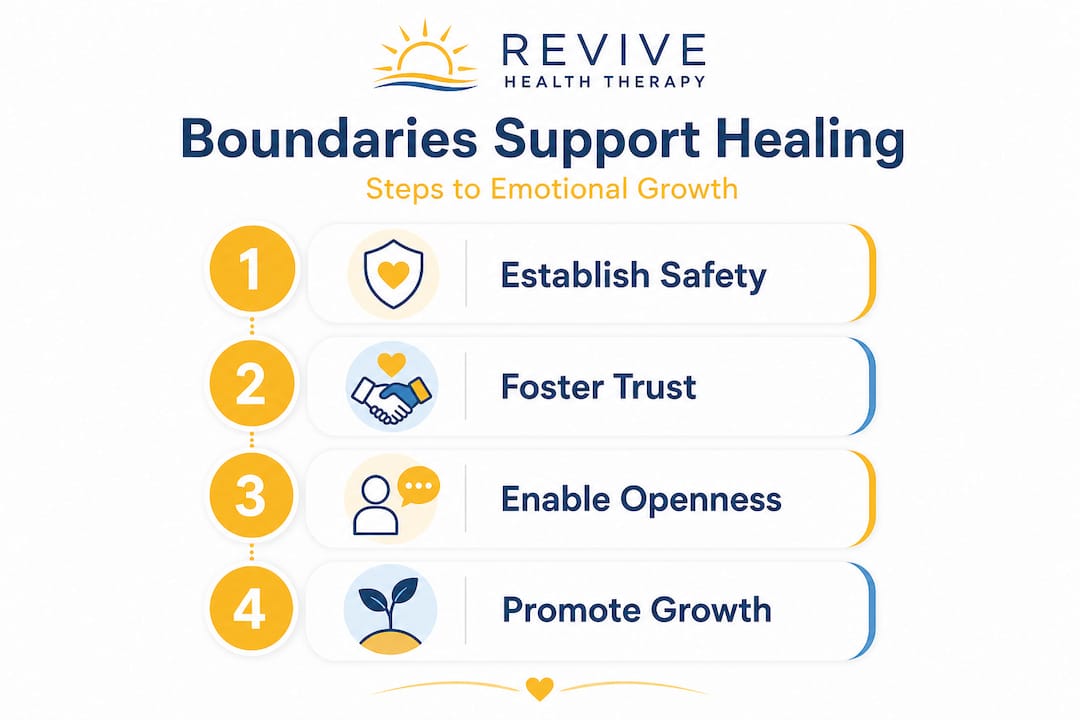
When you’re dealing with anxiety, the unpredictability of the world already feels overwhelming. A therapy relationship that’s consistent, structured, and reliable gives your nervous system a break. You know what to expect when you walk through the door or log on to your telehealth session. That predictability is more than comforting. It’s actively therapeutic.

Boundaries in trauma-focused work foster safety, emotional regulation, and help manage relational instability before trauma processing begins. This matters enormously for anyone working through complex trauma or PTSD. You can’t safely revisit traumatic memories if your nervous system doesn’t feel stable in the present moment. Boundaries create that stability.
Here’s how boundaries help in specific contexts:
- Anxiety: Consistent session timing and clear communication policies reduce the cognitive load of uncertainty, freeing mental bandwidth for actual therapeutic work.
- Depression: Knowing the relationship is defined and protected from outside complications helps counter the isolation that depression often reinforces.
- Trauma recovery: Clear relational and physical boundaries signal that this relationship is different from the ones that may have caused harm, building the felt sense of safety that trauma processing requires.
Strong research backs this up. Relational depth predicts reductions in depression symptoms (r=.060) and anxiety symptoms (r=.050), showing that the quality and structure of the therapeutic relationship directly affects symptom relief. This isn’t just clinical theory. It’s measurable, real-world impact.
For those exploring trauma therapy options, the structured nature of evidence-based approaches like EMDR and CBT inherently relies on clear boundaries to guide the pacing of treatment. You can learn more about the role of therapy in trauma recovery and how these frameworks create the safety necessary for lasting change.
Pro Tip: If you’re in therapy for trauma and feel like the work is moving too fast, naming that discomfort is itself a healthy use of the therapeutic boundary. You have the right to pace the process. A skilled therapist will welcome this feedback.
Therapist self-care: Why boundaries protect both client and provider
Therapists, just like clients, need boundaries for healthy and effective work. Here’s why it matters for everyone in the room.
When a therapist’s boundaries are weak or unclear, the ripple effects reach you directly. Burnout is not just a personal problem for the clinician. It’s a clinical quality problem that affects every client that therapist sees.
Healthy therapist boundaries reduce burnout risk, and this is urgent: over 50% of early-career psychologists report burnout, which is mitigated significantly by value-based boundary-setting. This statistic reflects a systemic challenge in the mental health field, and it’s one reason understanding burnout in therapy matters for clients as well as providers.
“A therapist who cannot maintain their own emotional wellbeing cannot fully hold space for yours. Therapist self-care is an ethical obligation, not a luxury.”
Here’s what strong therapist boundary-setting looks like in practice:
- Clear caseload limits: Accepting only as many clients as they can serve with full presence and energy
- Supervision and consultation: Regularly debriefing with colleagues or supervisors rather than carrying secondary trauma alone
- Time limits on after-hours contact: Protecting personal time so they show up fresh and focused for every session
- Setting relational limits: Not allowing client relationships to blur into friendships or dual roles that compromise objectivity
When your therapist maintains these practices, you benefit directly. Their focus is sharper, their empathy is more sustainable, and their clinical judgment stays clear. Mutual respect for boundaries isn’t one-sided. It’s a shared foundation for effective, ethical care.
What happens when boundaries are violated? Navigating complexity
But what if something goes wrong? Here’s what everyone should know about violations and how to respond.
Not every boundary deviation is a violation. As we touched on earlier, some boundary crossings are intentional and beneficial. The difference comes down to intent and impact. Boundary violations exploit power imbalances, causing real harm to clients, while crossings may benefit if they’re client-focused and carefully considered.
Here’s a step-by-step guide for navigating concerns:
- Name the discomfort. If something feels off, trust that feeling. You don’t need certainty to raise a concern.
- Speak directly with your therapist. A skilled clinician will welcome this conversation. Raising it is often therapeutic in itself.
- Seek an outside perspective. Talk to a trusted friend, a patient advocate, or consult another mental health professional if needed.
- Change providers if necessary. You have the absolute right to leave a therapeutic relationship that feels unsafe or exploitative.
- Report if warranted. In California, clients can file complaints with the California Board of Behavioral Sciences if they believe a licensed therapist has violated ethical standards.
Pro Tip: Signs of healthy boundaries include clear agreements at the start, consistent session structure, and a therapist who welcomes questions. Signs of unhealthy boundaries include pressure to extend sessions without explanation, blurring of personal and professional roles, or discomfort with your raising concerns.
If you’re unsure whether the fit is right, learning about finding a trauma-informed therapist can help you identify what ethical, client-centered care looks like before you commit to a new relationship.
A new perspective: Why flexible boundaries often foster deeper healing
Here’s a view based on clinical experience and real-world outcomes that doesn’t always appear in standard guides.
Rigid boundaries can sometimes replicate the emotional coldness that brought clients into therapy in the first place. For someone with an anxious attachment style or a history of abandonment, a therapist who mechanically enforces rules without warmth or explanation may actually reinforce old wounds rather than heal them. The structure matters, but so does the human warmth within it.
Flexible, transparent boundaries foster genuine safety, while rigid approaches can feel impersonal, especially in anxiety and trauma treatment. This doesn’t mean boundaries should be loose or ambiguous. It means they should be communicated, explained, and revisited collaboratively over time.
The greater risk, in our experience, is not therapist warmth. It’s unspoken lines. When expectations aren’t made explicit, clients fill in the gaps with their own fears, assumptions, or past experiences, which is exactly the material that often brought them to therapy in the first place. Naming and clarifying expectations removes that unnecessary burden.
The best therapeutic relationships treat boundaries as something you build together, not a rulebook handed down from a position of authority. This is where client-centered boundary practice becomes transformative. When you feel genuinely involved in shaping the structure of your treatment, you’re more invested in the process. You’re also more likely to speak up when something isn’t working.
Our advice: at the start of therapy and periodically throughout, ask your therapist to revisit the boundaries and agreements that shape your work. It’s not disruptive. It’s one of the most productive things you can do, and it models the kind of open communication that healthy relationships in all areas of your life require. This practice also deepens what evidence-based session structure is designed to accomplish: an environment where real change becomes possible.
Next steps: Finding boundary-respecting therapy in California
If this article has clarified one thing, we hope it’s this: boundaries aren’t obstacles to healing. They’re the architecture of it. The right therapeutic relationship feels structured and safe, warm and honest, consistent and human. All of these things coexist when boundaries are handled well.
At Revive Health Therapy, ethical, collaborative care is central to how we work. Our therapists in Walnut Creek and Oakland, and across California via telehealth, are trained in trauma-informed approaches including EMDR, CBT, and mindfulness. We believe that why seek psychotherapy is a question every Californian deserves a clear, honest answer to, and that answer begins with a relationship built on integrity and mutual respect. Explore the trauma-informed therapy benefits that come from working with a team that takes boundary ethics seriously, and when you’re ready, contact a California therapist on our team to get started.
Frequently asked questions
What are early signs of poor boundaries in therapy?
Early signs include unclear session limits, inconsistent communication practices, or discomfort about something your therapist says or requests. A therapist who uses a clear decision-making process to distinguish crossings from violations will always be open to discussing concerns.
Can boundaries benefit trauma recovery?
Yes, significantly. Strong boundaries create felt safety and emotional regulation, which are essential conditions before trauma processing can safely begin. In trauma therapy, boundaries help stabilize the nervous system before any deeper work starts.
How do boundaries relate to therapist burnout?
Well-maintained boundaries protect a therapist’s emotional reserves, helping them stay present and effective with every client. Over 50% of early-career psychologists experience burnout, and value-based boundary-setting is one of the strongest protective factors.
What should I do if I feel a therapist crossed a boundary?
Start by naming your discomfort directly with your therapist. If you feel unsafe or believe the behavior was exploitative, boundary violations exploit power imbalances, and you have every right to seek a different provider or file a formal complaint with California’s licensing board.
What are examples of beneficial boundary crossings?
A therapist might offer brief, appropriate self-disclosure to normalize your experience, or use carefully considered physical proximity during a crisis moment. These beneficial boundary crossings are intentional, client-focused decisions, not lapses in professional judgment.
Recommended
- How therapists guide self-discovery for growth in California – Revive Health Therapy
- Child Therapy: Healing Emotional Wounds Early – ReviveHealthTherapy
- How therapists foster personal growth: Evidence and insights – Revive Health Therapy
- Why Seek Adult Therapy for Emotional Wellness – ReviveHealthTherapy