
Anxiety doesn’t always respond to willpower alone, and medication isn’t the only path forward. Research shows that mindfulness-based interventions reduce perceived stress in non-clinical adults, with measurable anxiety reduction that rivals some traditional treatments. If you’ve been searching for something grounded in science, not just breathing exercises from a wellness blog, you’re in the right place. This guide walks you through what mindfulness actually is, how it works in the brain and body, who benefits most, what the real risks are, and how to integrate it safely into your anxiety treatment plan.
Table of Contents
- What is mindfulness and how does it relate to anxiety?
- How mindfulness works to reduce anxiety: Core mechanisms
- Who benefits most? Effectiveness and limitations of mindfulness for anxiety
- Risks, challenges, and safe integration of mindfulness in therapy
- A therapist’s take: Mindfulness is powerful, but context is everything
- Get help: Evidence-based therapy options for anxiety in California
- Frequently asked questions
Key Takeaways
| Point | Details |
|---|---|
| Mindfulness reduces anxiety | Research shows mindfulness-based approaches can moderately decrease anxiety symptoms for most adults. |
| Not a one-size-fits-all solution | Mindfulness works best for some groups but should be tailored and combined with other therapies when needed. |
| Risks and best practices | Adverse effects are possible; practicing under guidance and with adequate support ensures safety. |
| Integration improves outcomes | Combining mindfulness with CBT or psychotherapy enhances long-term mental health benefits. |
What is mindfulness and how does it relate to anxiety?
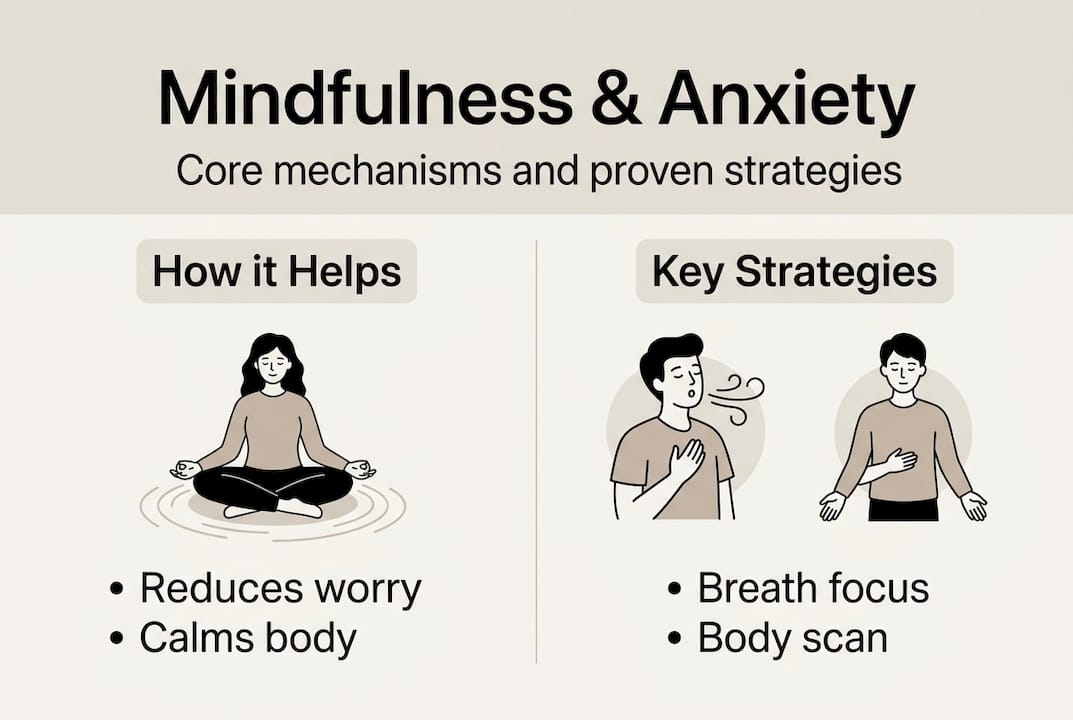
Mindfulness is the practice of paying deliberate, non-judgmental attention to the present moment. That sounds simple, but the clinical application is far more structured than sitting quietly and breathing. Mindfulness-Based Interventions (MBIs) are formal, evidence-based programs designed to teach these skills systematically over weeks.
The two most widely studied MBIs are:
- Mindfulness-Based Stress Reduction (MBSR): An 8-week group program that combines meditation, body scanning, and gentle movement. It targets general stress and anxiety.
- Mindfulness-Based Cognitive Therapy (MBCT): Builds on MBSR by adding cognitive behavioral strategies. It’s particularly designed for people prone to recurring anxiety and depression.
Both programs teach you to notice anxious thoughts without immediately reacting to them. Over time, that pause between thought and reaction becomes your most powerful tool.
“MBIs show a moderate effect on anxiety (Hedges’ g = -0.56), meaning the average person completing an MBI scores better on anxiety measures than roughly 70% of those who don’t.”
Here’s a quick look at what the research says about anxiety types most commonly targeted:
| Anxiety type | Evidence for MBI effectiveness |
|---|---|
| Generalized Anxiety Disorder (GAD) | Strong |
| Social anxiety | Moderate |
| Panic disorder | Moderate |
| Health anxiety | Emerging |
| Existential anxiety | Limited |
If you want a deeper look at how these approaches are applied clinically, mindfulness therapy techniques offers a practical breakdown of what to expect in a session.
How mindfulness works to reduce anxiety: Core mechanisms
Knowing that mindfulness helps is one thing. Understanding why it helps is what makes it stick. Anxiety thrives on automatic patterns: a worry thought appears, your nervous system reacts, and suddenly you’re caught in a loop. Mindfulness interrupts that loop at multiple points.
Research on MBCT mechanisms identifies four core pathways through which mindfulness creates change:
- Attentional regulation: You learn to redirect focus away from worry spirals and back to the present.
- Cognitive restructuring: Thoughts are seen as mental events, not facts. This reduces their power over your behavior.
- Behavioral integration: Skills practiced in sessions are applied to real-life situations, building new response patterns.
- Acceptance and non-judgment: Instead of fighting anxious feelings, you learn to observe them without adding a second layer of self-criticism.
That last point is often the most transformative. Many people with anxiety don’t just feel anxious; they feel anxious about feeling anxious. Acceptance skills cut that cycle short.
“Attentional regulation and acceptance are not just philosophical concepts. They are trainable cognitive skills with measurable neurological correlates.”
Pro Tip: Start with “labeling.” When you notice anxiety rising, silently name what you’re experiencing: “This is worry,” or “This is fear.” Research shows this simple act activates the prefrontal cortex and reduces amygdala reactivity, the brain’s alarm center. It’s one of the fastest entry points into mindfulness in therapy.
For those who want to build on these skills between sessions, structured mental health self-care practices can reinforce what you learn in therapy and accelerate progress.

Who benefits most? Effectiveness and limitations of mindfulness for anxiety
Mindfulness is not a one-size-fits-all solution. Understanding who gets the most out of it helps you set realistic expectations and choose the right combination of treatments.
Who tends to benefit most:
- Adults with Generalized Anxiety Disorder (GAD), especially when worry is the primary symptom
- People with a history of childhood emotional abuse, where MBCT reduces worry more effectively than psychoeducation alone
- Individuals who have tried CBT and want to add a skill-based complement
- Those dealing with anxiety linked to chronic illness or pain
- People motivated to practice consistently outside of sessions
Who may see less benefit:
- Those with existential anxiety rooted in life circumstances rather than thought patterns
- Individuals without a support system to reinforce practice
- People in acute crisis who need stabilization before skill-building
- Those with untreated trauma (without trauma-informed modifications)
Now, about the numbers. MBTs show moderate efficacy for anxiety reduction with an effect size around 0.63. That’s meaningful, but effect sizes shrink when compared to active controls like CBT or exercise. Some study designs may also inflate results due to expectancy effects.
| Comparison | Effect size for MBIs |
|---|---|
| vs. waitlist or no treatment | Moderate (~0.63) |
| vs. active controls (CBT, exercise) | Small to moderate |
| For GAD specifically | Moderate to strong |
Pro Tip: Combining mindfulness with CBT often produces better outcomes than either alone. If you’re exploring your options, reviewing proven anxiety therapies in California and types of therapy for anxiety can help you find the right fit. For those with trauma in the picture, trauma recovery therapy options are worth exploring alongside MBIs.
Risks, challenges, and safe integration of mindfulness in therapy
Mindfulness is often presented as universally gentle and safe. The reality is more nuanced, and you deserve the full picture.
“Roughly 25% of meditators report adverse effects including increased anxiety, panic, dissociation, or emotional flooding, particularly in unguided or intensive settings.”
This doesn’t mean mindfulness is dangerous. It means context matters enormously. Risks are higher when:
- You have a trauma history and begin intensive body-focused practices without professional support
- You have bipolar disorder and use meditation without clinical oversight
- You have OCD and misapply mindfulness as a form of reassurance-seeking
- You confuse mindfulness with “positive thinking” and suppress rather than observe difficult emotions
Dos and don’ts for safe integration:
- Do work with a trained facilitator, especially in the first 8 weeks
- Do tell your therapist about any distressing experiences during practice
- Do combine mindfulness with established psychotherapy for anxiety rather than using it as a standalone replacement
- Don’t push through panic or dissociation during meditation; stop and ground yourself
- Don’t use intensive retreat formats if you have unresolved trauma without clinical clearance
- Don’t assume more meditation is always better; quality and guidance matter more than quantity
The goal is to make mindfulness a safe, structured addition to your care, not a solo experiment.
A therapist’s take: Mindfulness is powerful, but context is everything
Here’s something most online guides won’t tell you: mindfulness practiced in isolation, without a skilled therapist helping you navigate what comes up, can sometimes make anxiety worse before it gets better. The research confirms this. About a quarter of people in unguided programs experience distress.
What we see in clinical practice is that mindfulness works best when it’s personalized. Someone with GAD needs a different entry point than someone managing anxiety after trauma. A generic 8-week program isn’t wrong, but it’s rarely enough on its own.
The other thing worth saying plainly: MBSR and MBCT are widely available across California, but not all programs are equal. Look for facilitators with formal training, not just a weekend certification. The real impact of mindfulness shows up when it’s integrated into a broader treatment plan, not when it’s used as a shortcut.
Pro Tip: Think of mindfulness as a skill-building tool, not a cure. It gives you better equipment for handling anxiety. It doesn’t eliminate the anxiety itself, and expecting it to do so sets you up for frustration.
Get help: Evidence-based therapy options for anxiety in California
If this guide has made one thing clear, it’s that mindfulness works best with professional support behind it. Whether you’re curious about MBCT, want to combine mindfulness with CBT, or need a trauma-informed approach, working with a licensed therapist makes all the difference.
At ReviveHealthTherapy, we offer evidence-based therapy in California that integrates mindfulness with proven modalities like CBT and EMDR, tailored to your specific anxiety profile. Sessions are available in person in Walnut Creek and Oakland, or via secure telehealth statewide. Sliding-scale fees and insurance are accepted. If you’re ready to take the next step toward transforming mental wellness, we’re here to help you build a plan that actually fits your life.
Frequently asked questions
How quickly can mindfulness reduce anxiety symptoms?
Some people notice improvements in as little as 2 to 4 weeks, but lasting anxiety reduction typically requires 2 to 3 months of consistent, guided practice.
Are mindfulness programs like MBSR and MBCT widely available in California?
Yes. MBSR and MBCT programs are offered through clinics, hospitals, and universities throughout California, including telehealth formats that expand access statewide.
Is mindfulness safe for everyone with anxiety?
Mindfulness is generally safe, but roughly 25% of meditators report adverse effects. People with trauma histories or bipolar disorder should consult a professional before starting.
Can mindfulness replace medication or talk therapy for anxiety?
No. Mindfulness shows a moderate effect on anxiety (Hedges’ g = -0.56) but works best as a complement to CBT or medication, not a replacement, without professional guidance.
What’s the key difference between MBCT and MBSR?
MBCT integrates cognitive behavioral strategies with mindfulness practice, making it especially effective for recurring anxiety and depression, while MBSR focuses primarily on mindfulness meditation and body awareness.
Recommended
- Role of Mindfulness in Therapy: Real Impact on Anxiety and Depression – ReviveHealthTherapy
- What is mindfulness therapy? Techniques and access in CA – Revive Health Therapy
- Manage anxiety with proven therapies in California 2026 – Revive Health Therapy
- Why evidence-based therapy matters for mental health – Revive Health Therapy
- Overcoming Dental Anxiety: Tips for a Stress-Free Visit
- Overcoming Worry – Peak Performance Swim Camp
5 Responses