
TL;DR:
- Many mental health conditions can improve with structured psychotherapy like CBT and EMDR, often without medication. These evidence-based therapies offer lasting benefits and help address root psychological issues more effectively than medication alone. Choosing therapy early and seeking professional assessment can lead to better, sustained mental health outcomes.
Reaching out for mental health support takes courage, and the last thing you need is to walk into that journey with the wrong map. A widespread assumption exists that medication is the automatic first step for anxiety, depression, or trauma recovery. That assumption is wrong, and understanding why could genuinely change your outcome. CBT is recommended by the APA as a first-line PTSD treatment, delivered over structured sessions designed to produce lasting change. This article breaks down what wellness medication actually does, how evidence-based therapies like CBT and EMDR compare, and how Californians can make informed decisions about their own care.
Table of Contents
- Wellness medication and its role in mental health care
- CBT and EMDR: Evidence-based therapy alternatives
- Comparing medication, CBT, and EMDR: Which works best?
- Making your decision: Practical steps and tips for Californians
- Why the “medication first” approach is outdated
- Take the next step toward proven healing solutions
- Frequently asked questions
Key Takeaways
| Point | Details |
|---|---|
| Therapy often outperforms medication | CBT and EMDR have robust evidence as first-line treatments for anxiety, depression, and trauma. |
| Structured sessions drive results | CBT usually involves 12 to 16 sessions with specific, goal-oriented plans for lasting progress. |
| Combination may suit complex cases | For some individuals, combining evidence-based therapy with medication may yield the best outcomes. |
| Local resources are available | Californians can access expert support, structured therapies, and practical help close to home. |
Wellness medication and its role in mental health care
Now that you know why medication isn’t always the automatic solution, let’s clarify exactly what wellness medication is and when it comes into play. The term “wellness medication” broadly covers psychiatric medications prescribed to support mental health, most commonly antidepressants and anti-anxiety agents. The most frequently prescribed categories include:
- SSRIs (Selective Serotonin Reuptake Inhibitors): Examples include sertraline and fluoxetine, commonly prescribed for depression and anxiety disorders.
- SNRIs (Serotonin-Norepinephrine Reuptake Inhibitors): Examples include venlafaxine and duloxetine, effective for generalized anxiety and certain depressive conditions.
- Benzodiazepines: Short-term anxiety relief, though associated with dependency risk when used long-term.
- Prazosin and mood stabilizers: Sometimes used for specific PTSD symptoms like nightmares or mood dysregulation.
These medications work by adjusting the balance of neurotransmitters in the brain. That adjustment can reduce symptom severity, making daily functioning easier. However, they rarely address the root causes of trauma, maladaptive thought patterns, or the behavioral cycles that keep someone stuck.
The importance of evidence-based therapy becomes clear when you understand the clinical guidelines. Current guidance does not recommend medication as the universal first step. For PTSD specifically, medication may be considered alongside psychotherapy rather than instead of it.
“Medication alone does not teach the skills needed to process trauma, challenge distorted thinking, or rewire long-standing behavioral patterns. Psychotherapy does.”
This is the key distinction. Medication manages symptoms. Therapy builds capacity. For many people dealing with anxiety, depression, and trauma, therapy is not just an alternative to medication. It is the superior primary intervention.
CBT and EMDR: Evidence-based therapy alternatives
Understanding where medication fits, it’s vital to see what modern therapy methods can offer as powerful, standalone treatments. Cognitive Behavioral Therapy and Eye Movement Desensitization and Reprocessing are two of the most rigorously studied psychotherapies available today. Both are used in California and nationally, and both produce measurable, lasting results.
What is CBT?
CBT targets the relationship among thoughts, feelings, and behaviors. The model is straightforward: how you think about a situation shapes how you feel, and how you feel shapes how you behave. When that cycle becomes negative, CBT helps you identify and restructure it. A person with social anxiety, for example, might catastrophize rejection in social settings, avoiding situations that then reinforce the fear. CBT directly challenges that pattern with practical tools.
Remarkably, CBT can be as effective as antidepressant medication for depression, and research consistently supports this. That is not a minor finding. It means that for a large percentage of people with depression, a structured, skills-based approach produces outcomes comparable to daily medication, without the side effects.
CBT is typically delivered over 12 to 16 sessions, making it a time-limited, goal-oriented approach. You are not committing to years of open-ended talking. You are enrolling in a structured process with clear benchmarks. This predictability is one reason many people find CBT manageable and motivating.
Conditions CBT effectively addresses:
- Major depressive disorder
- Generalized anxiety disorder (GAD)
- PTSD and trauma-related disorders
- Panic disorder
- OCD and specific phobias
- Social anxiety disorder
What is EMDR?
EMDR is a specialized therapy developed specifically for trauma. It uses bilateral stimulation (typically guided eye movements, but also taps or sounds) while you recall distressing memories, allowing the brain to reprocess those memories and reduce their emotional intensity. Many clients are surprised to find that memories that previously triggered intense distress feel neutral or manageable after EMDR treatment.

Exploring trauma recovery therapy options reveals that EMDR works differently from CBT. While CBT actively restructures thoughts, EMDR focuses more on the memory itself, allowing the nervous system to process what was stored incorrectly during a traumatic event. Both approaches are valid; the right fit often depends on the individual.
| Feature | CBT | EMDR |
|---|---|---|
| Primary mechanism | Thought restructuring | Memory reprocessing |
| Session format | Structured, skill-focused | Protocol-driven, adaptive |
| Typical length | 12 to 16 sessions | 8 to 12 sessions average |
| Best for | Anxiety, depression, PTSD | Trauma, PTSD, phobias |
| Evidence level | Extensive, gold-standard | Strong, APA-recommended |
| Homework required | Yes, practice between sessions | Minimal |
Pro Tip: When starting CBT or EMDR, expect the first two to three sessions to focus on your history and goals rather than active treatment. This assessment phase is essential, not filler. It allows your therapist to customize the approach to your specific situation. Being honest and detailed during this phase makes everything that follows more effective.
Comparing medication, CBT, and EMDR: Which works best?
Now that you’ve seen the unique strengths of CBT and EMDR, let’s distill the scientific differences, especially compared to medication, to help you choose a tailored path. The honest answer is that research does not declare one clear winner across all conditions. What it does show is that structured psychotherapy holds up exceptionally well in direct comparisons.
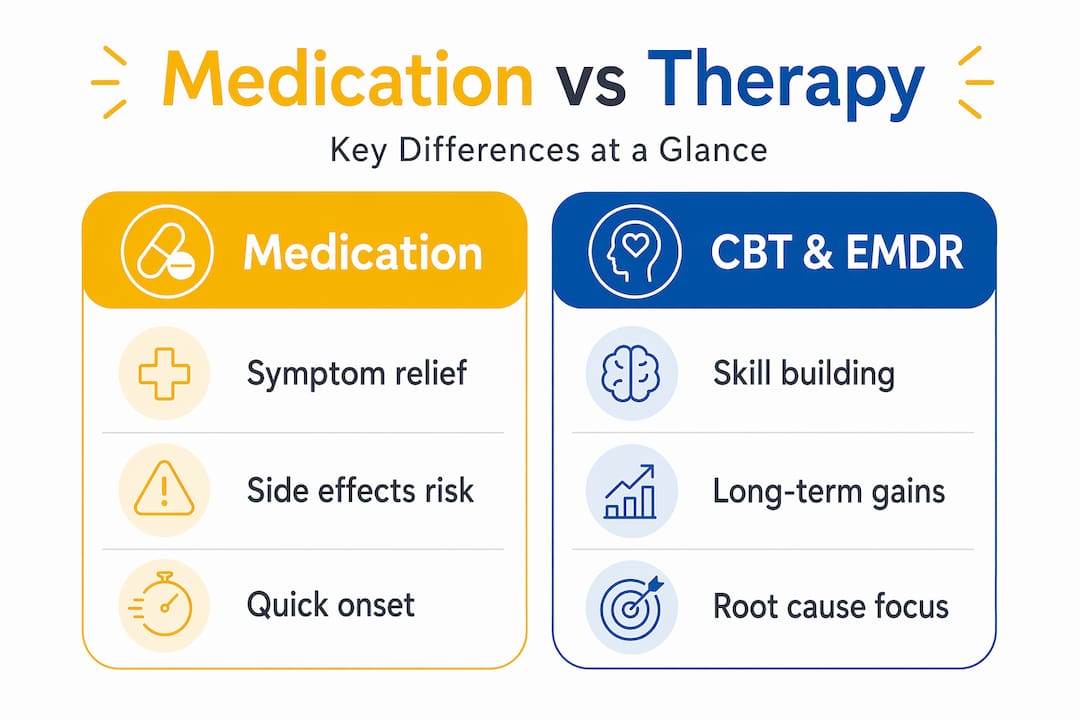
A systematic review of trauma therapy outcomes found that some meta-analyses rated EMDR as superior to trauma-focused CBT, while others found no significant difference between the two. What matters most is the finding that long-term effects after one month were robust only for trauma-focused CBT and EMDR. Medication, by contrast, tends to lose its effect when discontinued, while therapy-produced gains persist.
| Treatment | Mechanism | Long-term gains | Side effects | Cost model |
|---|---|---|---|---|
| SSRIs/SNRIs | Neurochemical adjustment | Moderate; often return on stopping | Weight gain, sexual effects, withdrawal | Ongoing monthly cost |
| CBT | Thought and behavior change | Strong and lasting | None physical | Time-limited course |
| EMDR | Memory reprocessing | Strong and lasting | Temporary emotional activation | Time-limited course |
Key finding: For depression specifically, exploring depression treatment alternatives reveals that CBT and medication produce similar short-term outcomes, but therapy-trained individuals are less likely to relapse. This is a critical distinction for anyone who wants a long-term solution rather than ongoing symptom management.
Here are three structured steps to evaluate which approach suits you best:
- Clarify your diagnosis and severity. Mild to moderate anxiety and depression often respond excellently to therapy alone. Severe, treatment-resistant cases may genuinely benefit from a combination of therapy and medication. Get a clear assessment first.
- Consider your priorities. If avoiding medication side effects is important to you, or if you’re pregnant, nursing, or sensitive to medications, therapy-first is a strong, supported choice. Discussing psychotherapy for anxiety with a qualified therapist can clarify what you can realistically expect.
- Think about timeline and lifestyle. Medication can provide faster symptom relief in some cases, but therapy builds lasting skills. If you have the capacity for weekly sessions and are willing to practice between them, therapy often produces more durable results.
Making your decision: Practical steps and tips for Californians
Armed with the facts, turning that knowledge into action means finding the right steps and local resources. Here’s how to proceed thoughtfully.
The process of choosing evidence-based care does not have to feel overwhelming. Breaking it into manageable steps makes the decision clearer and less stressful.
- Start with a professional assessment. Before deciding anything, speak with a licensed therapist or psychiatrist who can assess the severity and nature of your symptoms. Self-diagnosis and self-directed treatment choices rarely lead to optimal outcomes.
- Ask specifically about evidence-based options. When meeting with a provider, ask whether they use CBT, EMDR, or other guideline-recommended therapies. Not all therapists are trained in these methods, so it matters to ask directly.
- Check your access and logistics. California residents have strong access to both in-person and telehealth therapy options. Telehealth in particular has expanded dramatically, meaning you can access finding a trauma-informed therapist without being limited to your immediate geography.
- Understand what structured therapy looks like in practice. CBT is structured and time-limited, meaning you will have a clear agenda each session and measurable goals to track progress. This is different from open-ended supportive counseling.
- Consider specialized formats if you have children. For families, SAMHSA’s TF-CBT resource highlights how trauma-focused CBT is specifically adapted for children, covering components like psychoeducation, coping skills, and trauma narrative development.
The benefits of psychotherapy extend beyond symptom relief. Effective therapy builds emotional regulation, improves relationships, and develops coping skills that remain with you long after treatment ends. That is a qualitatively different outcome from medication alone.
Pro Tip: One common decision trap is waiting until symptoms are severe before seeking therapy. Research consistently shows that earlier intervention produces better outcomes. If you are managing daily anxiety or low-grade depression, that is exactly the right time to explore structured therapy, not after years of struggling.
Why the “medication first” approach is outdated
The mental health field has spent decades correcting the assumption that psychiatric medication is the default starting point for care. This assumption took root partly because medication was faster to prescribe, easier to access, and historically more reimbursable by insurance. Those systemic factors shaped clinical practice more than science did.
What the evidence now clearly shows is that structured psychotherapy, particularly CBT and EMDR, produces outcomes that are equal to or better than medication for a wide range of conditions, with lasting effects that medication alone does not reliably achieve. The cultural shift happening in California and nationally reflects this reality.
Telehealth has been a major driver of change in California specifically. Secure, statewide therapy access means that geography no longer determines whether you can receive quality, evidence-based therapy for mental health. Someone in a rural county now has the same access to an EMDR-trained clinician as someone in San Francisco. That democratization of access has permanently altered what responsible, modern mental health care looks like in this state.
In 2026, the standard of care is not medication or therapy. It is personalized, evidence-informed treatment planning that begins with what the research supports most strongly, which, for the majority of anxiety, depression, and trauma presentations, is structured psychotherapy. Medication remains a valuable tool in complex or severe cases. But the reflex to prescribe before exploring therapy is a habit the field is actively moving away from. Clients deserve to know that.
Take the next step toward proven healing solutions
If this article has helped you see your options more clearly, the next move is connecting with therapists who specialize in exactly the approaches covered here.
At ReviveHealthTherapy, we offer structured, evidence-based care across California, whether you’re in the Bay Area or accessing sessions via secure telehealth from anywhere in the state. Our therapists are trained in CBT, EMDR, and trauma-informed approaches that reflect current clinical guidelines. We also offer sliding-scale fees and accept insurance including HSA/FSA plans, so cost doesn’t become a barrier to effective care. If you’re ready to explore why seek psychotherapy in California or want to learn more about local evidence-based trauma recovery, we make it straightforward to get started. Explore the proven benefits of psychotherapy and take that first step toward lasting change.
Frequently asked questions
Is medication required to treat anxiety and depression?
No, many cases improve significantly with evidence-based therapies like CBT and EMDR without medication. CBT and EMDR are robust first-line treatments, and medication is typically recommended only alongside or after psychotherapy in more complex cases.
How effective are CBT and EMDR compared to medication?
CBT is as effective as antidepressants for depression, and EMDR is among the most supported options for trauma recovery. Both therapy methods also produce more durable long-term gains than medication alone in many studies.
What is a typical course of evidence-based therapy?
Most CBT-based approaches are structured around weekly sessions and typically span 12 to 16 sessions, with clear goals and progress markers throughout. EMDR courses are often slightly shorter but equally focused.
Are there special therapy options for children with trauma?
Yes. Trauma-Focused Cognitive Behavioral Therapy, known as TF-CBT, is specifically designed for children experiencing trauma-related symptoms. SAMHSA’s TF-CBT framework outlines its core components, including psychoeducation, coping skills training, and trauma narrative work, all adapted for younger clients.
Recommended
- Mental health self-care ideas for anxiety and depression – Revive Health Therapy
- Why Seek Psychotherapy: Transforming Mental Wellness – ReviveHealthTherapy
- Why Choose Telehealth Therapy for Mental Wellness – ReviveHealthTherapy
- Emotional Wellness Checklist: 35% Better Therapy Adherence – ReviveHealthTherapy
2 Responses