
TL;DR:
- Acceptance and Commitment Therapy focuses on building psychological flexibility rather than eliminating feelings.
- ACT uses mindfulness, metaphors, and experiential activities across 12 to 20 sessions for various populations.
- It is effective for anxiety, depression, OCD, chronic pain, and suits California’s diverse, multicultural communities.
Most people walk into therapy hoping to feel less anxious, less sad, or less overwhelmed. That goal makes complete sense. But Acceptance and Commitment Therapy, known as ACT, challenges the assumption that eliminating difficult feelings is what makes life better. Instead, ACT teaches you to stop fighting your inner world and start building a life driven by what truly matters to you. This guide breaks down the science behind ACT, how it works session by session, and how it applies to adults, families, and couples across California seeking lasting mental health change.
Table of Contents
- What is ACT therapy? Core philosophy and benefits
- How does ACT work in practice? The six core processes
- ACT therapy for different populations: Adults, children, and couples
- ACT therapy vs CBT and other modalities: Strengths, limits, and practical considerations
- Why ACT therapy matters in California today: An expert perspective
- How to find ACT therapy in California
- Frequently asked questions
Key Takeaways
| Point | Details |
|---|---|
| ACT focuses on acceptance | Instead of fighting negative thoughts, ACT helps you accept and move forward based on your personal values. |
| Proven for many conditions | Scientific studies confirm ACT is effective for anxiety, depression, OCD, pain, and more. |
| Flexible for all ages | ACT adapts for adults, children, parents, and couples, making it a versatile therapy for diverse families. |
| Works beyond symptom relief | ACT builds resilience and well-being even when symptoms persist, focusing on meaningful life changes. |
What is ACT therapy? Core philosophy and benefits
While many therapies focus on reducing symptoms, ACT starts from a different foundation. Developed by psychologist Steven Hayes in the 1980s, ACT is a third-wave cognitive-behavioral therapy built on six core processes that together promote something called psychological flexibility. That phrase simply means the ability to stay open, present, and effective even when life is hard.
The six core processes are:
- Acceptance: Embracing difficult emotions rather than suppressing them
- Cognitive defusion: Learning to observe your thoughts instead of being controlled by them
- Being present: Practicing full attention to the current moment
- Self-as-context: Recognizing that you are more than your thoughts or feelings
- Values: Identifying what genuinely matters most to you
- Committed action: Taking deliberate steps toward your values, even when discomfort shows up
These six processes work together. No single one is a magic fix. Instead, they build on each other to shift how you relate to your own mind.
Why does this matter? Because suppressing or avoiding distress often backfires. Think of trying not to think about a pink elephant. The harder you push the thought away, the louder it gets. ACT works with that reality rather than against it.
Research backs this up strongly. ACT is empirically supported for anxiety, depression, OCD, and chronic pain, with meta-analyses reporting effect sizes as high as g=0.88 for depression. That is a clinically significant result.
“The goal of ACT is not to feel better. It’s to get better at feeling.”
For adults managing anxiety or depression, ACT creates a way to pursue meaningful goals without waiting until symptoms disappear. For parents, it offers tools to model emotional resilience for their children. For couples, it builds the kind of acceptance that deepens genuine connection. If you want to understand the full range of approaches for mood concerns, reviewing depression treatment evidence alongside ACT gives you important context. The same applies to exploring types of anxiety therapy to see where ACT fits.
How does ACT work in practice? The six core processes
With the core ideas grounded, it’s important to see how ACT comes to life in the therapy room.
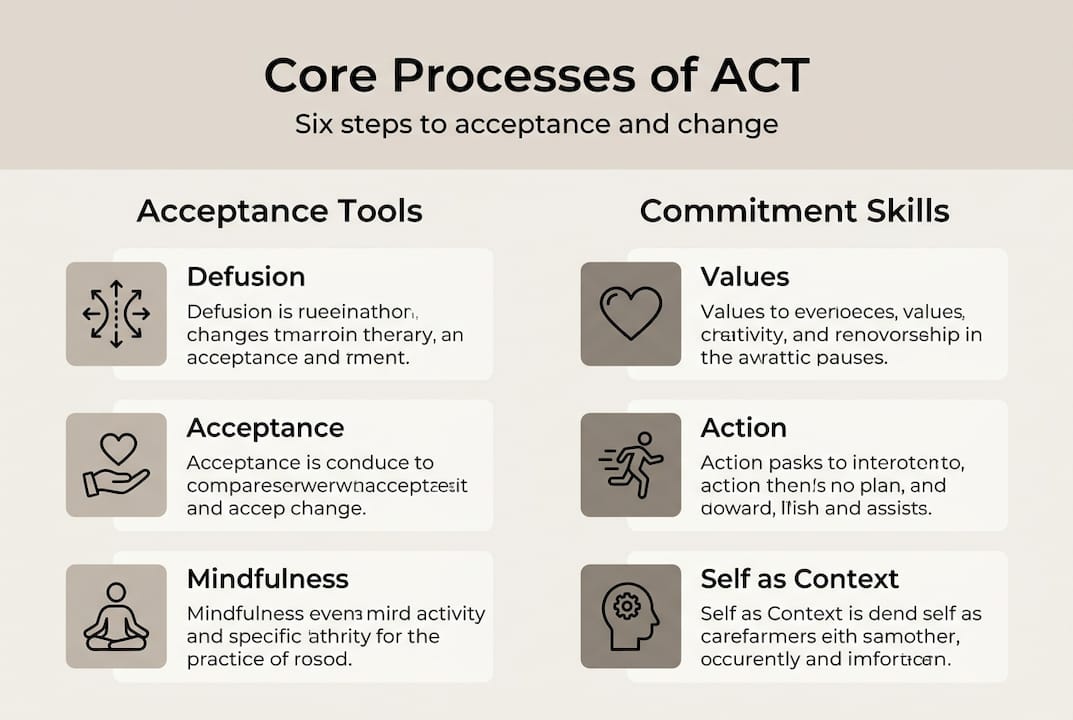
An ACT session does not look like traditional talk therapy where you analyze your past or debate the logic of your worries. Instead, expect mindfulness exercises, vivid metaphors, and hands-on experiential activities. One classic exercise is “leaves on a stream,” where you imagine placing each thought on a floating leaf and watching it drift past without grabbing on. It sounds simple. But for someone who has spent years at war with their own mind, it is genuinely transformative.
Here is how the six processes typically unfold across a course of treatment:
- Acceptance is introduced early, often through body-based exercises that teach tolerating discomfort without escape
- Cognitive defusion follows, using humor and metaphor to create distance from unhelpful thoughts
- Present-moment awareness is woven throughout using mindfulness in therapy practices
- Self-as-context is explored through perspective-taking exercises, often profound for people who feel defined by their diagnosis
- Values clarification is the heart of ACT, helping clients name what a meaningful life actually looks like for them
- Committed action moves therapy into real-world behavior, building habits and plans tied directly to personal values
ACT typically spans 12 to 16 sessions for focused concerns like OCD or anxiety, though the timeline shifts based on individual, family, or couples needs. A parent working on their own reactivity may finish sooner than a couple rebuilding trust after a conflict-heavy period.
| Population | Typical session focus | Average duration |
|---|---|---|
| Adults with anxiety/depression | Defusion, values, committed action | 12 to 16 weeks |
| Parents and families | Acceptance, modeling flexibility | 10 to 14 weeks |
| Couples | Values alignment, present-moment connection | 12 to 20 weeks |
Pro Tip: When searching for psychotherapy for anxiety, specifically look for therapists who list ACT as a primary orientation, not just a supplementary tool. The quality of ACT delivery depends heavily on training and practice.
ACT therapy for different populations: Adults, children, and couples
Now that you know the mechanics, let’s see how ACT adapts its tools for everyone from adults to families.
For adults, ACT shines brightest when anxiety, depression, OCD, or chronic pain have proven resistant to other approaches. Rather than reframing every negative thought, adults learn to carry those thoughts more lightly while still taking meaningful action. A busy professional in Oakland who fears failure does not need to believe failure is impossible. They need to act on their values even when the fear is present.

For children and teens, ACT uses playful, age-appropriate exercises. Studies show ACT is highly effective for childhood anxiety and depression, and family involvement significantly improves outcomes. Parents who participate in sessions reduce their own distress and learn to respond to their child’s emotions with more flexibility, creating a healthier dynamic at home.
For couples, ACT integrates its core skills into the relationship itself. Partners learn to enhance connection through acceptance instead of spending energy trying to change each other. Values clarification becomes a shared exercise. The result is less reactive conflict and more intentional, values-driven relating.
| Approach | Key ACT tools | California-specific consideration |
|---|---|---|
| Adults | Defusion, values, behavioral commitments | Adapted for multicultural backgrounds and work stress |
| Children/teens | Playful metaphors, parental co-involvement | Culturally responsive exercises for diverse families |
| Couples | Shared values work, acceptance of differences | Relevant for blended families and cross-cultural partnerships |
California’s diversity matters here. Therapists trained in ACT understand how to tailor acceptance and values work to different cultural frames, whether a family navigating collectivist versus individualist values or a couple managing bicultural expectations. Understanding the benefits of couples counseling alongside ACT gives couples a fuller picture of what’s possible. Exploring types of marriage therapy can also help narrow down the best fit. For a California-specific lens, reviewing the role of therapists in marriage health offers practical guidance.
ACT therapy vs CBT and other modalities: Strengths, limits, and practical considerations
But how does ACT fit within the wider landscape of therapy options, especially compared to the well-known CBT?
Cognitive Behavioral Therapy (CBT) works by identifying and challenging distorted thinking patterns. It asks: “Is this thought accurate?” ACT takes a different path. Rather than debating whether a thought is true, ACT asks: “Is holding onto this thought helping you move forward?” That shift in focus changes everything for certain clients.
Key differences:
- CBT challenges thought accuracy; ACT changes your relationship to thoughts
- ACT tends to be more effective for people with high experiential avoidance (those who go to great lengths to escape uncomfortable feelings)
- ACT is strongest for avoidance, chronic pain, and treatment resistance, where fighting thoughts has made things worse
- CBT may be preferred for clients who respond well to structured, skill-based homework
- Both approaches share a commitment to behavior change and evidence-based practice
ACT is described as “transdiagnostic,” meaning it addresses multiple conditions with the same framework. That is a genuine strength for people dealing with overlapping anxiety and depression, or trauma alongside relationship stress.
ACT also has limits worth naming. It offers less direct symptom relief in the short term, which can feel frustrating for someone in acute distress. And because there is no formal ACT certification required, the quality of delivery varies. Expert ACT therapists use “workability” questions and in-the-moment interventions that less trained practitioners may miss.
Pro Tip: Before committing to any therapist, ask directly about their ACT training background. A therapist who can explain the six core processes clearly and describe how they use them session-to-session is a strong sign of genuine competence. Comparing different therapy types for anxiety and checking the anxiety therapy success rate can sharpen your decision.
Why ACT therapy matters in California today: An expert perspective
Bringing these perspectives together, here’s why ACT is uniquely suited for our region and this moment.
Conventional wisdom says therapy success means fewer symptoms. We’d challenge that framing. For many of the clients we see across California, the turning point is not the week their anxiety scores dropped. It is the week they signed up for a class, repaired a relationship, or said yes to something they had been avoiding for years, while the anxiety was still present.
ACT is built for that kind of progress. And in California, where evidence-based, flexible therapy is in high demand across incredibly diverse populations, that framework travels well. It adapts for blended families, multicultural couples, and parents who are exhausted by the pressure to be perfect.
The uncomfortable truth is that not every uncomfortable feeling needs to be fixed. Some need to be accepted, made room for, and carried forward into a fuller life. That is not resignation. It is psychological maturity. For anyone ready to explore this kind of growth, mental health services for adults offer an entry point into care built on this foundation.
How to find ACT therapy in California
If you’re ready to take the next steps, support is available.
At Revive Health Therapy, we offer ACT-informed care for adults, teens, parents, and couples across California. Whether you are in the Bay Area or prefer telehealth from anywhere in the state, getting started is straightforward.
Our Oakland ACT therapy location serves clients across the East Bay with in-person sessions. We also offer specialized ACT for teens that includes family involvement for stronger results. Ready to connect with a licensed therapist trained in ACT methods? Visit our team page to find an ACT therapist who matches your needs. Sliding-scale fees and insurance options, including HSA/FSA, are available to keep care accessible.
Frequently asked questions
What makes ACT therapy different from CBT?
ACT teaches you to accept thoughts and feelings while committing to your values, whereas CBT directly challenges cognitive distortions to change how you think. Both are evidence-based, but they take distinct paths to change.
Is ACT therapy effective for children and families?
Yes. Research shows ACT is highly effective for childhood anxiety and depression, and parental involvement during treatment reduces parental distress while boosting outcomes for the child.
How long does ACT therapy usually take?
ACT typically runs 12 to 16 weekly sessions for focused concerns, though the timeline is always tailored to individual, family, or couples needs.
What conditions does ACT therapy treat?
ACT has strong evidence for anxiety, depression, OCD, chronic pain, and PTSD, making it one of the most versatile evidence-based therapy approaches available.
How can I find an ACT therapist in California?
Look for licensed therapists who list ACT as a specialty and can describe how they use the six core processes with clients who share your background and goals.
Recommended
- Explaining therapy goals: a clear guide for California adults – Revive Health Therapy
- Step-by-step couples therapy guide for lasting connection – Revive Health Therapy
- Step by step therapy guide for Californians 2026 – ReviveHealthTherapy
- How to Find a Therapist for Accessible Trauma Care – ReviveHealthTherapy